
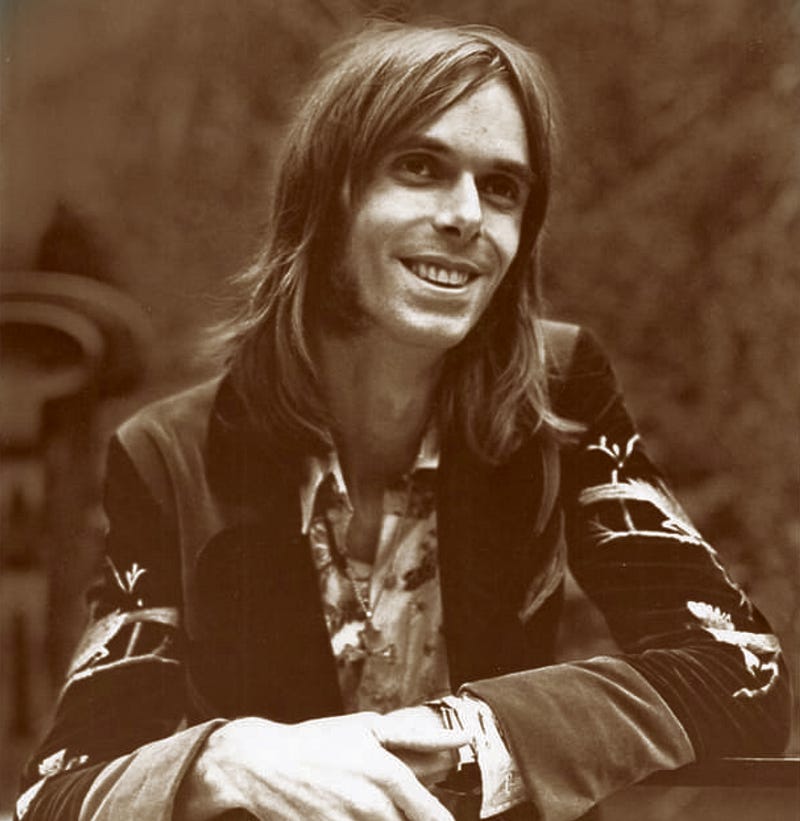
Nicky Hopkins: Sideman to the Stars
The life and times of rock’s most legendary piano man
Nicky Hopkins (1944–1994) lent his unique touch to hundreds of iconic recordings between the 1960s and 1990s. A partial list of his credits include the Rolling Stones, the Kinks, the Who, the Beatles (including solo projects from all four) the Steve Miller Band, Jefferson Airplane, Quicksilver Messenger Service, Rod Stewart, Jeff Beck, Cat Stevens, the Hollies, Carly Simon, Harry Nilssono, Joe Walsh, Peter Frampton, Jerry Garcia, Joe Cocker, Art Garfunkel, Badfinger, Graham Parker, Gary Moore, Donovan and Ella Fitzgerald. He is widely considered to be the greatest piano session man in rock music history.
Born in London during a bombing raid in World War II, Nicky began playing the piano at 3, being barely able to reach the keys. A slight child with striking brown eyes, Nicky was quiet but keenly intelligent. His emerging musical talent led to a scholarship from the Royal Academy in London. He battled Crohn’s disease (a digestive disorder) his entire life, which put a damper on touring with bands and led him to become the most in-demand studio piano player in London by the late ‘60s.
He left school at 16 to play with Screaming Lord Sutch, an outrageous London act in the early ’60s. During this time, England’s fixation with American blues was taking hold, and one of the best early practitioners, harmonica legend Cyril Davies recruited Hopkins to join his hard-driving all-star group. He was forced to leave Davies’ group when medical issues forced a series of surgeries that resulted in his being hospitalized for more than a year and a half, barely surviving. Sadly, Davies himself died and his band disintegrated, but not before Hopkins’ explosive piano on Davies’ instrumental 45, “Country Line Special” brought Hopkins to the attention of Britain’s blues aficionados, as well as a young Ray Davies of the Kinks (no relation to Cyril) with whom Hopkins would later record.
London at the time had a lively session community. Hopkins and others his age, such as Jimmy Page and John Paul Jones were the “new kids” on the scene, spreading the “new sounds” that were rippling through pop culture, replacing the traditional, older types who showed up for work in coats and ties. Emerging artists, such as the Rolling Stones and David Bowie, would regularly pop up in the clubs featuring Cyril Davies, Alexis Korner and other British blues luminaries. His fame spread rapidly, and producer Glyn Johns got him sessions for a client list that included the Easybeats, David Bowie, the Who, the Kinks and many others.
Hopkins would appear on four Kinks albums: The Kink Controversy, Face To Face, Something Else by the Kinks, and The Kinks Are the Village Green Preservation Society. Although they parted ways somewhat acrimoniously, Ray Davies greatly respected Hopkins’ talent and character, remarking, “When we recorded “Sunny Afternoon,” producer Shel Talmy insisted that Nicky copy my plodding piano style. Other musicians would have been insulted but Nicky seemed to get inside my style and he played exactly as I would have. No ego. Perhaps that was his secret.”
Hopkins was also recruited by The Who, appearing with them on some of their biggest albums, including Who’s Next and The Who By Numbers. Pete Townshend was willing to make him a full band member, but Hopkins chose not to join them.
He did, however, join the Jeff Beck group, along with future Rolling Stone Ronnie Wood and Rod Stewart, for two acclaimed albums and a couple of haphazard tours.
Like a Rolling Stone
Much of Nicky Hopkins’ most respected and best loved piano playing was in the service of the Rolling Stones. Although they had seen each other around town at blues shows for some time, Hopkins’ first work for the Stones involved tracks for a film soundtrack by Brian Jones. This resulted in an invitation from the Stones to record tracks for what would become their classic studio album, Between the Buttons.
Once ensconced in the Stones’ inner circle, Hopkins impressed with his uncanny ability to supply piano parts that could either propel a song forward or nestle nicely among the two guitars. He also wasn’t bothered by minor chords, something that couldn’t be said about incumbent piano player Ian Stewart, who would simply leave them out rather than play them.
Hopkins’ sly sense of humor and non-confrontational demeanor made him a welcome addition to studio sessions, where things can and often do become boring or tense. He recited memorized Monty Python routines, or might dash off an impromptu version of “The Teddy Bear’s Picnic.” Sometimes, during down times in between takes, Hopkins would play what he called “Wrong Music” where he would play a well-known piece perfectly, only to spoil it with a deliberately wrong phrase. Keith Richards was a big fan of Nicky’s “Wrong Music.”
Hopkins shone on the next album, the psychedelic Their Satanic Majesties Request, an album perceived as a response to the Beatles’ Sergeant Pepper’s Lonely Hearts Club Band. From the baroque pseudo-classical piano on “She’s a Rainbow” and the trippy keyboard parts on “In Another Land, “ an odd song that Bill Wyman wrote and sang lead on, while Keith Richards was occupied and Hopkins and Wyman were in the studio with nothing to do.
It was on the next studio album, Beggar’s Banquet, where Hopkins’ presence made its full impact. Critical reaction to it was immediate… the Chicago Sun-Times declared: “The Stones have unleashed their rawest, rudest, most arrogant, most savage record yet. And it’s beautiful.” His bracing accompaniment on grand piano over tracks such as “Sympathy For the Devil,” “Low Expectations” and the closing “Salt of the Earth” seem to have established a high water-mark among rock piano performances. Even the Stones, reluctant as they are to share credits for their achievements, added the words “We are deeply indebted to Nicky Hopkins” on the album’s cover. Hopkins also contributed to the following albums, the highly regarded Let It Bleed and Sticky Fingers.
Coming to America
After a long time in the isolation of the session world, Hopkins began to dream of going on tour, particularly in the United States, to experience the thrill of playing for live audiences. With an enviable track record from his high-profile sessions with the Stones, The Who, Donovan and others, he heard that Jeff Beck was putting a group together to tour the U.S. Beck asked him if he knew a piano player who sounded like him and was available, and Hopkins replied “Yes, me!”
The Jeff Beck Group (Beck, Hopkins, Ron Wood and Rod Stewart) released an album, Truth, and launched a tour. The tour was a mixed bag, and there was tension among the band members, but it served to introduce Hopkins to the San Francisco Bay Area, and in particular, Marin County, where he would reside for a few years.
Hopkins made contact with several bands there with which he would collaborate, including the Jefferson Airplane (with whom he would perform at Woodstock) the Steve Miller Band, and Quicksilver Messenger Service. He appeared on Steve Miller’s Your Saving Grace and Number Five albums to great effect, and also lent his piano skills to the Airplane’s Volunteers.
Quicksilver Messenger Service was generating a lot of buzz at the time, and after the departure of a key member, heard Hopkins was in town and, like nearly everyone who ever auditioned him, were blown away by his almost supernatural ability. He especially connected with lead guitarist John Cipollina, and the two enjoyed the trappings of rock stars…not too far removed from his nearly two years’ hospitalization in his late teens, Hopkins eagerly partook of substances and willing women.
One of these women, Lynda Louise Van Orden, a New Jersey wannabe also known as “Dolly” was to become a major figure in his life. An ambitious and pushy person, Dolly basically took over Hopkins’ life, acting as caretaker, companion and business manager. Although described as “the girlfriend from hell” by Steve Miller, Dolly was someone Hopkins desperately needed to buffer him from being taken advantage of, as well as providing medical care and advocacy. During a brief hospitalization, Dolly nursed him back to health. Ultimately, though, Dolly would wind up being a mixed blessing.
Things were beckoning him from London. The Who still wanted him to join their group, and the Rolling Stones, perhaps his most reliable sense of work, were still very much interested in his talents. Faced with the prospect of work on both sides of the pond, Hopkins realized that Dolly could be an invaluable co-pilot on his journey. He proposed to her with the memorable line “Will you marry me? I need a green card.” Dolly, reveling in her position as a rockstar wife, became ever more controlling, eventually earning singing and writing credits on some of his recordings.
He fell in with the Steve Miller Band and appeared all over Northern California with them. Miller offered Hopkins a spot in his band, but he wound up joining Quicksilver Messenger Service. His work on their album Shady Grove contained one of his strongest pieces of work, the instrumental “Edward the Mad Shirt Grinder,” an epic piano exercise that I vividly remember as a college freshman in 1970…a friend and I tried mightily to play it without much success. It was the arpeggios that did me in.
Exiled in France
In 1971, the Rolling Stones became tax exiles, their accountants having failed to pay their income taxes, and fled to France. Keith Richards rented a large, run-down chateau in the south of France, Nellcote, and sessions for their legendary Exile on Main Street album commenced. As there were no suitable recording studios in the area, the Stones used a mobile studio they had put together. The sessions were difficult to arrange…prodigious drug use and a hedonistic atmosphere resulted in many no-shows for sessions, and a divide between the druggies and non-druggies (Jagger, Wyman and Watts) resulted in many lineup changes…for instance, Keith Richards and Mick Taylor laid down a lot of the bass parts.
A steady stream of drug dealers and celebrity visitors (William S. Burroughs, John Lennon and Gram Parsons, as well as others) frequented the chateau, adding to the atmosphere of chaos. Richards asked Parsons to leave when French authorities threatened to raid the chateau, and Jagger was often back in London with his wife Bianca, who gave birth during the sessions. They would typically start at 8 pm and go until 3 the following afternoon. Hopkins was among the last to arrive at Nellcote, not being a particular fan of France. Once there, he was one of the most reliable players, and his soulful playing served as many of the album’s highlights, such as his shimmering piano on tracks such as “Tumbling Dice” and “Loving Cup.”
In 1972, Hopkins received another invitation from the Rolling Stones to record an album, this time in Jamaica. Keith Richards was a big reggae fan, and felt that the environs might lead to an evolution of the Stones’ music. Hopkins, for his part, was even less enthusiastic about this location than he had been about going to France. To make things even more complicated, Hopkins was preparing to record his own solo album (a 1966 effort failed to make any sort of impact) which he managed to record around the Stones’ schedule. The Stones’ album, Goat Head Soup, failed to capture the imagination of the record buying public to the extent that their previous handful of albums had. Much of its unfocused feel could be blamed on Keith Richards’ deepening heroin addiction, although Hopkins shines on cuts such as “Angie” and “Time Waits For No One.”
A determined Hopkins managed to finish his solo album, titled The Tin Man Was a Dreamer, with cover artwork by Dolly’s ex-boyfriend. Nicky delivers some rare singing performances, and the album was well received. But Hopkins’ ambivalence about being a frontman prevented his label from promoting it aggressively, and it failed to establish Hopkins as a solo star, which was ultimately fine with Hopkins, as he was more comfortable making other artists’ albums better, rather than calling attention to himself.
The Rolling Stones themselves were moving in a different direction. The arrival of disco in the mid 70s and the emergence of Billy Preston as their go-to keyboard player, as well as the departure of guitarist Mick Taylor, ended Hopkins’ tenure as the Stones’ alpha piano player, although he would continue to make occasional guest appearances. Many people, myself included, consider the lineup from 1968–1973 with Taylor and Hopkins to be the Stones’ finest hour.
At Loose Ends
As his tenure in the Rolling Stones was coming to an end, so was his love affair with the town of Mill Valley. A nearby shooting that slightly damaged his truck convinced him that he and Dolly should return to England. Hopkins had received a small offer from Mercury Records to embark on another solo album, No More Changes. Hopkins was far from being in shape to undertake such a project, and the sessions lacked focus. Dolly did a lot of the singing, and the album received decidedly mixed reviews. A tour was part of the plan, although it only lasted about half a dozen shows before Hopkins pulled the plug. One review of the live act complimented the group’s instrumental prowess, but commented that Nicky’s vocals were at best “charmingly vulnerable” and at worst “alarmingly frail.”
The experience cured Hopkins of any ambitions to become a solo artist. He returned to session life and worked with more artists, some well-known, some less so. In 1975 he hooked up with the Jerry Garcia Band, during a hiatus the Grateful Dead took at the time. He also started an association with Art Garfunkel that lasted several years. Back in Mill Vally, he reunited with John Cippolina and other Quicksilver alumnae to appear with Terry and the Pirates, a popular Bay Area band in the ’70s and ’80s. Things were deteriorating between he and Dolly, and his drinking was getting out of control. Some work popped up in Los Angeles, so Hopkins wound up there, working with Harry Nilsson, Carly Simon, Donovan and others. Producer Richard Perry, with whom Hopkins had recorded an album with jazz legend Ella Fitzgerald, was working with emerging artist Leo Sayer, and tapped Hopkins to anchor Sayer’s touring band.
Then Jim Price, a trumpeter who had played on the Stones’ Exile on Main Street, approached Joe Cocker during a slow period in his career, where he was largely trying to mend bridges from years of less-than-reliable behavior. Price had with him a cassette of a Billy Preston tune called “You Are So Beautiful,” and Price kept saying how amazing the song would be with piano by Nicky Hopkins. When Cocker got to hear Hopkins’ work, he was bowled over and enthusiastically embraced the song. There were shows to promote the album, the first one being in LA at the Roxy Theater with lots of industry people in the audience. Cocker showed up too drunk to perform, and three songs into the show, wound up in a fetal position beneath his microphone. Subsequent shows did not go much better, and Cocker wound up back in Britain, broke with his career in shambles. Michael Land, a promoter who had hired Cocker for Woodstock, had remained a fan and wanted to prevent Cocker from hitting bottom. By this time Cocker was drinking a fifth of booze every morning and a fifth every afternoon. Lang set about rebuilding his career, securing an agreement with Cocker that if he drank before a show, it would be cancelled and paying off his debts to A&M Records.
With Cocker having alienated music promoters in America and the UK, Lang figured Australia would be the ideal place to tour. However, he came to wish he had made the same agreement with Hopkins, who seemed able to keep up with Cocker’s prodigious alcohol intake. Both Cocker and Hopkins misbehaved, alienating passengers on their plane with a hilariously filthy comedy record which resulted in them being kicked off the plane and left behind. Reviews of the shows were generally positive, with Hopkins often praised for his work, but Cocker made the front pages of the local tabloids for his obscenity-laden interviews and foul mouth with the Australian public. From there the tour led to South America, where more mayhem took place, with shady promoters and ending with a harrowing trip back to the USA. Lang, trying to hold things together, decided to put everyone up in LA’s suburban San Fernando Valley. It was hoped that some music might emerge from the peace and quiet, but everyone involved was too dysfunctional to get anything done…they lived as neighbors for six months and never so much as gathered around a piano. But into this mess, producer Richard Perry was about to throw Hopkins another lifeline.
An Unexpected Opportunity
Richard Perry, fresh off some successful projects, had started his own record label and was developing talent for it. He had been working with ex Manfred Mann lead singer Chris Thompson and co-singer Stevie, who were putting a band together called “Night.” Their keyboardist had gotten bored and left, and Perry suggested that they use Hopkins and add him to the band. He set up a tour with the Doobie Brothers, who had Michael McDonald with them at the time.
Hopkins seemed happy, at least initially. He enthused about being in a developing band again and seemed to enjoy the music. He also would do the radio station meet-and-greets with enthusiasm. He enjoyed dressing for the stage and performing for his fans. It also got him away from Dolly, with whom he had been fighting constantly. But live situations don’t provide the control that Hopkins was used to in the studio, and he was drinking a lot and taking Valium. His behavior became increasingly erratic, and eventually, his playing began to fluctuate in quality. One musician, who requested anonymity, reported seeing him walking up the aisle of a commercial airliner, tapping his nose suggestively and asking total strangers if they had any cocaine.
Ultimately, things got to the point where Lang simply had to tell Hopkins to go home. No one was able to deal with him, and for the first time in his life, his playing had tailed off. Lang felt badly for Hopkins, but he had done all he could.
An Unlikely Redemption
Hopkins was at the point which Alcoholics Anonymous refers to as “rock bottom.” Someone in the “Night” entourage was involved with Scientology and worked at its Celebrity Center. Bill Fisher talked to Hopkins a couple of times about Scientology, answering questions and generally laying back. Hopkins recalled seeing a television interview with jazz pianist Chick Corea, which made an impression on him. “He was doing everything without drugs. I couldn’t do anything without drugs” Hopkins remarked later. After meeting with Corea, he looked into Dianetics and felt that he had nothing to lose.
With Corea’s encouragement, Hopkins got more involved with L. Ron Hubbard, Scientology’s controversial leader, contributing piano work to Scientology projects. He attempted to get Dolly into Scientology, but she adamantly refused. The rift this caused finally enabled Hopkins to get rid of Dolly.
Most importantly, ridding himself of his addictions enabled his playing to return to its earlier glory. He found a welcoming community of like-minded sorts, as well as a promoter named Gray Levett who was invaluable in helping Hopkins re-establish himself as a top-tier session musician, although his workload by the mid ’80s was a fraction of what it had been not that many years earlier. By the mid ’80s, Hopkins decided to return to England, but not before he was introduced to a woman, Moira Buchanan, who would become his second wife, and who was able to support him in ways Dolly couldn’t or wouldn’t. Buchanan was from Scotland, and with their British Isles heritage in common, they hit it off. Hopkins departed for England, and he and Buchanan engaged in a colorful correspondence in which they evolved a storyline and created characters with which to populate it. They were reunited when she came to the UK, and they married a short time later. By this time, he was serving as musical director for Art Garfunkel, who came to their wedding.
Meanwhile, having rejoined the living, Hopkins was receiving requests from all over…John Cipollina in California, Meat Loaf, Nils Lofgren and Graham Parker, and work from as far away as Japan and Australia. He continued to go back and forth to the States, touring with session group Sky and a Gene Clark-led reboot of the Byrds, with which he remained for six months. It was a much more hardscrabble tour than Hopkins was used to…travel by bus and staying in two-and three-star hotels.
By this time, technology had evolved to the point where keyboards were much more versatile tools for making music than they had been in the ’60s and ’70s. Hopkins was beginning to receive gigs that called for him to compose music for films, and command higher fees through publishing agreements. He continued to work for clients such as Gary Moore and Jack Bruce, but after four years in Britain, Moira convinced him that he had lost a lot of work by not being in LA, and convinced Hopkins, who by all accounts loathed LA, to return. It would be the last time Hopkins would set foot in the UK.
Once back in LA, he tried to reconnect with the people he had worked with previously. One of them was Gene Clark, from the Byrds tribute tour he had recently completed, who had passed away right after Hopkins’ return, devastating him. Fortunately, the film work he had begun while still in England began to expand. A Japanese company used him for a bunch of soundtrack work, to which he took readily. He and Moira were flown to Japan and treated like national treasures.
Not long after, Hopkins copped what many of his rock peers would consider a dream gig…sitting in with Spinal Tap. Appearing in Spinal Tap: Break Like the Wind, the band not only paid him, but gave him an autographed photo with the inscription: “You got a future in rock!”
One early ’90s project that particularly excited Hopkins was a thrown-together suburban band comprised of guitarist Joe Walsh (Eagles, James Gang) a talented singer, Frankie Miller and Hopkins at its core, plus a rhythm section. The low-key vibe of the band and the quality of the players and material fulfilled and energized Hopkins.
Another was his association with Bay Area favorites Zero. A band that drew musicians and fans from both the Quicksilver and Grateful Dead scenes, Zero boasted amazing players such as guitarist Steve Kimock and sax player Martin Fierro. Hopkins frequently flew up to San Francisco to perform with them. This mostly sunny period was abruptly interrupted by a medical emergency. Hopkins was discovered by Moira barely able to walk and howling in pain. She took him to a hospital, where they were reluctant to give him pain medication, viewing his gaunt physique and assuming he was a drug addict. After lots of back and forth without much action, Moira got her husband into another hospital more willing to treat him. He received surgery for Crohn’s Disease complications and embarked on a slow but steady recovery. It took him a bit longer to recover from the hospital bills, which were staggering. Ultimately, the Rolling Stones ended up quietly paying for most of his medical expenses.
Just as the Joe Walsh/Frankie Miller project seemed ready to tour and record, Walsh, who had been on sabbatical from the Eagles while they all got mad at each other, found out they were going to reunite for the “Hell Freezes Over” album and tour, and it was an offer he couldn’t refuse. Walsh felt badly about it, though…he had enjoyed the camaraderie and the freedom to improvise which he certainly couldn’t enjoy as a member of the Eagles.
One Frightening Morning
In early 1994, Hopkins was shaken to hear that Harry Nilsson had passed away. Two days later, Los Angeles was hit by a strong earthquake at 4:30 in the morning. Both Hopkins and his wife wound up on the lawn, scared to go back into the house until daylight. The experience literally and figuratively shook the Hopkinses and they decided to move. Nicky thought that Nashville might be a place that provided enough work for him to support himself, and be a pleasant change of pace from LA, with which Hopkins had a love/hate relationship, mostly the latter.
They took almost two weeks to drive to Nashville, stopping in New Mexico and Tulsa, where Hopkins did some sessions for old friend Jerry Williams, who had sung on Hopkins’ 1973 solo album The Tin Man Was a Dreamer.
Despite some misgivings as to whether Nashville had a music scene that Hopkins would fit into, it seemed to embrace Nicky and Moira. He seemed to be making fruitful contacts, and was being considered for a high-profile tour with Stevie Nicks. Hopkins, reunited with his books and personal effects from England, felt more at home than he had in years. He and Moira began to talk about buying a house. But their plans were never realized.
On the Monday after Labor Day, after spending the day at a songwriter barbecue event, Moira and Nicky were watching a movie with Anthony Hopkins (no relation) in which a famous writer loses his wife to cancer. Moira recalls thinking that she would be lost if Nicky were to leave her, and she hugged him. She left Hopkins at the kitchen table and went upstairs to read but fell asleep. She was awakened by Hopkins screaming in agony. As soon as he saw her, he yelled “Call an ambulance!” Much confusion ensued, and a fire engine appeared on the scene. Finally, an ambulance appeared and brought him to the hospital, where the staff refused him painkilling drugs, fearing they would mask his symptoms and make it hard to tell what was happening. “How could they be that inhuman?” asked Moira bitterly.
Nicky Hopkins passed away early on the morning of September 6, 1994. He was 50 years old.
Flowers, tributes and acknowledgements poured in from around the world, from famous names and not…Paul and Linda McCartney and former bandmates, the Rolling Stones, Rod Stewart and dozens of others. The funeral was held at a nature reserve outside Nashville and was attended by about 100 people. He is remembered as the greatest piano session player in rock. One could argue the point with Leon Russell or Billy Preston, great players both. But Nicky Hopkins will always be the gold standard of rock piano playing.
There is currently a petition circulating on the internet, trying to get Nicky Hopkins into the Rock and Roll Hall of Fame. Leon Russell is in it. So is Billy Preston. If there was any justice in the world, so would Nicky Hopkins.
Note: Much of this article drew upon an excellent book by Julian Dawson, “And On piano…Nicky Hopkins.” If you want to do a deep dive into Nicky Hopkins and the world he inhabited, this book will make you very happy.
Apologies to Mr. Dawson for not citing his book for this article…I did rely on it heavily, and not to have credited my source was a regrettable mistake on my part. It was never my intention to represent Mr. Dawson’s work as my own, but I can see that I should have been more professional and respectful.


