NFL Championship Sunday picks and preview
The best weekend in football is here, and the best 4 teams are playing. Here’s everything you need to know.
This is it, the best Sunday in football: NFL Championship Sunday. Oh sure the Super Bowl is great, but that’s all about pageantry and parties and eating nachos until you can barely keep your eyelids open. This is the best football day of the season. All year long we knew the Saints, Rams, Chiefs, and Patriots were the four best teams in football, and now we get to watch them duke it out in the semifinals. Remember last week’s boring games? They were boring because these teams were so good they made it look easy. Boring tournament games only ever guarantee even better games later. Later is now.
Both the AFC and NFC Championship games are rematches from earlier this season, so I went back and re-watched the Saints outlast the Rams 45–35 and the Patriots eke by the Chiefs 43–40 to see what we could learn. Every detail matters at this level, so we dove deep. I can’t tell you how excited I am for these two games!! Let’s consider every angle and pick some winners.
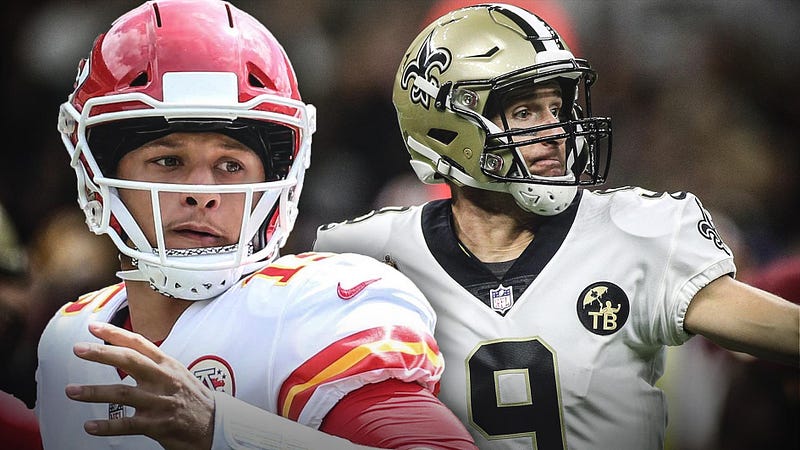
New Orleans -3.5 vs Los Angeles Rams
The first meeting was the non-Chiefs game of the season, a 45–35 Saints victory in New Orleans in early November. The Saints went up 35–14 just before the half and had a 96% chance to win before the Rams roared back to tie in the fourth quarter. Both teams pulled out all the stops — there were flea flickers, fake field goals, and Taysom Hill sightings, and the teams were dead even at 487 to 483 yards. That game looked a lot like what we can expect this Sunday. So it’s worth taking a closer look to see what we can learn.
What happened the first game?
The game breaks down nicely into four segments, so we’ll recap each segment. It started as a shootout. New Orleans opened with a classic Saints mix of Alvin Kamara, Michael Thomas, and Mark Ingram for a touchdown. Los Angeles answered with a long pass and flurry of Todd Gurley runs to tie it up. A bunch of short Drew Brees passes took the Saints right down the field for a score, and the Rams responded with a drive buoyed by another long 48-yard pass and tied things up 14–14 a minute into the second quarter. Whew.
The next two minutes could’ve changed the entire season. Ingram fumbled on the first play of the drive and gave the Rams the perfect chance to take the lead, but the Saints defense stepped up and held the Rams, then stuffed them on a fake field goal. Galvanized, the Saints dominate the quarter, beginning with another classic 87-yard TD drive involving everyone. The Rams get another long pass and are starting to trend pass-happy but stall and miss a field goal. Helped by a short field, the Saints drive right down again and find the end zone a minute before halftime. Disaster strikes the Rams as Jared Goff throws an interception on the very next play, and Michael Thomas dominates in a quick Saints response, touchdown, 35–14, game over. Or so it seems.
The Rams convert three long passes into a quick field goal before half, then get the ball after the break and turn a bunch of quick passes into a long TD drive. The Saints offense gets a bit cautious here, featuring the run game in an obvious effort to keep the clock moving. Their drive stalls at the L.A. 44 and they choose to punt. The Rams put together another solid drive buoyed by another long pass, and a red zone field goal makes it 35–27. The Saints attack with Thomas but stall when they turn too much to the run game, punting again. Again the Rams answer with three passes to Cooper Kupp, including the game-tying 41-yard score to tie it up at 35 with ten minutes left.
It now appears to be anyone’s game — but that turned out to be the last Rams first down. The Saints go back to Thomas yet again. They miss a few deep shots to his teammates and settle for a long field goal. A Rams three-and-out gives the ball right back to New Orleans, and three plays later, Thomas scores a 72-yard TD and pulls out a cell phone to tell Joe Horn he’s put the game away for good. The Rams turn the ball over on downs, and the Saints run the clock out to end it.
So what did we learn?
- Michael Thomas slaughtered the Rams. He had 12 catches on 15 targets for 211 yards and the clinching TD, and he burned Marcus Peters early and often, including multiple penalties. Notably, Aqib Talib did not play for the Rams. Talib will surely get the Thomas matchup this week.
- The Rams got pass-happy, and it hurt them. Gurley had only 13 carries and averaged two yards a pop outside of one long run, and L.A. had just five rushing first downs. The Saints were one of the league’s top run defenses and gave up big passing yardage all year, so perhaps this by design, but it hurt the Rams here. Goff had big numbers but missed key throws, and the Rams offense was inconsistent with choppy drives. The Rams are 2–3 when rushing for under 100 yards but a perfect 12–0 when going over the century mark. They needed to run more. On the other hand …
- … The Saints were not pass-happy enough. They had 34 rushes to just 19 for the Rams but averaged four yards per rush and almost 10 per pass. Leaning on the run to move the clock saw several drives stall, but when letting Brees do his thing, they were almost unstoppable. He was 35/46 for 346 yards, four TDs, and a near perfect 97.2 QBR. He was not sacked once. He stood there and picked the Rams apart.
- The Saints success felt more real and repeatable. New Orleans repeatedly went on long, sustained drives. The Rams had frequent choppy drives extended by a long pass, and when they didn’t get the long pass, the drives stalled. New Orleans was in manageable situations all game, while Los Angeles often faced 2nd- or 3rd-and-long. If anything, a replay of this game might have seen more Saints points and fewer from the Rams.
- The Rams made more mistakes. They were stuffed on a fake field goal and 0/2 on fourth down vs 2/2 for New Orleans. They doubled the Saints in penalties and threw the game’s only interception. They converted only 3/5 times in the red zone vs 5/5 for the Saints. New Orleans is one of the league’s most efficient teams. They allowed the second fewest sacks and turned it over the second fewest times, and they allowed the fewest field goal attempts, so red zone conversion is critical. The Saints do not beat themselves. The Rams did.
So what are the keys this week?
First, note a few key differences since the first game. The Rams are missing Cooper Kupp. Goff hasn’t been the same without him, and Kupp was a key part of two TD drives against the Saints. Without his key possession receiver, Goff has turned more often to his tight ends, Gerald Everett and Tyler Higbee. The duo combined for five catches and 88 yards in the first game. The Saints were one of the league’s best against tight ends, but this was the biggest game they allowed.
The Rams also have Aqib Talib back, which should make a huge difference on Michael Thomas. Thomas has been uncoverable at times this season, including in the first matchup and last week against the Eagles. Talib will need to do a much better job than Marcus Peters. Still, Brees has been almost perfect and the Rams secondary has been vulnerable all season. The Saints struggled to block Fletcher Cox last week. The Rams need Aaron Donald to play like the best player in football and disrupt Brees’ timing.
The Saints lost defensive tackle Sheldon Rankins last week, a key run stopper. The Rams have seen the recently-signed C.J. Anderson put up big numbers, but Gurley hasn’t been the same since his injury. L.A. needs a big run game to keep the Saints offense off the field and take the crowd out of the game, and the addition of Anderson with the absence of Rankins gives them an opening. The Saints would love to force Goff to try to beat them, but if the Rams win, it’ll likely be because they got the run game going.
The pick
One reason the Saints are so good is because they have so many avenues to beat you. They lost only two meaningful games all year. One was Week 1 when they gave up a million points to the Bucs and the Saints still almost won. The other was when the Cowboys played the defensive game of the season and the Saints still almost won. Last year it literally took a miracle to knock the Saints out of the playoffs, and this team is better.
If the Rams can’t get the run game going, the Saints probably win. If New Orleans hits a couple long TDs, the Saints probably win. If Thomas is unguardable again, the Saints probably win. If the Rams can’t put together consistent long drives without Kupp, the Saints probably win. If New Orleans challenges Goff to beat them and he can’t do it, the Saints probably win. If the Rams turn it over or don’t convert in the red zone or rack up dumb penalties, the Saints probably win.
If Goff is the better QB and Donald disrupts Brees and Talib keeps Thomas in check and Gurley and Anderson dominate in the run game, the Rams win.
The Saints probably win.
New Orleans 37, Los Angeles 28
Kansas City -3 vs New England
Here’s the thing about the Patriots: they’re weirdly predictable. And I don’t mean because they’ve been in the AFC Championship game every season since the Reagan administration. No, Bill Belichick is predictable. He studies everything about your team. He finds the weakest spot. And he attacks it. Mercilessly.
We went into last week knowing the Chargers had a beastly pass rush and a deep secondary and that the way to beat them was by running the ball right at them and dumping the ball off into the flats to James White and Julian Edelman. I said exactly that in my preview, and I knew it’s how the Pats would attack the Chargers. Apparently L.A. didn’t. They stayed with their many defensive backs all game, couldn’t make tackles, never adjusted, and Belichick didn’t either. He dinked and dunked on the Chargers all game and that was that. He found a couple simple repeatable things that worked and then did them over and over again without mercy. That’s what he does.
Both teams are vulnerable to each other’s strengths
The Chiefs are also vulnerable to pass-catching running backs. Six RBs caught five or more passes against them, including White, and only four teams allowed more such yards. The Chiefs were worst in the league against tight ends, allowing 50 yards or a TD to a tight end in all but two games. Rob Gronkowski had 97 yards against the Chiefs, including two huge catches late. Kansas City has also been chewed up by possession receivers like Jordy Nelson, who scattered 19 catches for 175 yards across two games. The Patriots produce scrappy white possession receivers like they have a factory.
All of that sounds like trouble for the Chiefs. Tom Brady can dink and dunk to White and Edelman or go over the middle to Gronk, and that should be more than enough to move the ball against Kansas City.
Except that’s really not the point. Everyone moves the ball against the Chiefs. Every matchup is a problem against their defense. The real story is on the other side of the ball, and the Pats have just as many matchup problems as the Chiefs on that end. The numbers just obscure it a bit because New England played such an easy AFC-East-populated schedule.
The Pats allowed the 12th most fantasy points to QBs, but they had only seven good games — and those were against Sam Darnold, Josh Allen, Kirk Cousins, Josh McCown, Derek Anderson, Ryan Tannehill, and a first-game-back Deshaun Watson. Against anyone else, they struggled. They got beat over the top by deep threats like Keelan Cole, Kenny Stills, and Tyreek Hill, who had 7 catches for 142 yards and 3 TDs against them. They also struggled against versatile tight ends. Trey Burton and Eric Ebron caught 9 balls for over 100 yards each and 3 TDs, and Travis Kelce is the best tight end in football. New England’s defense is vulnerable against Kansas City’s strengths, too.
What happens when the Chiefs lose?
That’s why we got a 43–40 shootout the first time these teams played. There’s no need to go through a full script of this one — outside of one punt and a few turnovers, both teams moved into scoring position every drive and the team with the ball last won. The Patriots went to Gronk early and again with the game on the line, relying on Sony Michel and White in between, as Brady racked up YAC with dump-offs to all the usual suspects. Patrick Mahomes was shaky early with two first-half interceptions, but the Chiefs moved into scoring position on nine of their 11 drives and never stopped attacking.
One of those interceptions gave the Pats the ball on the four and the other was in the end zone, so those two turnovers cost Kansas City 10 to 14 points, and settling for four field goals inside the 25 cost them 16 more. Turns out 30 blown points matters against the Pats. The game was back and forth in the final quarter, but the Pats kicked the winning field goal on the final play.
That was one of four Chiefs losses this season, all by 1, 3, 3, and 7 against playoff teams holding on for dear life. Even when Mahomes struggled early, the Chiefs roared back late. No one ever really stopped this Kansas City offense. They just slowed it down for awhile.
There were a few common threads in those Chiefs losses. First, they racked up penalties: 36 across four losses for 335 yards and 16 first downs. That is a metric ton of penalties. They also turned the ball over, with nine turnovers in four losses versus nine more in their 12 wins. Thirdly, they lost the time-of-possession battle, running an average of 14 fewer plays than their opponent in losses. That’s 14 fewer plays for an offense that led the league at 6.8 yards per play — almost 100 yards lost — and it leads to a tired-out defense that allowed at least 14 points in all four losing fourth quarters.
If you think about it, you could argue that no one really ever even beat the Chiefs as much as they beat themselves. They beat themselves with dumb penalties and turnovers. They lost when the defense couldn’t get off the field, or sometimes when the offense just scored too quickly. All of those were issues against the Pats.
Kansas City is going to score. Belichick knows that. He went for it on fourth down on the first possession against the Chiefs. That’s the sort of move you make when you know you need a lot of points. He’s going to attack the Chiefs offense and try to force Mahomes to make mistakes, even if attacking gives up a few long plays. Long plays put the Chiefs defense back on the field faster, and Belichick will trust his team and his quarterback late. If you assume the Chiefs are going to move the ball anyway, then the right move is to be over-aggressive and hope you force a mistake. That’s what the Rams did to beat the Chiefs, giving up 51 points but forcing a couple defensive TDs.
Belichick will risk letting Mahomes beating them in hopes that Mahomes will beat himself instead. The Patriots were third in the league in interceptions. They aren’t a great defense, but they’re a ball-hawking one. But Andy Reid is 4–4 against Belichick with the Chiefs, with a couple notable victories. He’s moved the ball plenty against the defensive guru, and he won’t be afraid.
Home field changes everything
There’s one key difference between that first Chiefs-Pats game and this one, and it’s not the absence of Kareem Hunt as Damien Williams looks just fine filling in. No, it’s the location. That game was in New England. This one is in Kansas City. And that could make all the difference.
How can one field change everything? Aren’t both fields going to be a cold, wintry mess? The basket is still ten feet tall, right?
Tell it to New England. They went 9–0 at home, outscoring opponents 304-to-161. Only the Chiefs game was ever even in doubt. They were a different story on the road, just 3–5, outscored 192-to-173 with losses to the Titans, Dolphins, Jaguars, and Lions. The road Pats scored almost two TDs fewer per game.
The Pats weren’t the only team with massive home-road splits. Kansas City is 8–1 at home, the only loss on a late Chargers comeback. They outscored opponents 290-to-157, similar to New England. They were a much different team on the road, going 5–3 with 275 points to 264 from their opponents. Road Chiefs games were shootouts; at home, they dominated like the Pats.
Inside those splits lie two huge keys. The Patriots #4 DVOA offense was not nearly as dominant on the road, while the Chiefs terrible defense was just fine at home. The first game featured the road Chiefs and the home Pats. The road Chiefs averaged a 34-to-33 game while the home Patriots averaged 32-to-17 domination. Now the Pats are on the road, where they averaged a 24-to-22 loss, and they’re visiting a Chiefs team that averaged 32-to-17 domination at home. That’s a massive swing — from 14 points in New England’s favor to 17 points in Kansas City’s.
You might think those are just numbers, and what real effect can they have on a team? I’ll tell you. Offensive lines block much better at home where communication is easier, and that’s key to the dominant road game New England hopes to have. Studies have also shown that home field advantage is often most apparent in referee bias. A raucous crowd pushes the refs to make the big call. Remember how the Chiefs have struggled with huge penalty yardage in their losses? They’ll likely have a more favorable whistle at home. This is the first AFC Championship game ever at Arrowhead. It won’t rattle Belichick and Brady, but it could affect other Patriots or the guys in stripes.
The pick
In the end, I just can’t shake two gut feelings. One is that the Chiefs have been the league’s best offense all season by a wide margin, even better in close games when they can’t hold back. Even when the Chiefs lost, it always felt like they were the better team. Like they’d have won an immediate rematch. Second is that the Patriots just weren’t that great this year. New England faced only four playoff teams all season. Just one was on the road, and Chicago led that one 17–7, and their next most difficult road opponents Pittsburgh and Tennessee beat them. Kansas City is battle-tested. They played eight games against playoff teams, five on the road, and they won five times and were in every game until the final seconds.
New England is 12–4, an off year by their standards, and they piled up most of those wins against bad quarterbacks and teams. History tells us the Patriots either have it or they don’t. Belichick as a 1-seed has made the Super Bowl six of seven times. In nine other playoffs, the Pats made just one Super Bowl — and they were 14–2 that season. The last three times the Patriots were the 2-seed, they won at home, then lost on the road in the AFC Championship. The Pats as a 1-seed are invincible. The Pats as a 2-seed are good, not great.
You have to be great to come to Kansas City and beat the Chiefs. Either that or you have to hope they beat themselves.
This game will be in the hands of Patrick Mahomes, for better or for worse.
I believe.
Kansas City 33, New England 27
2019 playoff record: 5–3 Season record: 127–114–10 Best bets: 27–24–3 Locks: 6–0
Last season: 130–116–10 Best bets: 29–20–1 Locks: 2–1
Follow Brandon on Medium or @wheatonbrando for more sports, television, humor, and culture. Visit the rest of Brandon’s writing archives here.