
Nexus — an introduction
Scaling Scrum, part 6
This is part six of the series:
Nexus is the scaling framework that is created by Ken Schwaber from Scrum.org. Yes, that’s the person that presented Scrum to the world in 1995 (together with Jeff Sutherland). Ken Schwaber also is the co-author of the Scrum Guide (again together with Jeff Sutherland).
I believe that with this it is obvious that Nexus intends to scale Scrum.
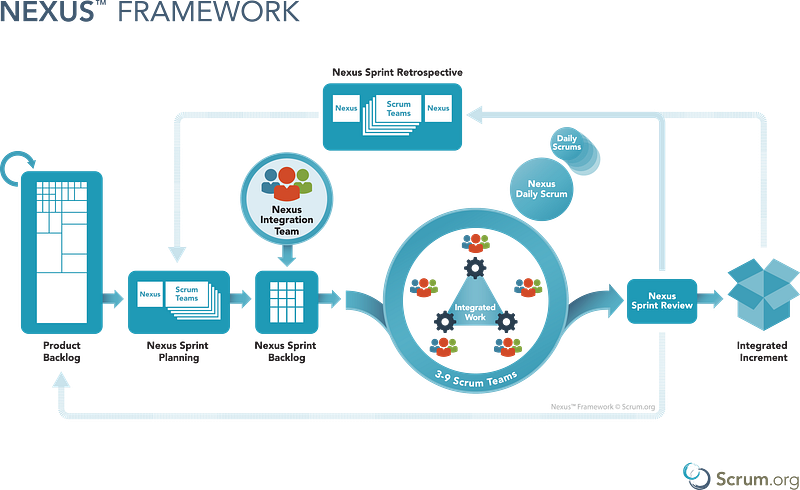
As said Nexus builds on Scrum, but it adds, changes or replaces a number of roles, artifacts and events.
Nexus Characteristics
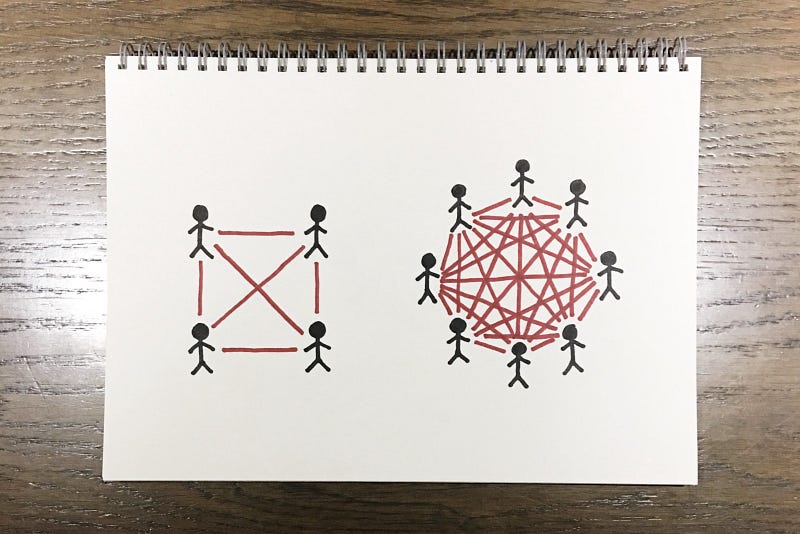
Nexus is created to be a scaling solution for 3 to 9 teams. This is directly related to the ideal size of a Development Team, which is also 3 to 9 people for the same reasons. Bigger teams will have more and more coordination issues. See below a picture that I borrowed from Paddy Corry’s article on Scrum@Scale:
Contrary to other scaling frameworks there is one defined type of Nexus (as described in the Nexus Guide). The Nexus framework aims to resolve the alignment and integration issues by forming a Nexus Integration Team that has it’s events as a preparation for the individual original Scrum events per team:
- A Nexus Planning to discuss the overall scope and dependencies resulting in a Nexus Sprint Goal, followed by Scrum Team planning events with their individual Sprint Goals, adhering to the Nexus Sprint Goal.
- A Nexus Daily Scrum to address alignment and integration issues prior to the Scrum Team Daily Scrums.
- A Nexus Review replacing the standard Sprint Review(s).
- A Nexus Retrospective to discuss issues on Nexus level and then do the team’s Retrospectives.
The Nexus Integration team oversees and is responsible for the alignment and integration.
Roles
Additional Role — Nexus Integration Team
The Nexus Integration Team is a new role. Their aim is to coordinate the application of Nexus and the correct use of Scrum. The Product Owner, a Scrum Master and Nexus Integration Team Members (often members of the individual Scrum Teams) are part of the Nexus Integration Team.
They aim to resolve cross-team constraints that can stand in the way of delivering an Integrated Increment. They should find the solutions via bottom-up intelligence.
Roles that stay the same
The individual Scrum Teams continue to have a Product Owner, a Scrum Master and the Development Team.
Artifacts
Additional Artifact — Nexus Sprint Backlog
The Nexus Sprint Backlog is introduced. This is to ensure transparency during the Sprint. It does contain the work of all Scrum Teams and any dependencies.
Renamed Artifact — Integrated Increment
The Nexus Integration Team is responsible for creating a “Done” Integrated Increment from all work delivered by individual Scrum Teams.
Artifacts that stay the same
All Scrum Teams work from the same Product Backlog. Individual Scrum Teams have their own Sprint Backlog and build their own “Done” Increment.
Events
Additional Event — Nexus Sprint Planning
The Nexus Sprint Planning is an event that is conducted with the Product Owner and representatives of the Scrum Teams. Nexus says it is best to have all members of the Scrum Teams attending the event. The Nexus Sprint Goal and all the Backlog Items to meet this goal are being discussed. Next each team plans its own Sprint.
Additional Event — Refinement
This is an odd one. Refinement is an activity that is well described in the Scrum Guide. But it is NOT an event. It is in Nexus. The Refinement has the same purpose as within Scrum. It is — as in the Scrum Guide — not exactly described how refinement is done. Nexus only makes it clear that it is continuously required.
Additional Event — Nexus Daily Scrum
The Nexus Daily Scrum is there to coordinate activities of all Scrum Teams. The basis is the Nexus Sprint Goal which is a sum of all the individual Sprint Goals. The integration of the work is the central theme of the Daily Nexus. The observations from the Nexus Daily Scrum are taken to the Daily Scrums of the teams.
Replaced Event — Nexus Sprint Review
The Nexus Sprint Review replaces the standard Scrum Sprint Review. The entire integrated Increment is the topic of discussion, hence it impacts all Scrum Teams within the Nexus.
Additional Event — Nexus Sprint Retrospective
This is a Sprint Retrospective for the Nexus to inspect and adapt itself. It expands upon the standard Sprint Retrospective and consists of three parts:
- On the Nexus level issues are discussed that impacted more than a single team.
- Then each team has their own Sprint Retrospective. Issues from part one can be used as input.
- On Nexus level identified actions are visualised and planned to be tracked.
Sprint — start and end at the same time and have same length
The whole “Nexus” should have a Sprint of a certain length and they should start and stop the Sprint at the same time. In Scrum there is — intentionally — no mention about this because it may vary if teams don’t use Nexus.
Bottom Line
Nexus is the framework created by Ken Schwaber. The aim of the framework is to uphold everything that Scrum entails. Alignment and integration are covered by a number of Nexus events, an additional role and two Nexus artifacts. Integration needs to be done within the Sprint (at least once per Sprint) and it is a focal point for the Nexus Integration Team.
Did you like the article? Then it would be awesome if you’d clap 👏🏻. I am also very keen to learn what you think about this topic.
My twitter profile is https://twitter.com/WJAgeling


