
How To Recognize Negative Impacts of Watching News And Empower Your Best Self
How I recognized negative mental health impacts and shifted 640 hours from news to personal wellness. You can too.
I admit it. I used to be a compulsive news media junkie.
At the time I didn’t realize it. I spent all my “spare time” on non-stop consumption of political, world, and business news. This was my default mode.
Until the end of 2020. That’s when my habit broke me.
But I’m better now. I stopped chasing the fear-driven news. I developed a new perspective.
In this post I share the negative effects that a news habit can have on our minds and the pivot to health and wellness that I made instead. I don’t share this to brag but rather to show a potential alternative path.
I reclaimed my time saving an hour and forty-five minutes per day. That’s over 12 hours per week. That’s saving 640 hours per year. That’s one-third of a full-time job!
I shifted my attention away from daily news to personal development. The impact on my life has been amazing:
- I’ve read 35 additional books over 2 years
- I’ve spent 3-hours more weekly with my kids
- I’ve adopted a 30-minute daily meditation routine
- I’ve increased my average workouts by 40%
I’m grateful for transforming my mind and body. I know I’m a better person by now only consuming 9 minutes per day of news.
The 2020 Tipping Point
The backdrop — is outrage everywhere. I’ll spare the details. You recall the storylines: COVID-19 pandemic, presidential elections, protests, violence, and economic malaise. The world gone mad.
The first weeks of 2021 was my personal tipping point. My daily two-hour habit of consuming news left me:
- Anxious, angry, and argumentative
- Feeling hopeless and discontent about events
- Feeling my personal wellness was wavering
News was consuming all my excess attention. I was following news stories like a soap-opera, sporting event or gossip.
I had to make a change. Here’s what I realized.
How Much Spare Time Do You Have?
You might find your week looks something like mine.
- Mandatory — sleep, work, personal routines & chores, eating and transportation. This foundational routine takes 70% of our week.
- Base Lifestyle — family time, exercise, leisure & entertainment, vacations, and social connection. This is time we’ve adopted as our base lifestyle routine. Represents 22% of our week.
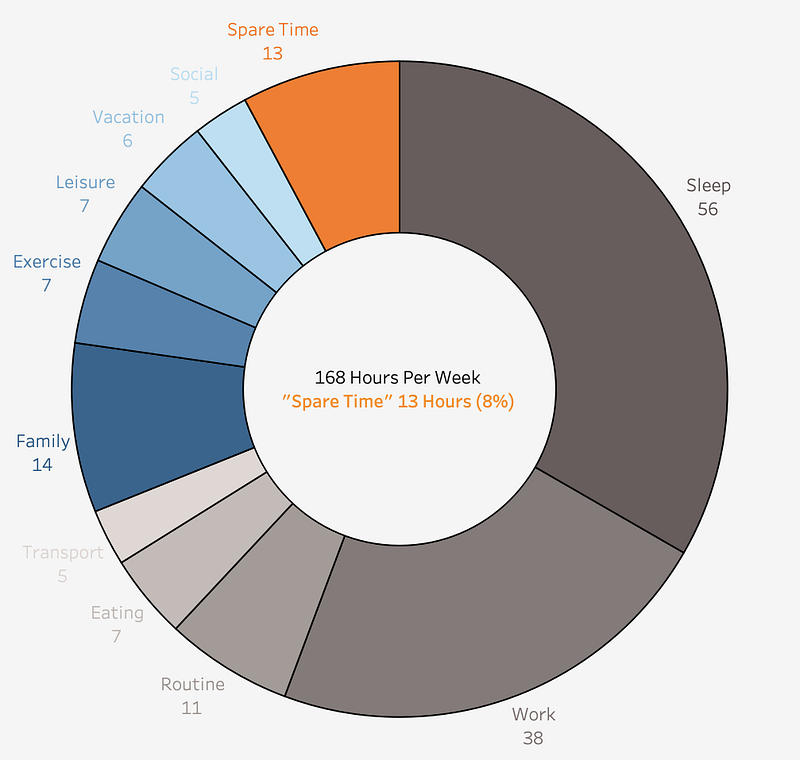
This leaves 13 hours, only 8%, of our week left over as “spare time” or “disposable time”.
Take a minute to estimate for yourself — write these two numbers down.
- How much spare time do you have each week?
- How much news are you taking in across TV, the web, apps, and social media?
What proportion of your spare time goes to the news? How many hours per year do you watch or read the news? Are you happy with investing your time following the news?
4 Ways News Affects Our Minds
Our attention is an important currency that each of us chooses how to spend every waking moment.
You become what you give your attention to…If you yourself don’t choose what thoughts and images you expose yourself to, someone else will, and their motives may not be the highest.
— Epictetus, Greek Stoic philosopher
1 — Stoking Human Negativity Bias
Humans have a negative attention bias built into our biology.
While negativity bias helped our ancestors stay safe, it is a liability in the modern world. When we are drawn into negativity and outrage, we become captive to primal emotions. These fear-based emotions stress our bodies — increasing cortisol, blood pressure and anxiety.
We go on high alert.
The mainstream news serves up more of what we are clicking — negative stories. Over 90% of news stories have a negative bias.
We get stuck in a fear-triggered loop.
2 — Watering Seeds of Despair
The information we consume affects our mental health and wellness.
The stories delivered by the news usually highlight violence, scandal, corruption, and sensationalism. In most stories we can’t change or influence what’s happening. We feed our unconscious minds this constant negative narrative.
When we consume negative news, we water seeds of fear, anger, resentment, and despair in our minds. This negativity shapes the maps of reality our minds create. We make unrealistic estimations of direct risks to ourselves.
Your mind is the garden, your thoughts are the seeds, the harvest can either be flowers or weeds. — William Wadsworth
3 — Reinforcing Our Ego Identities
Everyone builds an identity based on their experiences, beliefs, concepts, and stories. But without self-awareness an unchecked ego may go awry. Our egos tend to reinforce separation of ourselves (“us”) versus other groups, cultures, or political parties (“them”).
- Do we watch or read news to reinforce our self-concepts?
- Are we looking to confirm our beliefs and prop ourselves up?
- Are we fueling excessive separation between ourselves and others?
- Do we consume news to make us feel like we are “the winning team”?
The polarization and sensationalism of news media fuels this separation. Without mindfulness of our biases and motivations then news consumption can be a habit of ego reinforcement.
4 — Enabling the Habit of Aversion
There are many ways by which the mind diverts attention from the needed.
We may have an aversion to getting healthy, having tough conversions, or making a change. We may procrastinate on tackling tough tasks or projects. We may not want to accept the reality of our circumstances. We may instead feel more comfortable on autopilot performing a mindless routine. Read this article “Are Your Escapist Habits Wrecking Your Life?” for a great summary on our tendency to “check-out”.
Like any habit-forming distraction, we can escape for the moment by watching the news. We can continue to be consumers of others’ stories rather than creators of our own unique stories.
Is your habit of watching the news a mindless distraction?
Is it keeping you from doing something of more value in your life?
Problems with News Media
There is much content published on the structural problems with the news media. Please take a look at “33 Problems With Media in One Chart” by Visual Capitalist. This article summarizes the complex media ecosystem, forces at play and imbalances.
News Echo-Chambers and Polarization
If you aren’t already aware of media bias, then please start with the chart below. It’s important to understand the political filter through which we ingest information. Every time we watch or read a story, we must consider the source and look for potential bias.
Echo chamber — an environment where a person only encounters information or opinions that reflect and reinforce their own.
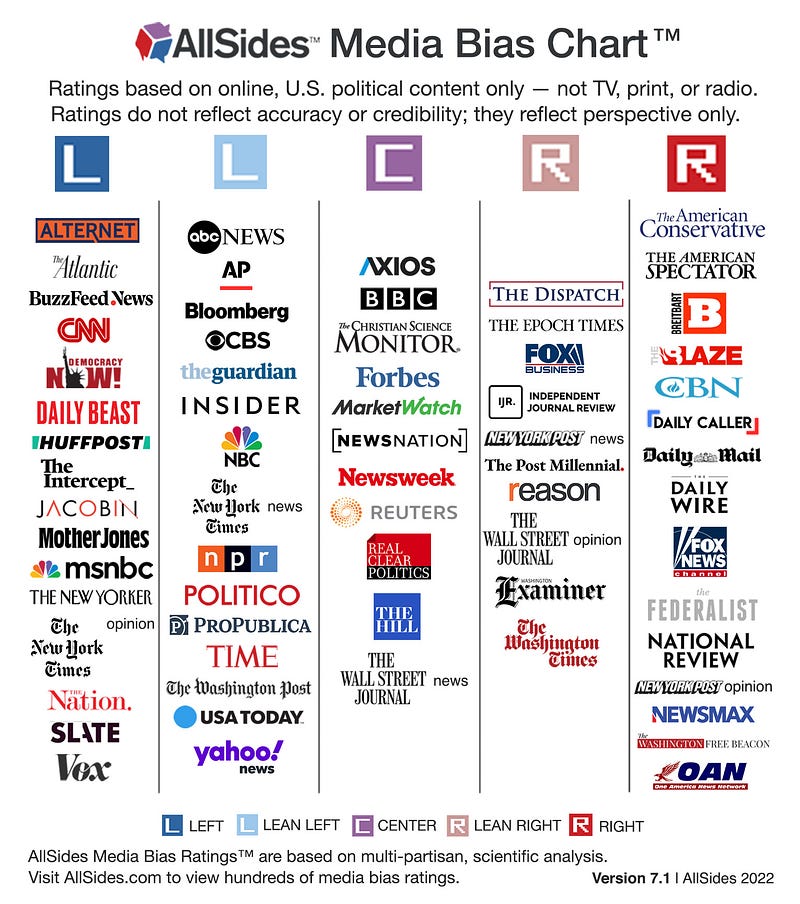
If we watch only one news channel or brand, we run a probable risk of getting caught in an echo-chamber. There are intentional reasons that opinion news shows usually have only a token, weak opposing viewpoint. These news programs deliver a “news entertainment product”. These products reinforce political beliefs of their loyal audiences.
News echo-chambers occur when we consume information through a single worldview lens. These filter bubbles serve up biased content that confirms the existing narratives.
Confirmation bias — the tendency to interpret new evidence as confirmation of one’s existing beliefs or theories.
Participating in an echo-chamber deepens beliefs and reinforces polarization among groups.
Breaking News, Always and Forever
The term “breaking news” used to mean something important. Today breaking news is usually spinning a new angle on the same story.
Why so much breaking news?
- Fixed Supply Capacity — there are 67 news brands listed in the media bias chart above. Each of these news outlets must produce content every day of the year, 24 hours a day, no matter what is happening. These companies profit through eyeballs consuming their advertising content. Constant breaking news attempts to train the consumer to check-in for fear of missing out.
- Competing For Attention — we have never seen more content demands for our attention. Messaging apps. Notifications. Social media. Traditional media. Streaming entertainment. Screens everywhere. Always online. The drama of breaking news headlines is media’s attempt to grab your attention to get their share.
The key takeaway is to realize the incentives for media companies trace back to profits. Breaking news, sensationalism and dramatization are tools to drive traffic. Buyer beware.
Invest in Yourself, not in the News.
Are you interested in reclaiming “spare time” instead of consuming news? Here are some guideposts to help.
Recognize the Problem
We must first acknowledge the negative impact of the news on our health and wellness. This awareness is necessary to create a window of opportunity to make a change.
I was shocked to admit I was spending 2 hours a day consuming news. That’s 700 hours per year! What a mindless waste of my time. I was mad with myself.
Ask yourself:
- Is watching the news improving my life?
- Do I watch the news without getting anxious, hopeless, or angry?
- Do I spend multiples of more time on myself rather than on the news?
- Am I pursuing all the hobbies and personal interests that I want to start?
- Do I like the fact that giving so much my attention to news media helps reinforce news media power, importance, and profits?
If you answered “No” to these questions, then this is your foundation from which to drive change.
Break the Habit — Go “Post-News”
Create an environment that supports your success in transforming to a “post-news” approach. I used these tactics in my journey.
- Stop watching the news on TV, period
- Delete news apps from your phone
- Turn off all news notifications and alerts
- Stop engaging in debates on news and politics
- Inform your partner, family, and friends of your news detox to increase your chance of success
- Stop reading news completely for 30 days. Use Screen Time to block news-related apps and sites.
- Use an app to track your time across activities like Life Cycle. Build historical data of how you spend your time.
- Enable Screen Time (Apple iOS) or Digital Wellbeing (Google Android) across all devices. Track and be aware of your usage.
- In social media apps unfollow news accounts, reporters, and politicians. Mute connections who post news or political stories.
After 30-days, if you are finding success, you may be happy with no news.
I chose to have a small exposure to news to stay informed. I limit myself to less than 15-minutes per day using App Limits in Screen Time. I only read news through the Apple News app that creates a curated content feed. I follow channels, companies, and topics that interest and improve myself. I used the media chart above to follow a balanced set of news media. I don’t follow the extremes.
As you reintroduce a daily 15-minutes of news consumption:
- Realize that your engagement (clicking, reading stories) results in algorithms upweighting those types of content for you next time.
- Be aware of negativity, biases, sensationalism and outright lies
- Click stories with intention — use your limited time wisely.
- Don’t get sucked into the details and drama
Reinvest the Time in You
Give yourself and loved ones a gift. Use your time saved reinvesting in positive themes for your life.
- Start working out more often
- Read books on topics that interest you
- Shift from being a consumer to a creator
- Develop a meditation or mindfulness routine
- Spend more quality time with family and friends
- Consume long-form content from trusted authors and podcasts
I encourage you to track your time for your new endeavors. My tracking enabled me to measure a shift of 105 minutes per day, one hour and forty-five minutes, from news consumption to personal development.
In 2022 I only read a brief average of 9 minutes of news per day. For me this amount is enough to stay aware of basic top news stories without news cannibalizing my attention and mood.
You are the best one to know how to change a habit in a way that sticks. Follow what’s worked for you in other areas of your life. Check out these two excellent books that offer structure in shifting essential habits in life.
A Different Type of Informed Society
A well-informed electorate is a prerequisite to democracy. — Thomas Jefferson
Through my 30-years of news consumption, I had honored this quote. I was college educated. I liked being informed about world events. I felt a moral obligation to be hyper-aware and have an opinion on every issue. I got attached to it. I thought I was immune to the negativity.
My transformation has cast a new light on my concept of “informed society”. Instead of following the drama of the modern news, I live by these principles:
- I try to lead by example
- I stay positive and grateful
- I focus on what I can control
- I invest time in becoming a better person
After all, what’s better for society?
- A “me” that reads 640 hours of news, staying “informed”?
- Or the “me” that plows 640 hours into personal wellness, becoming a better person and contributing more?
With gratitude, I will take the latter.
You can too.


