
Black Americans + Race Relations
New York Times Reports More Black Americans Moving To Africa To Escape U.S. Racism
The legacy of discrimination and racial pandemic prompted many of us to seek a new life abroad.
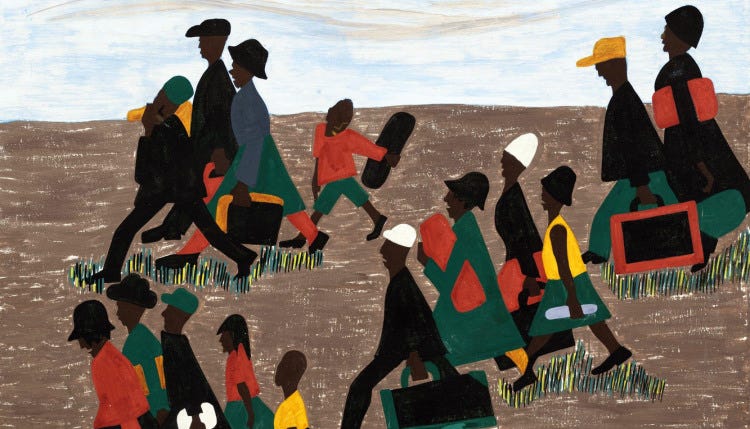
Black Americans have been trying to escape American racism — from segregation to heinous organized violence, such as lynchings — for generations. In America, we feel hyper-visible in ways that perhaps may not exist in other countries. This reality is all too routine and indicative of the recent report from the New York Times highlighting an increased number of Black Americans moving to Africa to escape American racism.
According to the Diaspora Affairs Office of Ghana, at least 1,500 African Americans moved to the country between 2019 and 2023. Despite potential concerns for newcomers — including a wave of extreme anti-L.G.B.T.Q. policies across the continent — Black Americans are still making the trip.
“Come home, build a life in Ghana. You do not have to stay…Africa is waiting for you.” — Barbara Gyasi, Ghana Tourism Minister
In a 2020 interview with USA Today, with more than a dozen expatriate Black Americans spread out across the globe from the Caribbean to West Africa, it became clear that for some, the death of George Floyd in Minneapolis provided fresh evidence that living outside the USA can be an exercise in self-preservation.
For other Black Americans who chose what amounts to a form of foreign exile, Floyd’s death and the ensuing protests confirmed that leaving may not mean a life free from racism and police brutality, but it at least feels somewhat more within reach.
“I don’t have to think of myself as a Black woman,” Lakeshia Ford, who lives in Ghana tells Kim Hjelmgaard from USA Today.
Ford said that although racism in the USA contributed to the decision, her move to Ghana was not a direct reaction to prejudice. She was equally intrigued by Ghanaian culture and what she saw as a growing economic success story rarely portrayed in the West, where Africa for many is synonymous with disease, poverty, and conflict.
“When I got here, I remember thinking: There’s wealthy Black people here. No one tells you that. I was really pissed off about it. I was also really intrigued,” she said.
Organizations like the Exodus Club have also been helping people in the African diaspora move to the continent since 2017. R.J. Mahdi, 38, a consultant for the group, moved from Ohio to Senegal 10 years ago.
Mr. Mahdi said he’d seen an increase in the number of Black Americans relocating to Africa in the past several years. “There are 10 times as many coming now as there were five or six years ago,” he said. By his estimate, demand for the Exodus Club’s services has grown at least 20 percent every year since its founding, when it had about 30 clients.
Mrs. Kirya-Ziraba, who is Jewish, said that when she moved to Uganda to join her husband, Israel Kirya, she went from being “a minority within a minority” to being surrounded by those who share her race and faith. Mrs. Kirya-Ziraba, who worked for a commercial real estate company in Texas, now runs Tikvah Chadasha Foundation, a nonprofit supporting Ugandan women and disabled children.
She and her husband live in Mbale, a small city home to the Abayudaya Jewish community, which has about 2,000 members.
In Uganda, she no longer faces “a thousand cuts” of racism, she said. For years she had made accommodations, big and small, to try to control other people’s perceptions: smiling to appear nonthreatening, buying nicer clothes to avoid being mistaken for a domestic worker, and straightening her hair to be seen as more professional.
She knew she had been acquiescing, but, she said, “I didn’t know the extent until I didn’t have to do any of that.”
The departure also indicates efforts to escape financial barriers imposed by structural racism, such as redlining and discriminatory mortgage lending practices in housing. Lending Tree recently reported that between 2019 and 2022, the median net worth for Black families skyrocketed by 58% to $44,100, while white families spiked by 30% to $284,310. Simply put, as Black wealth increased, — so did the racial wealth gap.
Racism and discrimination have historically shaped the experiences of Black homebuyers and owners in the United States, making it difficult for them to accumulate generational wealth.
Some of us are now seeking a change.
There is no official record of how many Black Americans have recently chosen to leave the United States, but based on personal accounts, there seems to have been an increase in interest in the topic since the racial justice protests of 2020.
It’s important to note, however, that moving to Africa may not be the perfect solution for everyone, as the trauma of racism and history of discrimination won’t disappear just with a change of location. It’s possible that moving could trigger old racial tensions.
While many of us consider whether to take flight, it’s unclear which double burden is worse: that of leaving, and possibly facing being ‘othered’ in the motherland or staying where we’re required to confront racism to survive.
Quintessa Williams is a Staff Writer for HBCU Buzz & EIC for The Daily Quinn, — a breaking news publication for African Americans. Williams is also a Contributing Journalist for The Root, MadameNoire, and Medium.