
New Survey Says (Why) Christian Nationalism Is Declining
Baylor University and Ryan Burge provide good news

Few movements have been dissected as much as Christian Nationalism over the past few years.
Several books have been written to define Christian Nationalism and raise the alarm about its potential threats to religious freedom and democracy, some of which became best-sellers. Countless essays and blog posts have unpacked Christian Nationalism and kept the spotlight on its authoritarian tendencies, including essays in major publications like Time magazine.
Heck, Dan Foster and I separately wrote about Christian Nationalism for The Backyard Church within the last couple weeks.
According to new survey data from Baylor University, Christian Nationalism seems to be declining. All the attention and criticism seems to have made an impact. Good news for a change. Amen!
Fewer Americans subscribe to Christian Nationalist ideas and values in 2021 than in 2007. The decline almost certainly results from greater awareness of Christian Nationalism’s toxicity and “proto-fascism.”
Let’s explore the data, courtesy of political scientist Ryan Burge and his Substack newsletter, Graphs about Religion.
The Baylor Religion Survey and Christian Nationalism
Baylor University is a private, Christian university in Waco, Texas. It has a reputation for rigorous academics and moderate politics. You may have heard of their history professor, Beth Allison Barr, author of “The Making of Biblical Womanhood.” If not, listen to my interview with her.
In 2007, Baylor University conducted the “Baylor Religion Survey.” They asked a representative sample of U.S. citizens the following questions:
- The federal government should advocate Christian values
- The federal government should allow prayer in public schools
- The federal government should allow the display of religious symbols in public spaces
- The federal government should declare the United States a Christian nation
- The federal government should enforce strict separation of church and state
- The success of the United States is part of God’s plan.
Then in 2021, Baylor posed the same questions to another representative sample of Americans. In both surveys, people could respond with “strongly disagree,” “disagree,” “not sure,” “agree,” or “strongly agree.”
These questions, of course, reflect the common beliefs and arguments of Christian Nationalists. With Baylor’s methodology, we can compare the change in Christian Nationalist belief during the period of 2007–2021.
The chart below, created by Ryan Burge with Baylor’s data, shows that agreement with Christian Nationalist beliefs declined across the board.
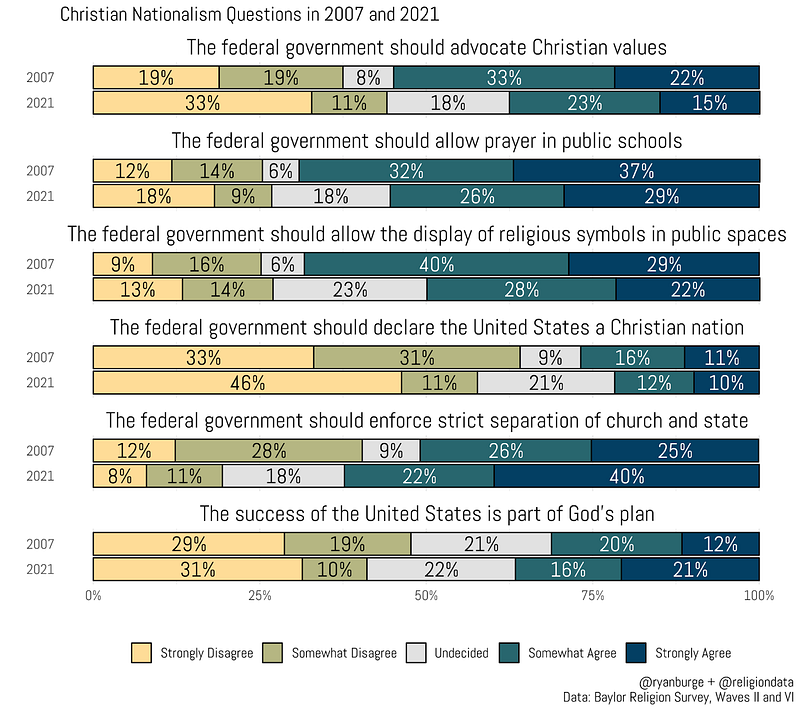
In 2007, 55% of the survey respondents “strongly agreed” or “agreed” that the government should advocate Christian values, compared to only 38% in 2021. Almost 70% in 2007 agreed that prayer should be allowed in public schools and religious symbols should be allowed in public spaces, but 55% and 50% agreed with those ideas in 2021. Far more people opposed the federal government declaring the U.S. a Christian nation in 2021, and many more strongly agreed with a strict separation of church and state.
The responses to the statement, “The success of the United States is part of God’s plan,” were surprising. Twelve percent strongly agreed with that statement in 2007 while 21% strongly agreed in 2021.
Baylor’s survey didn’t ask people why they answered the way they did, but I bet the exhaustion and disaster of the Iraq War circa 2007 likely affected the answers then and the racial reckoning of 2020 affected the answers later (more about that below).
The Covid pandemic wasn’t exactly a high-point in American life during 2020–2021, but many Christians double-downed on their faith in God’s plan and shepherding rather than abandoning hope. Republican Christians also had a strong reason to believe in God’s desire for America to succeed: the reelection of Donald Trump (more on that, too).
The “Nones” Don’t Skew Baylor’s Survey Results
My favorite thing about Ryan Burge may be his thoroughness.
Burge analyzed the same survey data but excluded the “religious nones,” the people who express religious or spiritual belief but indicate “nothing in particular” when asked about their religious affiliation.
As Burge points out, the proportion of “nones” in the overall U.S. population in 2007 sat at 16%. By 2021, the “nones” had swelled to 30% of Americans — the largest and fastest growing “denomination” in the country.
In 2007, 11% of Baylor’s sample were “nones.” In 2021, 19% of the sample were “nones.” Could the increase in “nones” have skewed Baylor’s results?
Actually, no!
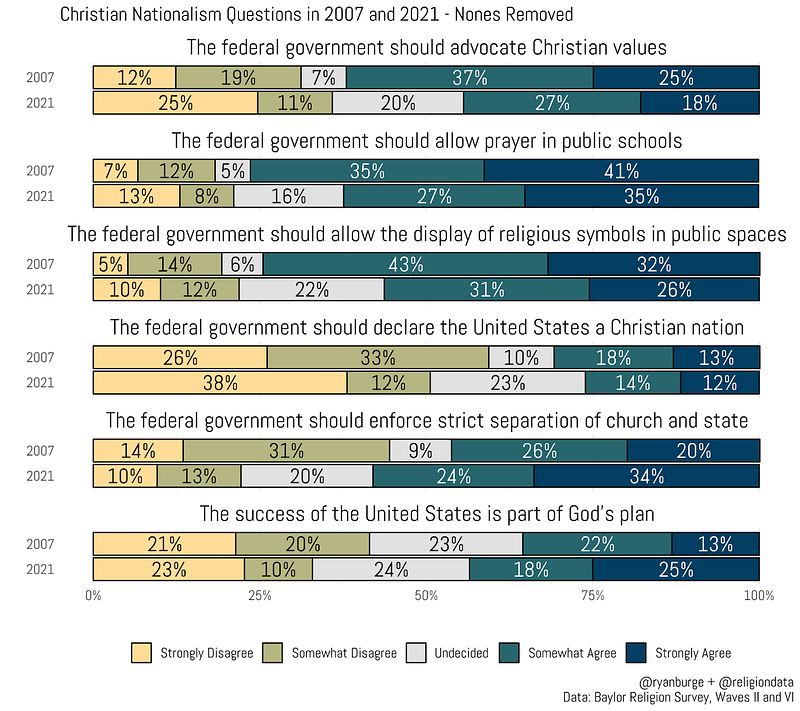
The results don’t change much when Burge excludes the “nones” from the data. Over 60% of respondents in 2007 “strongly agreed” or “agreed” that the government should advocate Christian values. That dropped to 45% in 2021. The percentages of people who want prayer in public schools and religious symbols in public spaces also declined by double-digits. Less than half (46%) in 2007 thought the federal government should enforce separation of church and state, yet 58% thought so in 2021.
Let’s assume that people who self-identify as belonging to a religion possess stronger religiosity than those who self-identify as “nothing in particular.” If that’s true, then fewer “more religious” people agree with Christian Nationalism in 2021 than 2007.
Most Mainline Protestants Do Not Support Christian Nationalism
Did I mention that Ryan Burge is thorough?
He also analyzed the strength of the survey respondents’ answers. Sure, belief in Christian Nationalism may be declining across the population, but what if the remaining Christian Nationalists believe even more strongly than before? And what if Christian Nationalism has declined entirely among, say, Mainline Protestants while remaining steady among Evangelicals? We could still have a very serious problem as a country.
Ryan Burge assigned a number to each response in the Baylor Religion Survey. When someone “strongly agreed” with Christian Nationalism, Burge assigned a 5 to that response. A “strongly disagreed” got a 1, and a “not sure” received a 3. (You can guess the others.) Then Burge added each respondent’s scores on the 5-point scale and subtracted 6, resulting in a Christian Nationalism scale of 0–24.
Next, Burge averaged the scores for the different religious groups in the survey. Here’s what he found:
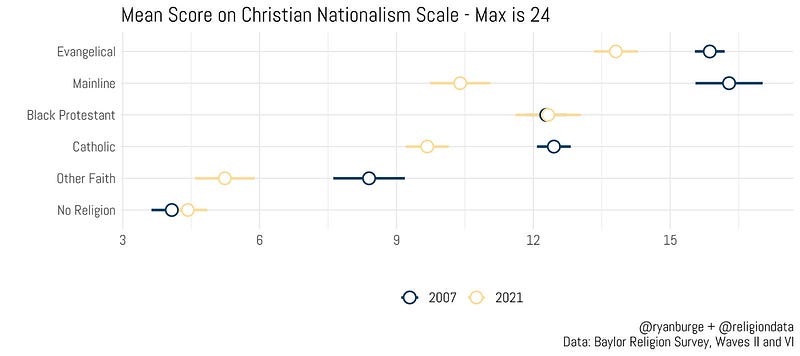
On average, Evangelicals scored almost 16 on the 24-point scale in 2001. That number fell to 13.8 in 2021, a modest but still significant drop.
Support for Christian Nationalism cratered among Mainline Protestants, falling from 16.3 to 10.4. The score for Catholics dropped from 12.4 to 9.7.
Surprisingly, the average score among Black Protestants did not change at all from 2007 to 2021. Why?
Black Protestants and Christian Nationalism in Baylor’s Survey
Researchers in religion separate Black people from other Protestants because of the unique experience of African-Americans. From the Civil Rights Movement to today’s systemic racism, Black Americans have a fundamentally different collective experience and therefore tend to hold distinct social and political views from white Protestants.
Baylor’s Survey Data can’t answer the question of why Black Protestants scored the same on Burge’s Christian Nationalism scale. For what it’s worth, I believe most Black Protestants mean something very different by “The federal government should advocate Christian values” than most white Protestants:
Of course, the federal government should care for the poor and promote social and economic justice. Haven’t you read the bible?
With that said, Burge also breaks down the data by each question. Mainline Protestants were far less likely to agree with any of the Christian Nationalist statements in 2021 than in 2007, while Evangelicals expressed less support for some questions but the same support for others.
About a quarter of the Black Protestants in Baylor’s 2007 survey agreed that “The success of the United States is part of God’s plan,” but then over half of Black Protestants agreed with that statement in 2021. The number of African-Americans in Baylor’s samples in 2007 and 2021 were drastically different, but still, that’s a huge increase on one question.
Martin Luther King, Jr., and other Civil Rights leaders often talked about their racial justice work in terms of God’s divine plan. Perhaps the racial reckoning over George Floyd’s death in 2020 spurred new hope for a God-led transformation of America’s racism?
Politics Affect the Christian Nationalism in Baylor’s Survey
Using other data, Ryan Burge has argued persuasively that church attendance and support for Trump don’t actually relate to each other.
Church attendance, Burge argues, maps onto political partisanship. Republicans are more likely than Independents or Democrats to attend church services. They’re also much more likely to support Donald Trump. Republican identity expresses itself through voting for Trump and attending church every Sunday. Few Democrats who attend church also vote for Trump.
Naturally, then, Burge also looks at how politics affects the responses to Baylor’s survey. He breaks down the data according to political affiliation.
Democrats in 2021 were far less likely to support Christian Nationalist statements than they were in 2007. Over 40% said in 2007 that the government should advocate Christian values, but only 20% agreed with that statement in 2021. Their support for prayer in schools and religious symbols in public spaces fell by over 20 percentage points.
Republicans were a mixed bag. About 10% fewer Republicans support the government advocating Christian values, allowing prayer in schools, or displaying religious symbols in public spaces. Over 20% more Republicans endorse a strict separation of church and state.
But 45% of Republicans said in 2021 that the government should declare the U.S. a Christian Nation, compared to 40% in 2007. Almost 60% of Republicans said in 2021 that America’s success is part of God’s plan, an increase from 46% in 2007.
As I said earlier, I wonder if America’s general discontent about the Iraq War could explain some of the gap in the “God’s plan” data between 2007 and 2021. I came of age around 2007, and it’s hard to overstate how pessimistic Americans felt then. We didn’t have DVR or streaming services to watch instead of the news, and the nightly news informed us about every single American soldier who died. The war also seemed to be a stalemate at best.
It’s possible that the gap between 46% and 60% reflects people’s feelings about current events more than their support for Christian Nationalism. Which brings to mind the racial reckoning after George Floyd’s murder by police and the Covid-19 pandemic in 2020. You would think those events would dampen anyone’s belief in God’s favor for America.
Yet Black Protestants may view the massive protests of Floyd’s murder as evidence of God moving Americans toward racial justice, similar to how the Civil Rights Movement viewed and promoted itself as a religious movement. Many Christians, especially Evangelicals, responded to the pandemic by doubling-down on their trust in God’s plan. Evangelical Republicans also had a strong incentive in 2021 to assert God’s favor on America — they wanted to reelect God’s chosen, Donald Trump.
The State of Christian Nationalism in 2021, 2024, and Beyond
Overall, the Baylor Religion Survey and Ryan Burge’s analysis reveal far less support for Christian Nationalism in 2021 than in 2007.
Mainline Protestants, Catholics, and Democrats were far less likely to support Christian Nationalist statements, beliefs, or ideas. Christian Nationalism didn’t wane as much among Evangelicals, but even they were less likely in 2021 to agree with Christian Nationlist statements.
Burge suggests three possible explanations for the retreat of Christian Nationalism across these groups.
- The January 6th attack on the U.S. Capitol, with crosses and bibles prominently displayed, and the subsequent discussion of Christian Nationalism may have pushed some people away from it.
- There could be more general awareness of Christian Nationalism and its authoritarian tendencies in 2021 than in 2007.
- Or the people surveyed could have changed — stronger adherents to Christian Nationalism may have died out before 2021, replaced by a younger and less-Nationalist generation.
I’m not persuaded by #3. If Evangelicalism and the Republican party have taught us anything, it’s that they’re very good at replicating themselves. Evangelical institutions produce clones of their (older) leaders, and Republican parents tend to raise Republican kids.
January 6th forced Christian Nationalism into the public’s face. No one could avoid seeing the fusion of insurrection and religious symbols.
But then Sam Perry, Andrew Whitehead, Kristen Kobes du Mez, and other researchers explained what Americans saw — and kept explaining it.
Christians formed groups like “Christians Against Christian Nationalism” and committed to maintaining awareness of the toxicity and authoritarianism of Christian Nationalists.
Without these efforts, I doubt Christian Nationalism would have retreated as much as it did in 2021. But now is not the time for complacency. It’s the time to wind up for a knockout blow.
As Kristen Kobes du Mez writes in her Substack:
What allows rhetoric to devolve into violence is when too many people say nothing. When people shrug their shoulders at escalating rhetoric and threats of violence.
We’re seeing the good fruit of speaking up, of stiffening our shoulders instead of shrugging them. Keep going.
The Backyard Church is not just a blog. It’s a real online community for people who have faith but can’t, don’t, or won’t go to church. Join today.
Check out my newsletter, Saving Faith, where we rebuild a faith that works one 2-minute read at a time.


