SORRY NOT HUMOUR
New Studies Say the Climate Crisis is Worse Than We Thought
We’re venturing into uncharted territory
I haven’t been writing much lately about the climate crisis, and not because I’ve gained new optimism that we can avoid a civilization-wrecking climate car wreck.
No, it’s more because as the year unravelled, with records shattered and new superlatives applied to the emerging catastrophe, I didn’t have much new to say besides “I told you so.” Anyway, sometimes it’s easier to give a polite hat tip to the abyss and retreat into the comforting minutia of everyday life.
But there’s new science suggesting that the climate crisis is worse and progressing more rapidly than expected, so let’s get dooming!
1. State of the climate = terrifying
That matters are not going well should be stupidly obvious to anyone following the news. 2023 will be the hottest year on record, and depending on how El Nino plays out, 2024 could be hotter still.
However, for those seeking expert opinion, The 2023 State of the Climate Report: Entering Uncharted Territory summarizes the situation:
Global daily mean temperatures never exceeded 1.5-degree Celsius (°C) above preindustrial levels prior to 2000 and have only occasionally exceeded that number since then. However, 2023 has already seen 38 days with global average temperatures above 1.5°C by 12 September — more than any other year — and the total may continue to rise. Even more striking are the enormous margins by which 2023 conditions are exceeding past extremes…
They follow up with a far from exhaustive list of this year’s weather disasters, including floods, wildfires, and heatwaves.
It’s increasingly hard to find words to express how messed-up all this is, but this Twit-X post from researcher Zeke Hausfather about temperature anomalies in September 2023 gives an idea:
This month was, in my professional opinion as a climate scientist — absolutely gobsmackingly bananas.
We already know that under a business-as-usual scenario, the situation will deteriorate further. But a couple of studies say that even our current dismal projections may be viewing the future through rose-coloured smoke goggles.
2. Models may be underestimating climate feedback loops
A recent paper suggests that climate models have underestimated the effect of positive feedback loops which amplify global heating. These feedbacks are initiated by warming from human greenhouse gases, but then roll along merrily on their own, meaning Earth could get dangerously toasty even if we eliminate our emissions.
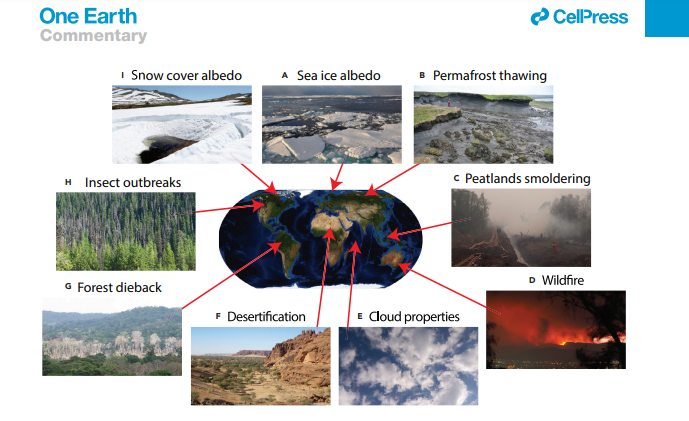
These feedbacks include melting permafrost releasing methane and CO2 into the atmosphere, wildfires spewing carbon, and newly ice-free seas absorbing heat instead of reflecting it, along with dozens more dangerous, poorly understood loops.
The money quote in the report is this (bolding mine):
In the worst case long-term scenario,interactions among feedback loops could result in an irreversible drift away from the current state of Earth’s climate to a state that threatens habitability for humans and other life forms.
If self-reinforcing feedbacks become the dominant driver of global heating and beyond human correction, all bets are off. Hello, hothouse Earth!
3. The climate may be more sensitive to greenhouse gases than we thought
Back in 1988, climate science pioneer James Hansen told a Congressional committee that human greenhouse gas emissions were heating up the planet and that action needed to be taken. His warnings were largely ignored, but he’s remained active and just co-authored a new study arguing that climate is more sensitive to greenhouse gases than accounted for in our models.
Sensitivity means the expected temperature rise for every doubling of CO2 in the atmosphere. If our estimates have been too low, as the report claims, then we’re going to see more heating than predicted in models.
According to this research:
Equilibrium global warming for today’s GHG amount is 10°C, which is reduced to 8°C by today’s human-made aerosols.
8°C is a change vastly beyond the ability of human civilization to survive in, let alone thrive, but the paper isn’t suggesting that’s a committed increase, nor one that will happen in the next few human lifetimes. However, more immediate problems face us:
…under the present geopolitical approach to GHG emissions, global warming will exceed 1.5°C in the 2020s and 2°C before 2050.
That’s enough to cause unprecedented chaos and disruption unless we act immediately.
The study says:
We are in the early phase of a climate emergency. The present huge planetary energy imbalance assures that climate will become less tolerable to humanity, with greater climate extremes, before it is feasible to reverse the trend.
It’s worth noting that not all climate scientists are in agreement with these apocalyptic projections. But Hansen has been right before, and given the stakes, it makes sense to take this work seriously.
But we’re fixing things, right?
Wrong.
The growing consensus of climate science is that it will be effectively impossible to meet the target goal of limiting global heating to 1.5C above pre-industrial levels, and even the less ambitious target of 2C isn't looking good.
The non-binding Paris Climate Agreement of 2015 has proven worthless, with virtually no countries meeting their stated GHG reduction goals, or even attempting to.
While the international community is making great strides in building out non-GHG-producing renewable energy, we’re increasing the amount of energy that we use even faster.
As a result, governments and fossil fuel companies plan to find and burn more coal, oil, and gas than ever, ensuring that the GHG emissions continue to climb. US President Joe Biden, who is theoretically climate-friendly, just approved the massive Willow oil-drilling project in Alaska, which opponents are correctly calling a “carbon bomb.” And China is producing and importing more coal than ever, with no apparent end in sight.
The situation has become so dire that the Hansen paper says geo-engineering will be necessary, likely by putting sulphur or other materials into the atmosphere to reflect sunlight.
While the idea has been around for years, it’s never been attempted, in part because it’s unclear what potential negative consequences could emerge from implementing it at scale. That serious scientists are advocating for it is an indicator of the perilous situation we’re in.
So what’s next?
Unchecked, tomorrow’s climate disasters will make today’s floods and wildfires look like a sunny day at the beach. To be clear: if we don’t turn this around, society will collapse before the middle of the century.
We no longer have the luxury of a slow, incremental approach. Time’s up for that.
What’s needed to prevent catastrophe now is a complete transformation of global energy, transportation and food production systems, and a shift in the way we think about the economy. It will require a massive overhaul of our wasteful lifestyle and an abandonment of the cult of endless growth that’s driven our society for decades.
Our governments show no interest in such an effort, and voters aren’t agitating for it. But it’s too late to do anything else and expect to survive as a civilization.