
New Relationship? Why Your Childhood Trauma Might Hi-jack Your Thinking
And what to do when it does

“What you experienced, that question of “If I don’t matter, why am I here? is existential.”
So said the psychotherapist, as I sat across from him, once again trying to sort out my feelings around a relationship issue.
A relationship that is hands down the healthiest and most loving I’ve experienced and oddly the one that is unearthing old and unresolved childhood trauma.
When you seek out help and do the work, it’s easy to believe that the effects of childhood trauma are done.
The truth is that the human experience is so rich and varied that you’ll continue to encounter old limiting and hurtful beliefs, even in happy and healthy relationships.
When that occurs, it’s worthwhile to know how to recognize what’s happening and what to do to meet your mental health and relationship needs.
What being triggered really means
While the psychotherapist’s statement might be a fascinating philosophical question to be pondered over in a beverage, it’s far less interesting when it’s the basis of your childhood trauma.
As a child impacted by in-family bullying and a complex and inconsistent experience of emotional neglect, one simple conversation with my new partner tipped me over into an insecure and doubtful child mind.
And what was the topic that toppled me from adult to child?
Gardening.
Yes.
You see, it’s not about the topic. Rather it’s the meanings that arise while in conversation with the other person. And from those meanings, are feelings, thoughts, and memories that tangle into a mess beyond what the conversation itself is about.
When that happens you go from a normal state of mind to one hi-jacked by your child-trauma mind.
In this instance, the gardening conversation brought back a cascade of stories from my childhood and beyond.
Yes, I was “triggered”.
Whatever you might feel about that term, it’s an accurate one. A neural switch containing old stories and responses is activated, bringing you back into the feelings and sensations associated with a childhood threat.
For someone with a brain unaffected by trauma it won’t make sense. It will seem illogical or even over the top.
The person whose neural pathways have changed because of trauma isn’t responding with logic or forethought. In fact, it’s more reactive than responsive, which is what makes relationships especially tricky.
For me, that trigger takes me from a calm and reasonable thinker to an agitated and overthinking state. Child trauma mind takes over and it tries to weigh out the meanings and options that are least likely to be emotionally hurtful.
It’s exhausting.
From trigger to truth and sound strategies for your future
Thankfully, when you’ve done healing work around childhood trauma, you can identify when your response or feelings don’t match the issue.
Then it’s time to unwind from the stories and feelings attached to the situation.
That can be as simple as asking yourself, “What’s this really about?”
Once you’ve done that, you can identify the old story and then take time to compare it with what’s really going on.
That skill is helpful and will start you on your healing path. But it won’t take you the whole way.
The work isn’t done, because while you can see the new story and begin to incorporate that new truth into your current circumstances, there’s more yet, the unseen stories that you’re not yet aware of and the feelings they generate.
In this case, the trigger was more complex than what I’d been able to pull apart for myself. Yes, there was a conversation about planning a garden and the inclusion of my partner’s adult son.
And while I knew that my old stories of being invisible and without a voice didn’t match my new experiences with my partner, I’d still been unable to go deeper, to shed light on what had remained a secret to me.
This is why having an expert who can kindly and competently ask you the questions you don’t think of yourself, or perhaps are afraid to ask, is integral to your healing.
Finding the truth
A question “asked simply” does not make it a simple question….or a simple answer.
When he asked, “what feelings is she afraid to have?” (She refers to my younger self.) It meant taking a breath and sitting with the fear to find the courage to voice it.
The fear was beyond being overlooked or invisible. It stretched into the worst kind of fear for anyone of any age…. one of not mattering.
A lifetime of unmet emotional needs fosters an unhealthy coping mechanism to either deny you have any needs or the belief that someone else’s is always going to trump yours. This makes asking for what you need far more demanding than someone who trusts that their needs will be met.
This new relationship was challenging me to find the balance of expressing my needs and being respectful of my partner’s personal needs and his needs as the parent of the adult son who lives with us.
The psychotherapist allowed me to see that mixed in with old stories about unmet emotional needs was also the deep fear of not mattering.
As a parent myself, I supported my partner in being there for his son but didn’t know how to manage the waging emotions erupting from my wounded child self.
What if someone else (like his son), was always first, would I and my needs once again be invisible, without needs, and ultimately not matter. Maybe…even at all?
And if you don’t matter, then why exist?
Getting to that place, being able to face down that kind of fear and see it for what it was….
……You don’t get that type of insight alone!
Once you have them, within a supportive and therapeutic container, you’re then better able to review strategies for future challenges.
Strategies for Continued Growth
Even if you feel like you’ve figured out the underlying cause, you usually don’t have the strategies for dealing with the situation. If you did, you wouldn’t be performing mental gymnastics. This is exactly why you want an expert informed in trauma, to help you with your thinking and next steps.
For instance, consider the suggestion of a Venn Diagram for learning how to deal with the tension that arises for every couple around their individual and couple needs.
In this case, when it comes to meeting needs, it would look like this
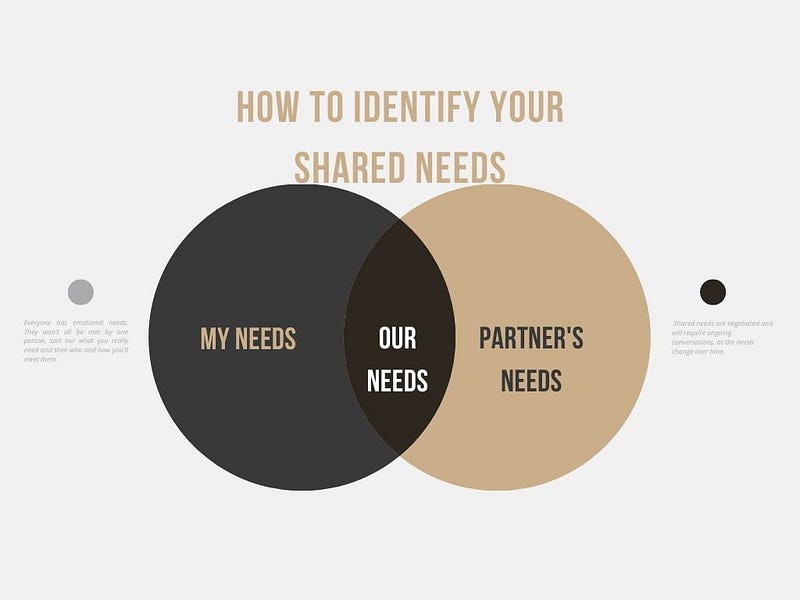
Diagram created by Frances Hickmott
Yes, you’ll each have those things that you “really need”. Identify those, and how you’ll meet them, and then find that common ground where you can identify your joint needs.
This means learning how to live with the tension, even though human nature wants it to go away.
A mind affected by childhood trauma will double down on that desire, which is precisely why you’ll need the help of your mental health expert from time to time.
Every relationship will have disagreements and challenges.
Tensions, happen.
With guidance, you’ll learn how to lean into the tension and…
observe it and “sit with it with kindness.”
With a safe psychological space to experience those tensions, you’ll learn how to deal with them rather than become overwhelmed or shut down.
Consider that every time you learn how to be with your feelings you’ve achieved another achievement on your path to mental wellness.
Final Thoughts
While the playing field for those affected by childhood trauma is different from someone who hasn’t had those experiences, we’re all on a journey to living life as healthily as possible.
That means both our physical and mental health.
The knowledge and the work necessary to create a healthier you and a healthier relationship isn’t a “one and done” effort.
The very nature of meaningful relationships means there will be times when you rub up against an unexpected challenge. Those challenges give you the opportunity to once again step into your commitment to healing.
As you do, you’ll increase your self-awareness, and not only benefit yourself but all those with whom you have relationships. And that’s the pathway to discovering just how good and satisfying your life can be.
As the saying goes “how you started isn’t how you need to end.” Here’s to you and your pathway to living the life you deserve.


