New Prospects for the Left in an Era of Extreme Wealth Concentration
The Institute for Policy Studies recently released an important, yet disheartening report on wealth concentration which found that the richest three Americans currently own more wealth than half of the population. It’s additional findings paint a bleak picture of a burgeoning First World oligarchy:
“The billionaires who make up the full Forbes 400 list now own more wealth than the bottom 64 percent of the U.S. population, an estimated 80 million households or 204 million people — more people than the populations of Canada and Mexico combined.”
“The median American family has a net worth of $80,000, excluding the family car. The Forbes 400 own more wealth than 33 million of these typical American families.”
“One in five U.S. households, over 19 percent, have zero or negative net worth. ‘Underwater households’ make up an even higher share of households of color. Over 30 percent of black households and 27 percent of Latino households have zero or negative net worth to fall back on.”
The authors of the report also observed that these statistics likely constitute a conservative estimate of the true scope of economic inequality, since “the growing use of offshore tax havens and legal trusts has made the concealing of assets more widespread than ever before.”
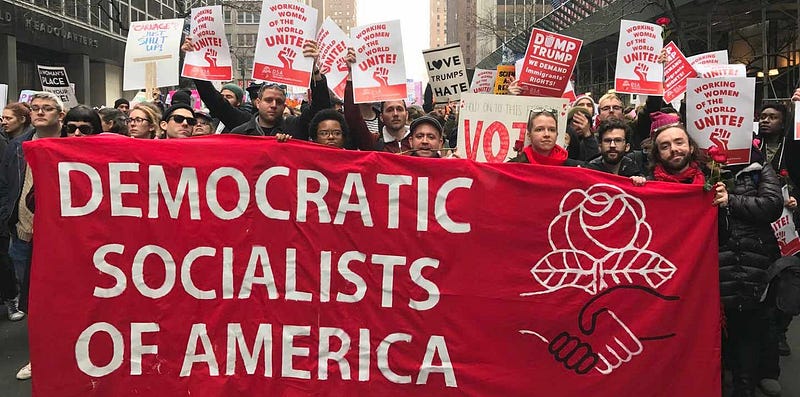
In what seemed to be a direct response to this dire situation, progressives and socialists accomplished sweeping electoral victories throughout the U.S. on November 8. These included the election of Larry Krasner (a civil-rights attorney and Black Lives Matter supporter) to the position of Philadelphia’s District Attorney, the election of Seema Singh Perez (an open socialist and Bernie Sanders supporter) to a seat on the Knoxville city council, and the election of Justin Fairfax (a progressive and environmentalist) to the position of Virginia’s Lieutenant governor. (Fairfax also became the second African American in Virginia’s history to be elected to statewide office.) In Maine, a Medicaid expansion referendum that was supported by Our Revolution was overwhelmingly passed by voters. Among the additional victories on the Left were 14 candidates who were endorsed by Democratic Socialists of America, an organization whose membership has quadrupled during the past year (and, in full disclosure, I am a member).
This leftward trend seems likely to continue into the future, if the attitudes of Millennials are any indiction of the trajectory of American politics. For instance, a recent YouGov poll found that 44 percent of Millennials would like to live in a socialist country (42 percent favored a capitalist country). This specific poll was conducted by a right-wing propaganda effort called “Victims of Communism Memorial Foundation,” so let’s review a few others as well.
A 2014 poll conducted by libertarian think tank Reason-Rupe found that 58 percent of those between 18 and 24 years old have a positive view of socialism (56 percent viewed capitalism favorably). And, while a 2016 Gallup poll did find a slightly higher preference for capitalism among Millennials (57 percent, versus 55 percent for socialism), the results for these two options were within the poll’s margin of error.
Although Millennials seem evenly divided between their espousal of capitalism and socialism, it’s clear that this younger generation has a much more favorable view of socialism than Baby Boomers, who, as studies indicate, overwhelmingly support capitalism (only about one forth veiwed socialism positively). A concrete verification of this fact was the widespread Millennial support for candidate Bernie Sanders — a self-described democratic socialist — during the 2016 presidential primaries (Sanders received more votes from those under age 30 than Trump and Clinton combined).
One issue that will have to be addressed is whether this progressive shift will take place with the cooperation of the Democratic Party establishment, or in spite of it. Aside from the fact that the Democratic National Commitee (DNC) is inherently hostile toward democracy itself, there have also been recent indications of vehement resistance to progressive change within the party. These include Donna Brazile’s revelations regarding the DNC’s efforts to rig the 2016 presidential primaries in Clinton’s favor, as well as the purge of progressive Democrats by current DNC Chair Tom Perez. Senator Bernie Sanders recently published a proposal for “fixing the Democratic Party,” but many are wary of this prospect.
Regardless of the precise logistics, one thing remains certain: Grassroots political action will continue, because Americans are sick and tired of business as usual, which has resulted in half the population living in or near poverty, tens of millions without access to healthcare, uncontrollable student loan debt, starvation wages, and other staggering systemic injustices. In the wealthiest country in world history, prioritizing dignity and prosperity for everyone is not only possible; it is a moral imperative.