
New Normal: An American Haiku
A response to Dead Poets Live April 5th Prompt
I have been reading a bit here and there about American haiku, surprised at it’s link to Kerouac. I don’t know why it surprised me so initially, his stream of consciousness style of writing definitely had poetic qualities about it.
Yet I wouldn’t have connected him to what started out as a more formal — and very short- style of poetry. The prose poem, sure, that I can easily see. I think much of his writing could actually be viewed as a type of lengthy prose poem. Maybe it would be called the American Prose Poem.
Take this passage for example that just discusses him hitching a ride. Take out the punctuation, or don’t, it’s an American prose poem after all, so the rules are relaxed and it’s up to you:
I went to sit in the bus station, and ate apple pie and ice cream; that’s almost all I ate all the way across the country. I decided to get a bus to the edge of the town, but this time near the gas stations. And after two minutes, a big truck stopped for me. The driver was a big guy who paid hardly any attention to me, so I could rest quietly without talking. We stopped later and he slept for a few hours in the driving seat. I slept too. Then, at dawn, we were off again, and an hour later the smoke of Des Moines appeared over the fields. He had to eat his breakfast now and wanted to rest, so I went right on into Des Moines, about four miles. I got a ride with two boys from the University of Iowa, and it was strange sitting in their new, comfortable car as we drove smoothly into town.
From “On the Road” by Jack Kerouac
I seem to be a bit out of sorts tonight. The virus, lock down, them reopening Atlanta businesses where my family lives and the related concern, worry about where to get rent money as I’m almost a month late due to the March 1st job that didn’t start March 1st, didn’t start at all, may not start at all but if so not until July or August and now my landlord has finally called. (See what I mean about Kerouac?) Just the normal COVID-19 night.
When I read Anna Rozwadowska’s poem, and read it again (I usually do that with hers as they are always beautiful, or poignant or startling or all of the above) then noticed it was for a Dead Poets Live prompt, I quickly shot over to the publication. I’ve been having an enormous amount of trouble writing anything I see as worthwhile this month and as the symptoms ebb and flow well past the time they should have abated, my mood does likewise.
“A Dead Poet Live prompt — could be just what the doctor ordered,” I thought. “American haiku? Alright I’m game to give it another go.”
I’d run into this particular form a few months ago, tried to learn about it and didn’t get very far. Coming back to it a second time coupled with the rather loose form my thoughts are taking seemed to help me make more sense of it. Or if not more sense, to at least relax enough to see what might come about. My experiences during this whole pandemic fiasco? How much time ya got?
I returned to the one by Anna R. Anna’s was in the formal 5–7–5 format of a Japanese haiku, tight and perfectly constructed. I knew whatever I came up with, publishable or not, it would be more in line with Kerouacs free association style (A teacher once compared my writing to Kerouac. It was not a compliment. He told me I needed to stop reading that !@#$%& writer. I said I would, but I didn’t.)
Next, I read the one written Austin Briggman. Hmmm, still a bit of a formal haiku feel but with lines that were a bit more lose of 4–8 syllables. Wait, there’s a four line stanza followed by a one line stanza at the very end. The description is in the language of the every day. Different from Anna’s but just as clear a representation of current life.
Dennett’s poem still in relaxed form and relaxed language of what new daily experience is like. The title “Wonky” was an entire poem in itself in terms of what it expressed, I thought.
Jane Vogel wrote of the sterility that has become an obsession with us today and of communicating with others from the outside looking in. The language was clean and clear and when I got to the end I couldn’t help but exhale a Yes.
Sara Grace Stasi’s poem begins with the simplicity that life now seems to revolve around, cats hiding under benches, watching a garden grow but then speaks of travel to Mexico, virus be damned. But alas, it is only the butterflies who are able to go. Simple language, perfect summary of our times when only insects and animals seems to have any normalcy and freedom.
Daphni Sawyer wrote a poem that seemed to describe the conflict and pain involved in a relationship during the lock down. It’s unclear when the conflict starts or stops only that they want to find a way back to each other. (At least that’s the basic gist I got from it — Sorry if I botched my interpretation of your intended meaning.)
Okay, so far it seemed more or less the poems were structured like traditional haikus with some straying from the traditional 5–7–5 structure and others changing the lines per stanza. After reading a bit more, I decided to try my hand at it, the first time just seeing what came out without worrying too much about it. After cleaning it up a bit, here then is my first attempt at an American haiku, a la Kerouac. (I’m sure I’ll try again with a bit more structure and format but that’s for another time).
new normal
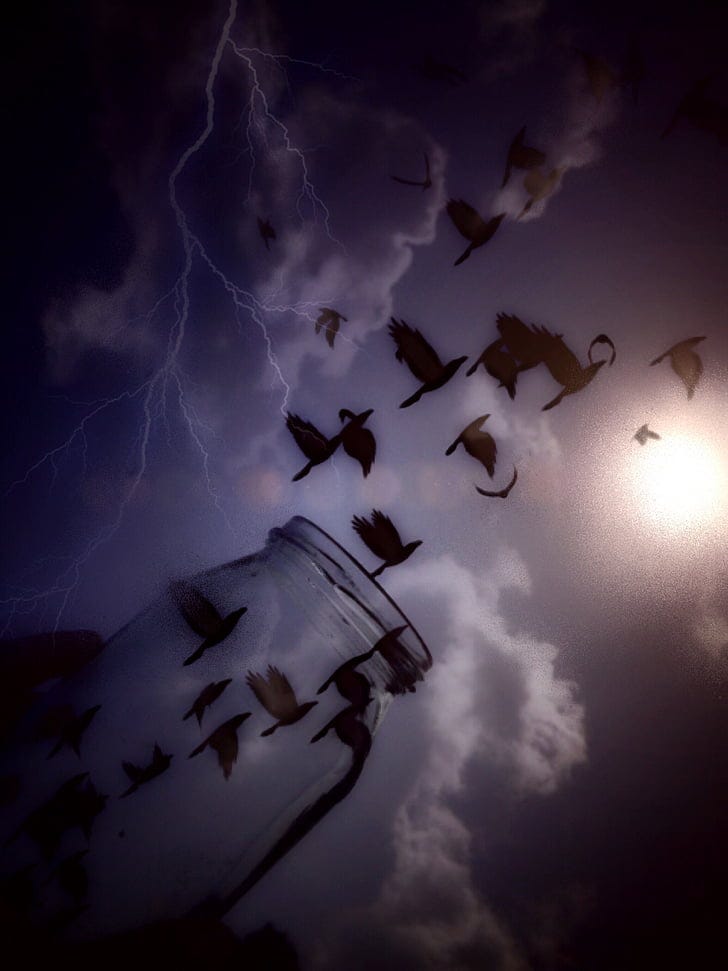
birds singing in the fresh rain drips and drops their background percussion
a momentary lapse in memory it spills back in from retreating wings
all is quiet I labor to breath virus, panic or both a question mark
when did breathing become so complex why can’t science simplify
eyes closed I vow to aspire a new goal to change the world donning peach leggings instead of black I breath
did birds always sing in the dead of the night or is this yet just one more meaningless change it has carelessly wrought as it wages it’s war
* thanks to David S. for a great prompt
Natalie Frank has had her poetry featured in several anthologies including Untimely Frost. Her fiction has been published in Haunted Waters Press, Weirdbook Magazine, Siren’s Call Publications, Lycan Valley Press and Zero Fiction among others. Her collection of poetry, Disguised I Breathe, In Love I Hold, can be found on Amazon under her pen name, Taye Carrol.

If you enjoyed this poem post, you might also like these:
You can find links to my other work on Medium and follow me here. Thanks for reading.