avatarBob Peck

Free AI web copilot to create summaries, insights and extended knowledge, download it at here

4216

Abstract

brahamic religions.</p><blockquote id="145c"><p>Where can we go to find God, if we cannot see Him in our own hearts, and in every living being? — Swami Vivekananda</p></blockquote><p id="b91e">Hinduism is considered pantheistic, but has more difficulty being considered polytheistic (many gods). While there are thousands, if not millions of separate gods in the Hindu pantheon, they all emanate from Brahman. This is extremely important. They are all <i>masks</i> of the One. The famous scholar Max Müller and others have referred to this ideology as <a href="https://www.newworldencyclopedia.org/entry/Henotheism">henotheism</a> — many iterations of the one God.</p><figure id="6475"><img src="https://cdn-images-1.readmedium.com/v2/resize:fit:800/0*9kScWf91RwCJ4zY-.jpg"><figcaption><i>Viraat Purushan-Vishnuoopam” portrayal of Vishnu as Krishna as a thousand avatars</i></figcaption></figure><p id="4c25"><a href="https://iep.utm.edu/hart-d-t/#H6">The term “panentheism” was expanded upon by a philosopher named Charles Hartshorne</a>, (a student of both Martin Heidegger and Alfred North Whitehead) making the jump from standard pantheism “god is in all things”, to a new definition that includes transcendence. The “<i>en</i>” after “<i>pan</i>” indicates that not only is God everywhere, but also <i>beyond</i> time and space as well as within it. In my film, <a href="http://facebook.com/thekingdomwithinfilm"><i>The Kingdom Within</i></a>, Dr. Stephen Phillips makes the analogy for panentheism as follows: “As human beings transcend our bodies by doing yoga and other spiritual practices, so does God transcend the universe.”</p><figure id="f4d0"><img src="https://cdn-images-1.readmedium.com/v2/resize:fit:800/0*iwwyBjky7aVs4ZzF"><figcaption>by <a href="https://www.instagram.com/cnikarts/">cnikarts</a></figcaption></figure><p id="ed63">Native American tribes have several names, many of which I find lovely: “Creator”, “The Great Spirit”, “The Great Mystery”.</p><p id="f1cd"><a href="https://plato.stanford.edu/entries/aristotle-natphil/">Aristotle wrote about a “Prime Mover”</a> or “Unmoved Mover”, the translation being “that which moves without being moved”.</p><p id="ce20">Zoroaster used the name <i>Ahura Mazda</i> meaning “Wise Lord”.</p><p id="e2c4">Rumi and the Sufis spoke of God as “The Beloved”, from the perspective of a lover.</p><p id="08e3">Guru Nanak of Sikhism uses the symbol <i>Ik Onkar</i> meaning “One All Pervading Spirit”.</p><p id="1781"><a href="https://www.ananda.org/autobiography/">Mahavatar Babaji</a>, the timeless Hindu sage refers to “The Infinite Current”.</p><p id="c4b1">Baha’is refer to God as many names but their most cherished name is “All-Glorious” or <i>Bahá</i> in Arabic.</p><p id="6da6">In Subud, “The Great Holy Life Force”.</p><p id="2d0d">Emerson and the Transcendentalists called God the <a href="https://archive.vcu.edu/english/engweb/transcendentalism/authors/emerson/essays/oversoul.html">“Over-Soul”</a>.</p><p id="0b4c">Carol Howe and the <i>A Course in Miracles</i> crowd often substitutes the usage of the word “God” for simply “Love”. So instead of Lesson 29: “God is in everything I see”, the phrase “Love is in everything I see” is a perfect substitution.</p><p id="5192">Madame Blavatsky had a variety: “Incomprehensible, Unknown and Unnamed”, “The One and Secondless Principle in the Universe”, the “Rootless Root of All”.</p><p id="b356">Lao Tzu called it the <i>Tao</i>, or “The Way”, <a href="http://www.with.org/tao_te_ching_en.pdf">writing</a>:</p><blockquote id="844f"><p>There is a thing inherent and natural, which existed before heaven and earth. Motionless and fathomless, It stands alone and never changes; It pervades everywhere and never becomes exhausted. It may be regarded as the Mother of the Universe. I do not know its name. If I am forced to give it a name, I call it Tao, and I name it as supreme.</p></blockquote><figure id="c509"><img src="https://cdn-images-1.readmedium.com/v2/resize:fit:800/0*fU0nn4VlIDqF5gZ0"><figcaption>by <a href="https://unsplash.com/@elijahdhiett">Elijah Hiett</a></figcaption></figure><p id="d6c0">Adi Shankaracharya, the Advaita master, refers to God as the “Supreme Self”:</p><blockquote

Options

id="6cdf"><p>Like bubbles in the water, the worlds rise, exist, and dissolve in the Supreme Self, which is the material cause and the prop of everything.</p></blockquote><p id="2778">There’s also a movement within New Age circles to refer to God as a Her — an idea so ancient that it dates back to <a href="https://en.wikipedia.org/wiki/Venus_of_Willendorf">the earliest relics of civilization</a>.</p><figure id="58c1"><img src="https://cdn-images-1.readmedium.com/v2/resize:fit:800/0*HfXcvK2OjAGsr0lt.jpg"><figcaption>The Venus of Willendorf, Fertility Symbol, 30000–25000 B.C.E.</figcaption></figure><p id="b98b">It certainly seems strange that we would consider the One That Birthed The Cosmos to be a male… as birthing anything is the defining characteristic of femininity. Archaeologists have found hundred-breasted idols dating back to before the modern patriarchal civilization as we know it, which begs the question: What could be more sacred than the life-giving aspect of the female?</p><p id="8535">My Apache teacher, Richard, prays to “Mother-Father-God”, paying respects to both aspects of our parental Creator. As these common parallels are no longer surprising… this is the same translation of the name for God in the Tamil Nadu branch of Shaivism (Hindu).</p><p id="b79d">It’s easy to get lost in the isms.</p><p id="83bc">While it can be helpful to understand the sheer spectrum of the word “God”, ultimately too much obsession over the word, or the form, fixates us on something finite.</p><p id="336d">Anything finite is destructible by definition and, according to the mystics, consequently unreal. <a href="http://timesdelphic.com/2018/05/that-which-cannot-be-named-philosophy-religion-professors-publish-book-about-ineffability/">The Source of All Creation is ultimately ineffable</a> — it cannot be contained by words alone.</p><figure id="5cce"><img src="https://cdn-images-1.readmedium.com/v2/resize:fit:800/0*lpxE2zfkdi8qhFiT.jpg"><figcaption>Hindu sadhu performing rituals in Varanasi, India by <a href="http://joeyl.com">Joey L.</a></figcaption></figure><p id="2dfb">Even William Winwood Reade in his humanist, rational-thinking “secular Bible” <a href="https://www.goodreads.com/book/show/1467199.The_Martyrdom_of_Man"><i>The Martyrdom of Man</i></a>, writes:</p><blockquote id="3206"><p>The Supreme Power is not a Mind; not a Force; not a Being; but something higher than a Being; something for which we have no words, something for which we have no ideas.</p></blockquote><p id="62c4">While there are five major religions in the world: Judaism, Christianity, Islam, Hinduism, and Buddhism, there are dozens if not hundreds of other faith traditions as well. And within the main five, there are hundreds if not thousands of sectarian divisions within each central faith.</p><p id="84ed">So pick one, or many, or honor every variation, or reject them all.</p><p id="6bca">Just know that the angry old Italian man on the ceiling of the Sistine Chapel doesn’t quite cover it.</p><p id="cbc0"><b>Further reading: <a href="https://amzn.to/3bbBkyO"></a></b><a href="https://amzn.to/3bbBkyO"><i>Anthology of Living Religions</i></a> (Fisher) <a href="https://amzn.to/2YLJf0T"><i>From Jesus to Christianity</i></a> (White) <a href="https://amzn.to/31LtYPD"><i>The Perennial Philosophy</i></a> (Huxley) <a href="https://amzn.to/3hL0qHd"><i>Isis Unveiled</i></a> (Blavatsky) <a href="https://amzn.to/32zarRs"><i>American Veda</i></a> (Goldberg) <a href="https://amzn.to/2QzbGKO"><i>Ineffability</i></a> (Kalmanson, Knepper)</p><div id="d359" class="link-block"> <a href="https://readmedium.com/the-nec-explainer-series-3fa2757c33a3"> <div> <div> <h2>The NEC SPIRITUAL EXPLAINER Series</h2> <div><h3>A New Earth Conscious (NEC) series of articles that define and explain key concepts in New Age spirituality.</h3></div> <div><p>medium.com</p></div> </div> <div> <div style="background-image: url(https://miro.readmedium.com/v2/resize:fit:320/1*Tn2dWSvBbckwga1La4sKdg.jpeg)"></div> </div> </div> </a> </div></article></body>

Part of the NEC SPIRITUAL EXPLAINER Series

New Names for God

God comes to a New Age with a global perspective.

All things are but masks at God’s beck and call, They are symbols that instruct us that God is all. — Farid ud-Din Attar

It’s the 21st century. The word “God” could be the most loaded term in all of the English language. There is not a more diverse set of meanings for the same grouping of letters, which is why I personally try to avoid using that term as often as I can.

One of the extremes is an old bearded white man on a cloud passing judgments. Michelangelo, despite his nearly unparalleled talent, is substantially responsible for that image.
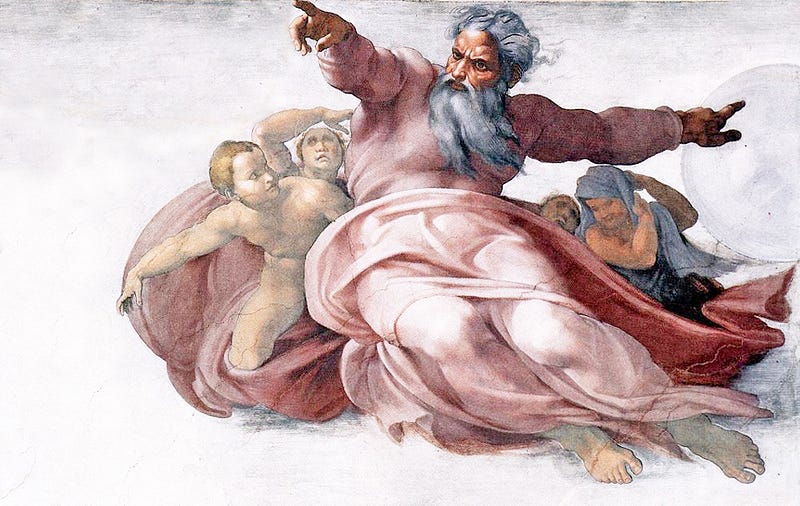
Creation of the Sun, Moon, and Plants, by Michelangelo (1508–1512)

The other extreme is a nebulous Cosmic Energy, Formless Love transcending this existence as we know it. I side more with the latter — and even beyond that, the further I get into mysticism and nonduality via Advaita Vedanta and A Course In Miracles, the more I start to understand that God is actually the only Reality… with everything else being a projection of our Mind, seemingly-endless layers of substance-less form, a dream brought about by the “tiny mad idea” of separateness… okay we’ll get there.
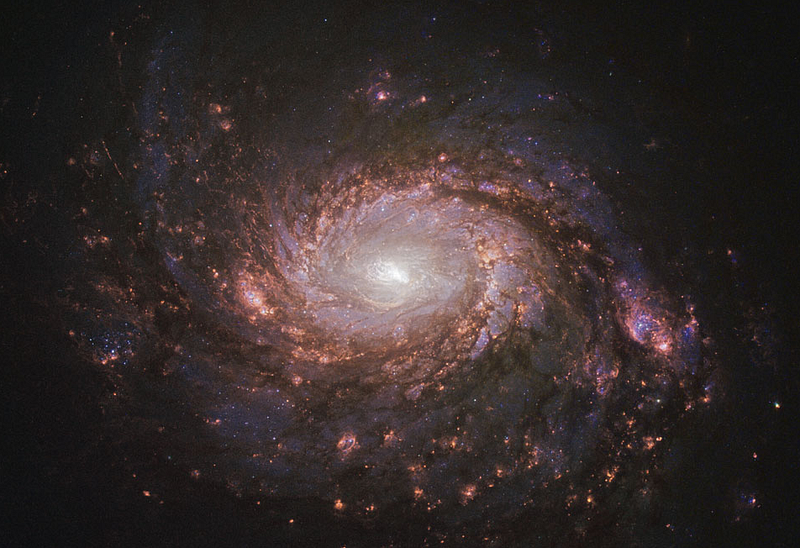
M77: Spiral Galaxy with an Active Center, Hubble, NASA

In a certain way, monotheism could be considered the beginning of the journey towards nondual mystical spirituality. Monotheism is dualism, really, because what it maintains is that God exists as a single entity, and the rest of us are here down on earth. While every religion’s mystics blur these theological lines, the three Abrahamic religious institutions (Judaism, Christianity, Islam) are ultimately monotheistic. For example if you’re a Christian: God sent his Only Son once, along with a few prophets, but otherwise God is pretty removed from the situation. At least in proximity. There’s variance within that of course, but the point here is that within monotheism, God is distinctly separate from us.
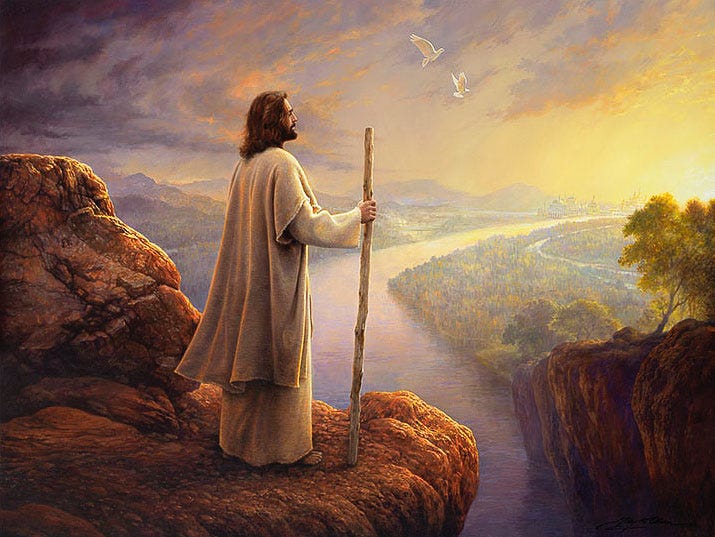
“Jesus on the horizon”, by Greg Olson

Despite this separation, it would be unfair to not mention the extent of their adoration for Him. Islam in particular has “99 Attributes of Allah”, from All-Compassionate, to The Giver of Peace, to the All-Seeing, to The Just, to Giver of Life and Bringer of Death.

And I can’t exclude the name He gave Himself, upon Moses’ inquiry — in Exodus, a book holy to all three Abrahamic religions, Moses asks what he should say to his tribe, to Whom was he speaking? The reply received was, “I AM THAT I AM.” Adding, “Say this to the people of Israel, ‘I Am has sent me to you.’”

Pantheism has an interesting take, expanding that framework a bit further. God exists, yes, but not in one concentrated place, rather within all things. Everything you see is God, or godlike, according to Hinduism, as well as a variety of tribal, shamanistic beliefs. The Vedic religion of ancient India certainly has a tribal aspect to it and pantheism is a doctrinal overlap with many of the non-Abrahamic religions.

Where can we go to find God, if we cannot see Him in our own hearts, and in every living being? — Swami Vivekananda

Hinduism is considered pantheistic, but has more difficulty being considered polytheistic (many gods). While there are thousands, if not millions of separate gods in the Hindu pantheon, they all emanate from Brahman. This is extremely important. They are all masks of the One. The famous scholar Max Müller and others have referred to this ideology as henotheism — many iterations of the one God.
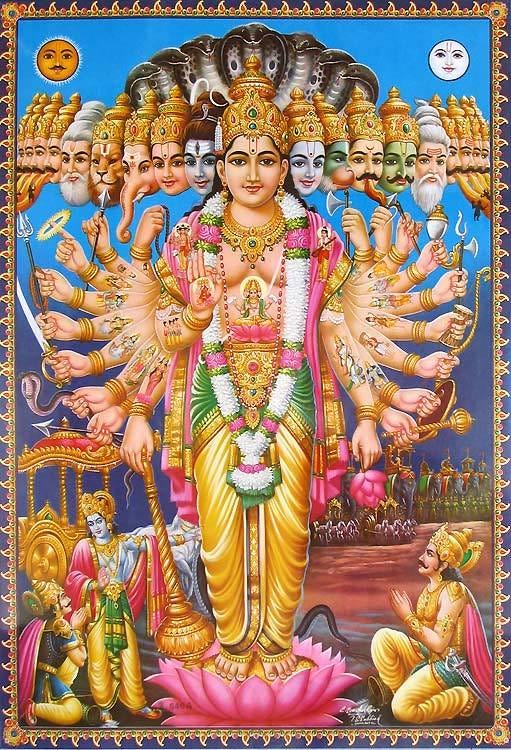
Viraat Purushan-Vishnuoopam” portrayal of Vishnu as Krishna as a thousand avatars

The term “panentheism” was expanded upon by a philosopher named Charles Hartshorne, (a student of both Martin Heidegger and Alfred North Whitehead) making the jump from standard pantheism “god is in all things”, to a new definition that includes transcendence. The “en” after “pan” indicates that not only is God everywhere, but also beyond time and space as well as within it. In my film, The Kingdom Within, Dr. Stephen Phillips makes the analogy for panentheism as follows: “As human beings transcend our bodies by doing yoga and other spiritual practices, so does God transcend the universe.”
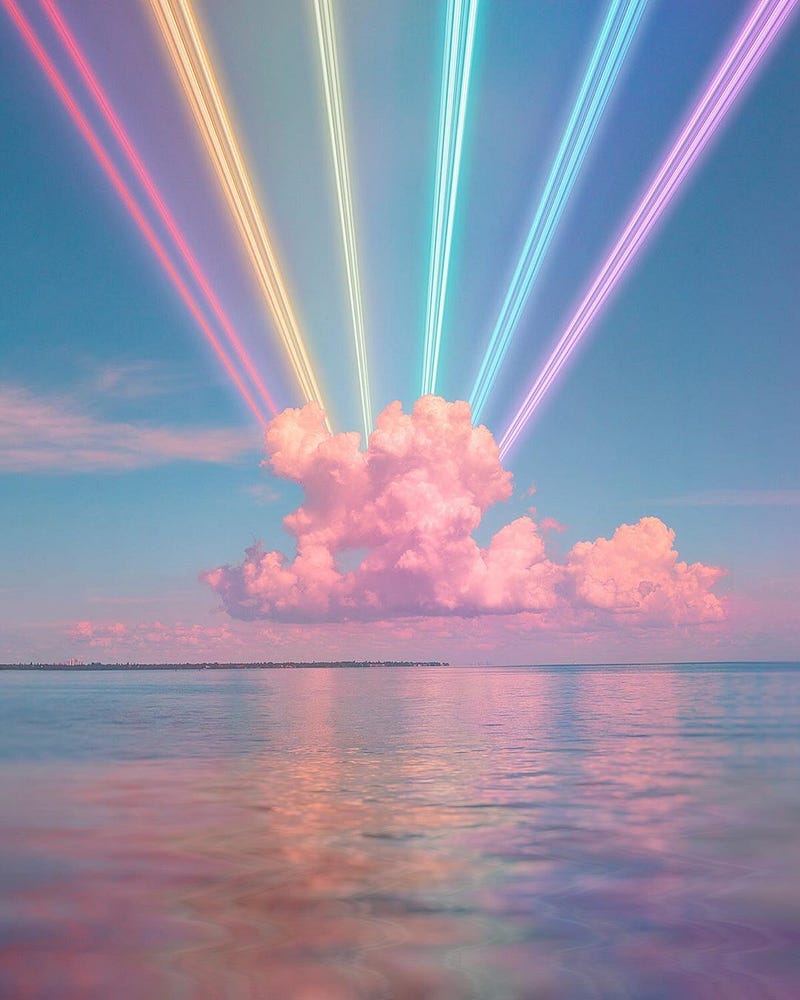
by cnikarts

Native American tribes have several names, many of which I find lovely: “Creator”, “The Great Spirit”, “The Great Mystery”.

Aristotle wrote about a “Prime Mover” or “Unmoved Mover”, the translation being “that which moves without being moved”.

Zoroaster used the name Ahura Mazda meaning “Wise Lord”.

Rumi and the Sufis spoke of God as “The Beloved”, from the perspective of a lover.

Guru Nanak of Sikhism uses the symbol Ik Onkar meaning “One All Pervading Spirit”.

Mahavatar Babaji, the timeless Hindu sage refers to “The Infinite Current”.

Baha’is refer to God as many names but their most cherished name is “All-Glorious” or Bahá in Arabic.

In Subud, “The Great Holy Life Force”.

Emerson and the Transcendentalists called God the “Over-Soul”.

Carol Howe and the A Course in Miracles crowd often substitutes the usage of the word “God” for simply “Love”. So instead of Lesson 29: “God is in everything I see”, the phrase “Love is in everything I see” is a perfect substitution.

Madame Blavatsky had a variety: “Incomprehensible, Unknown and Unnamed”, “The One and Secondless Principle in the Universe”, the “Rootless Root of All”.

Lao Tzu called it the Tao, or “The Way”, writing:

There is a thing inherent and natural, which existed before heaven and earth. Motionless and fathomless, It stands alone and never changes; It pervades everywhere and never becomes exhausted. It may be regarded as the Mother of the Universe. I do not know its name. If I am forced to give it a name, I call it Tao, and I name it as supreme.

by Elijah Hiett

Adi Shankaracharya, the Advaita master, refers to God as the “Supreme Self”:

Like bubbles in the water, the worlds rise, exist, and dissolve in the Supreme Self, which is the material cause and the prop of everything.

There’s also a movement within New Age circles to refer to God as a Her — an idea so ancient that it dates back to the earliest relics of civilization.
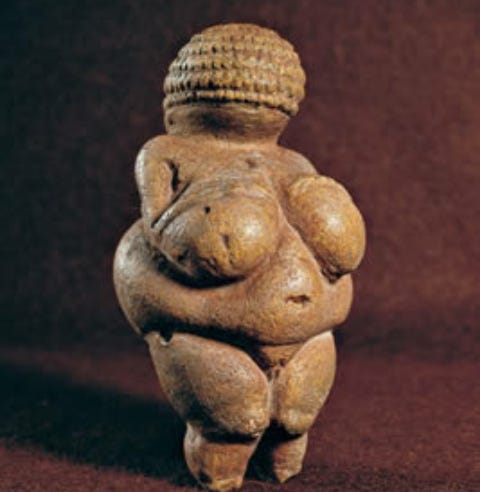
The Venus of Willendorf, Fertility Symbol, 30000–25000 B.C.E.

It certainly seems strange that we would consider the One That Birthed The Cosmos to be a male… as birthing anything is the defining characteristic of femininity. Archaeologists have found hundred-breasted idols dating back to before the modern patriarchal civilization as we know it, which begs the question: What could be more sacred than the life-giving aspect of the female?

My Apache teacher, Richard, prays to “Mother-Father-God”, paying respects to both aspects of our parental Creator. As these common parallels are no longer surprising… this is the same translation of the name for God in the Tamil Nadu branch of Shaivism (Hindu).

It’s easy to get lost in the isms.

While it can be helpful to understand the sheer spectrum of the word “God”, ultimately too much obsession over the word, or the form, fixates us on something finite.

Anything finite is destructible by definition and, according to the mystics, consequently unreal. The Source of All Creation is ultimately ineffable — it cannot be contained by words alone.

Hindu sadhu performing rituals in Varanasi, India by Joey L.

Even William Winwood Reade in his humanist, rational-thinking “secular Bible” The Martyrdom of Man, writes:

The Supreme Power is not a Mind; not a Force; not a Being; but something higher than a Being; something for which we have no words, something for which we have no ideas.

While there are five major religions in the world: Judaism, Christianity, Islam, Hinduism, and Buddhism, there are dozens if not hundreds of other faith traditions as well. And within the main five, there are hundreds if not thousands of sectarian divisions within each central faith.

So pick one, or many, or honor every variation, or reject them all.

Just know that the angry old Italian man on the ceiling of the Sistine Chapel doesn’t quite cover it.

Further reading: Anthology of Living Religions (Fisher) From Jesus to Christianity (White) The Perennial Philosophy (Huxley) Isis Unveiled (Blavatsky) American Veda (Goldberg) Ineffability (Kalmanson, Knepper)

Religion
Spirituality
Mysticism
Theology
Insights
Recommended from ReadMedium