
New methods of Entrepreneurship: An industrial driver of innovation
“The Start-Up Factory” (Pearson, Dec 2018) at a glance
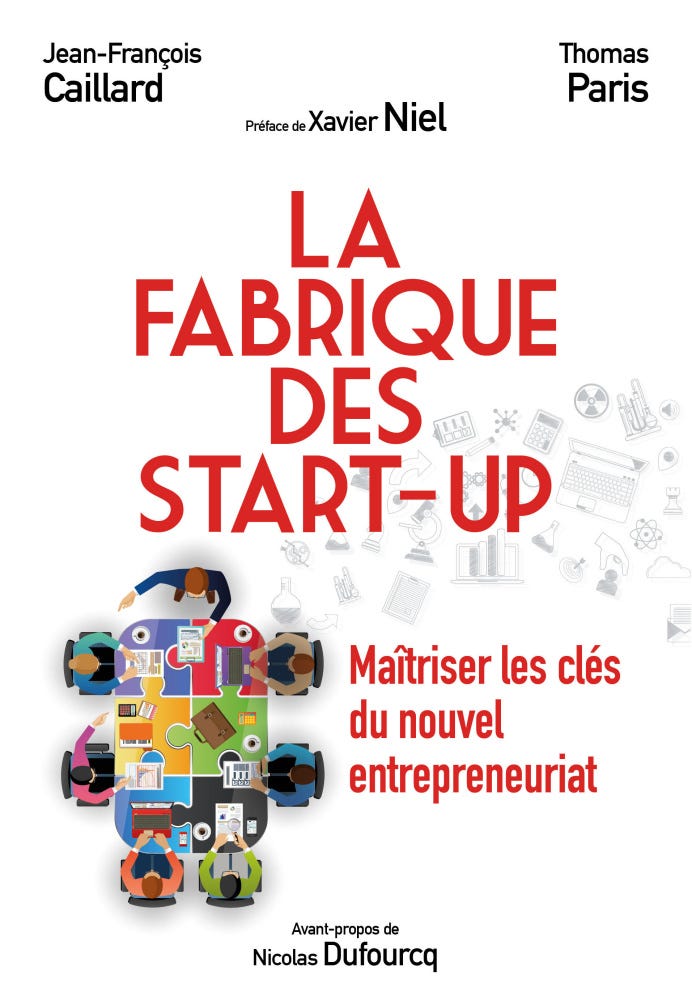
“Entrepreneur” is a word that appeared in France in the Universal Dictionary of Commerce in 1723. And yet it is only in the past dozen or so years, thanks to reproducible and proven methods, that entrepreneurship has become an industry: costs have decreased sharply, massive amounts of funding have become available, and millions of participants have become involved — all resulting in profound impacts on the economy, and society itself.
Historians will remember a profound change in the economy at the beginning of the 21st century in the form of the “digital revolution”, where the dominant economic players no longer came from the fields of Energy or Industry; instead, it was the famous GAFA (Google, Apple, Facebook, Amazon) in Western countries and BATX (Baidu, Alibaba, Tencent, Xiaomi) in China that became the major players. This revolution is as profound as the industrial revolutions of the nineteenth century or the invention of printing at the beginning of the Renaissance — but over a much shorter timeframe. And this is only the beginning.
Millions of entrepreneurs launch their start-ups every year, with very low entry costs, proven methods, and huge ambitions. This entrepreneurial revolution has its bible, The Lean Start-Up, which details a proven method: First, identifying a problem to be solved on a large target market; second, sourcing the needs and perceptions (“insights”) of users. This sourcing then leads to prototyping and launching a first testable version (“Minimum viable product”) to validate through iteration that the market need is being met (“Product/Market Fit”); and lastly, the reproducible recipes thereby generated are used to scale the product as fast as possible. New start-ups are quickly taking as the costs of building digital applications have plummeted. These new businesses are redefining value chains by shaking up spectacularly established players: Uber is replacing taxis in the same way that Airbnb is replacing hotels and Netflix is preferred over standard TV. Start-ups are born in all areas of activity, because all value propositions can be improved, either from a technological perspective or from an observation of the target’s expectations (thanks in particular to the “Design Thinking” method).
Innovation and entrepreneurship often come out of business or engineering schools. With famous and successful examples of entrepreneurs like Elon Musk, students are pursuing start-ups at an accelerated pace despite high failure rates. The process of founding a start-up is now well-established and provides an outlet for creative energy while remaining effective as a business method. The proof: Y-Combinator has facilitated initial funding of more than 100 billion dollars to thousands of start-ups in the US, thereby accelerating the production of ideas into businesses. In Berlin, the start-up studio Rocket Internet is worth over EUR 4 billion thanks to success of businesses they have launched like Zalando. In Paris, eFounders launched a dozen start-ups, raising more than EUR 120 million. They are the most advanced form of this industrialization, which mobilizes talents and works on standardized schemas to make the process reproducible on a larger scale.
Innovation investment funds have also contributed to the success of start-ups. These funds invested more than USD 100 billion in the US in 2018. Start-ups test a considerable number of value propositions every year; more and more are proving viable because of the industrialization of the sector.
Accelerating the pace of innovation and impact on large companies
Large companies have no choice but to respond to the speed of these challengers. They cannot model their entire operations on start-ups that have nothing to lose, but they can rely on them, be inspired by them, or acquire them. The GAFA showed that one could be big and keep the advantages of a start-up: speed, attractiveness and commitment of talent, risk taking, and more. Many large companies adopt their recipes, which apply different principles: integration of the risk of failure, open frameworks, flat organizational charts, employee empowerment, employee organization in short and multidisciplinary teams.
Some companies are also placing greater importance on activity based on customer observation, iterative and short development cycles (the Agile methodology), and opening up customer-focused process innovation through collaboration with start-ups and other innovative organizations (“open innovation”). They are also using the tools of start-ups: incubators, accelerators, corporate venture capital funds, or start-up studios. Intrapreneurship (the creation of start-ups by employees) is one of the most value-creating areas, but it takes time and requires a specific type of organization, the staking of funding, a well-framed acceptance of risk, and the integration of complicated components into an organization that is usually inherently a waterfall organization.
GV, formerly Google Ventures, is one of the 3 most active funds in the US. Google buys a dozen start-ups a year, yet has created Area 120, one of the largest intrapreneurship studios in the world.
Commonalities abound between start-up creation and creative industries
This process of structuring can be compared to the creative industries — a wide range of industries focused on creative activity, including cinema, fashion, architecture, design and video games, that have had their own structure for many years. Far from their sometimes romantic image, they are collective and structured, rely on mature organizations and processes, and are one step ahead of their project and talent management. These established creative industries have much to teach the new entrepreneurship, because they manage to preserve their creativity by multiplying projects while balancing between size and creativity. These industries manage the intuitive and subjective dimension necessary to create but still maintain the structured dimension necessary to execute. They structure reproducible patterns that preserve the place of creators and their freedom by being part of necessarily collective processes.
Moreover, they integrate inevitable failure into their process and demonstrate that innovation is compatible with a form of industrialization: it is this process that allows very talented architects like Jean Nouvel, for example, to participate in dozens of projects around the world. Likewise, a video game publisher like Ubisoft has the ability to identify nuggets in independent production and guide them through their development and promotion to make them successful. In either case, it is a matter of articulating methods and processes with the talent of individuals to identify or launch new projects. The start-up economy is following in the footsteps of the creative economy, in which a select number of large trans-national corporations coexist with a multitude of small, innovative, and fragile structures that nurture creativity.
“Change is the new normal”
This industrialization, which characterizes the 21st century so well, inevitably leads to strong acceleration in innovation. Innovation goes hand in hand with great unpredictability. Entrepreneurship is its main vector and is continuing to gain momentum. There is no other option but to know the right tools and methods. This industrialization may also achieve great successes in large groups where start-up acquisitions and the use of entrepreneurial methods still have a long way to go.
About the authors
- Jean-François Caillard has contributed to scale several successful start-ups and he is a former innovation director in large international groups
- Thomas Paris is a professor (HEC Paris) and researcher (CNRS)
- Forewords by Xavier Niel, billionaire entrepreneur, founder of Free, and by Nicolas Dufourcq, CEO of BPI, world’s largest sovereign fund
_____
Related articles from the author
In preparation of a Post Corona Crisis (Forbes, April 2020)
After a record breaking year, how should you invest in start-ups in 2019? (Forbes, February 2019)
Blockchain, the rupture potential of a technology (Forbes, Feb 2018)
«Blue Ocean Shift», the sequel to the bestseller on innovation (Forbes, December 2017)
Why is the Corporate Venture growing so fast? What are the keys? (November 2017)
Liked the first digital revolution: you’ll love the second (Sept 2017)