avatarMarlieke Kieboom

Free AI web copilot to create summaries, insights and extended knowledge, download it at here

6892

Abstract

ex, societal challenge. Last year nearly <a href="http://www.cbc.ca/news/politics/opioid-death-toll-marketing-1.4712419">4.000 people succumbed to an opioid drug overdose in Canada</a>. To uncover positive pathways forward one has to simultaneously address the complex, <a href="https://www.cbc.ca/radio/ondrugs/the-opioid-overdose-crisis-was-thousands-of-years-in-the-making-1.4642003">interconnected roots</a> of the opioid crisis as well as try and curb the immediate negative outcomes on the ground. Social labs can help to find ways to redirect the conversation at a societal level, away from criminalization and the war on drugs and towards how people <a href="http://www.cbc.ca/news/canada/nova-scotia/nova-scotia-opioid-stigma-campaign-1.4688523">stigmatize</a> each other and how modern society perceives and handles physical and emotional pain. For example, it means designing new policies that <a href="http://www.cbc.ca/news/politics/opioid-death-toll-marketing-1.4712419">restrict pharmaceutical companies</a> from influencing public health practitioners, or that encourage media to stop stigmatizing people who use drugs. It means diversifying public services (like <a href="http://www.cbc.ca/news/canada/london/london-ontario-safe-consumption-sites-1.4634957">supervised consumption sites</a> in residential buildings) and innovating new services (like <a href="http://www.cbc.ca/news/canada/edmonton/grief-therapy-peer-support-groups-because-of-opioid-crisis-1.4693388">grief therapy</a>). And while the inventions of technology driven labs have saved lives (for example by developing <a href="https://www.scientificamerican.com/article/1-fentanyl-test-strip-could-be-a-major-weapon-against-opioid-ods/">Fentanyl</a> test strips or the opioid antidote <a href="https://www.huffingtonpost.com/tessie-castillo/meet-jack-fishman-the-man_b_6329512.html">Naloxone</a>), it is important to note that they treat the effects of the crisis, not the roots.</p><p id="5e7f">In this context an ongoing and imperfect process of exploring, proposing, probing within social labs makes perfect sense. Not one single action of one tech or social innovation lab will eventually take credit for bringing the opioid death toll down, just like no single action was culprit to creating the situation. But the fact that we can’t control and measure social lab interventions like we can products invented in tech labs makes us (or our funders) feel uneasy and make us obsess over capturing their impact in metrics.</p><p id="fa50">At “Converge” I hope we can accept the unease that may come with choosing to work on societal challenges and we can move beyond our seemingly permanent existential crisis on who we are or what we do. Let’s embrace our diversity, and let it play its natural key role in the emergence of new systemic interactions.</p><h2 id="110a">2. Let’s diverge on the how (… our lab methodologies)</h2><figure id="ef7e"><img src="https://cdn-images-1.readmedium.com/v2/resize:fit:800/1*Qbt3_FL-T1GdtFxCQaBuBQ.png"><figcaption></figcaption></figure><p id="72c3">As much as we may converge on the <i>who</i>, the <i>what</i>, and <i>for whom</i>, I hope we will diverge as much as we can on <i>how</i> we do things so that we can learn from each other’s successes and failures. Social innovation labs may be contentious by nature, but that is no excuse to be intentionally vague or unintentional in our approaches. By revealing how we work, in being concrete on how we move from A to B, and by showing actual artefacts and outcomes I hope we can gain feedback, knowledge and ideas on how to move forward in our practice.</p><p id="75b4">Personally it’s been 5 years since I entered the world of labs. I co-organized the first global lab gathering in Amsterdam (<a href="https://ssir.org/articles/entry/a_lab_of_labs">Lab2: Lab for Labs</a>), and it’s been 4 years since writing “<a href="https://www.kl.nl/en/publications/lab-matters-challenging-the-practice-of-social-innovation-laborat/">Lab Matters</a>” and booksprinting “<a href="https://www.kl.nl/publicaties/labcraft-innovation-labs-cultivate-change/">LabCraft</a>”, 3 years since co-developing Kennisland’s lab methodology “<a href="https://www.kl.nl/en/news/feed-forward-stories-re-designing-public-policies-services-through-knowledge-co-production/">Feed Forward Stories</a>”, 2 years since last actively managing labs on <a href="https://www.kl.nl/publicaties/onderzoek-en-beleid-met-burgers/">co-designing city policies with citizens</a> and 1 year since I left the ‘labbed world’ in the Dutch non-profit sector to focus my efforts on <a href="https://www2.gov.bc.ca/gov/content/governments/services-for-government/service-experience-digital-delivery/service-design">service design</a> in the Canadian public sector. If one were to oversimplify complex adaptive systems as things with boundaries that we could cross, one may say i’ve moved from working ‘in between citizens and the system’ to working ‘inside the system’.</p><figure id="7478"><img src="https://cdn-images-1.readmedium.com/v2/resize:fit:800/0*CrSFBBP2wYpdTUy1"><figcaption>Example of a lab methodology: Feed Forward Stories. What is yours? (<a href="https://www.kl.nl/en/news/feed-forward-stories-re-designing-public-policies-services-through-knowledge-co-production/">Kennisland, 2015</a>)</figcaption></figure><p id="e2fd">The great thing about leaving a scene and entering another is that it enables you to critically reflect, compare and learn. I’ve come to the conclusion that leading a service design project for the British Columbia government isn’t too different from leading a social lab for the Dutch government. The process roughly follows the same iterative, non-linear design flow, starting with alignment and research, then moving into prototyping and implementation.</p><p id="52ca">However where my old and previous work scenes diverge is in their approach and underlying assumptions of how change happens. For example, working with people with lived experience on the topic of interest as equal, paid team members (aka ‘peer researchers’) was something common in my Dutch lab context, while it is new in the service design context in the B.C. Government, and possibly in the service design context at large. Vice versa, the political alignment practices of my government service design team are far more developed and advanced than I ever even thought of in my Dutch social labs. And it’s been much more challenging to convene a diverse set of (non-government) stakeholders inside government processes than in social lab processes outside government. I am wondering, why?</p><p id="954e">So what can we learn from each others thinking and doing at Converge? Are there new tools or methodologies that facilitate breaking away from our own patterns?<b> </b>When does a methodology restrict, instead of liberate systemic issues? I’m looking for

Options

ward to hearing the latest developments and trends in our field, especially around <a href="https://www.epicpeople.org/book-review-ethnographic-thinking/">design anthropology</a>, <a href="https://readmedium.com/questions-about-systemic-design-c0aa7e2bc380">systemic design</a> and the role of stories and ‘<a href="https://hackernoon.com/warm-data-9f0fcd2a828c">warm data</a>’.</p><h2 id="7413">3. Let’s converge on the where (…to make an impact and embrace the lab limbo)</h2><figure id="4251"><img src="https://cdn-images-1.readmedium.com/v2/resize:fit:800/1*PLAQ8SfHpHIkU1DmQ3Wt0A.png"><figcaption></figcaption></figure><p id="e007">At Converge I hope we converge on where we can (and should) make an impact, and where we can’t.</p><p id="578d">The bottom line for a social lab’s impact is pretty simple: social labs aim to support humans / people / citizens / end-users in living their best lives. But in order to do so labs have to operate at a systems level (consisting of institutions, processes, beliefs and value sets), the same systems that quite possibly brought about the problems labs are trying to fight, or even more complex: they finance our labs. When moving human-centred work of labs into boardrooms, log frames, metrics, post-its and ego’s can then easily wipe out or warp all human aspects and aspirations of innovation and experimentation efforts. It’s what i’d call ‘the lab limbo’ and I hope we can actively embrace it.</p><p id="ef0c">How can labs keep themselves grounded, and keep enabling different outcomes on the ground for-with people while operating on a systems level, in dominant systems that ever so often try to eliminate the proposed change? Escaping the lab limbo might not ever be possible, unless we start labs on Mars. However there are a variety of things we can do to counteract its influence:</p><ul><li>Hire a peer researcher (people with lived experience on the issue you are working on) onto your lab team to keep tight connections with the field and hold yourselves and the system continuously accountable for ensuring the best outcomes on the ground. Peer researchers can help transcend political power dynamics and show new realities.</li><li>Hardwire cross-organizational collaboration into your lab design <i>from the start</i> (for example in its governance and finance model) to foster collaboration and avoid singular institutional dominance.</li><li>Ensure that opportunity-generating processes convene ideas from people in the field, and from people operating on the fringes of a failing system (for example community action groups, burnt-out service providers). Their ideas might be bolder and less dominated by ‘the system’ then ideas generated in decision makers’ boardrooms.</li><li>Learn from age-old change management practises like <a href="https://www.bispublishers.com/designing-within-public-organizations.html">the art of ‘context building</a>’. New ideas might be too bold to instantly land in the executive realm, therefore mastering strong alignment practices is key.</li><li>Apply a post-colonial lens to your lab practices as “<i>design may be complicit in supporting elites</i>” (<a href="https://digitalcommons.wpi.edu/cgi/viewcontent.cgi?referer=https://readmedium.com/questions-about-systemic-design-c0aa7e2bc380&amp;httpsredir=1&amp;article=1093&amp;context=oa">Otto von Busch and Karl Palmas</a>, 2016). Design thinking risks to adopt “<i>the ethnographic gaze of the late nineteenth / early twentieth century anthropology</i>”, argues Jay Hasbroeck (<a href="https://www.epicpeople.org/book-review-ethnographic-thinking/">2018</a>). “[<i>Design Thinkers] frame their inquiries solely in terms of extracting data from consumers.… They seek to uncover ‘hidden’ behaviors and ‘unmet needs,’ capture them, and bring them back to headquarters where others can marvel over these exotic treasures from the field.”. </i>This <a href="https://www.themandarin.com.au/79865-govt-co-design-not-equal-partnership-aboriginal-health-ceo/">article</a> on design for (not with or by) First Nations — aboriginal communities in Australia is illustrative: “<i>Co-design with community groups cannot work if government asks for input after the big decisions have already been made or rush consultation” (..) “Without systematic change in mainstream attitudes and practices, and incorporation of Aboriginal peoples in all stages of policy design, health policies will remain unproductive.</i></li></ul><p id="601d">What are your ideas to embrace the lab limbo?</p><h2 id="b5b1">4. Let’s diverge on the why the hecks (.. our lab critiques)</h2><figure id="b299"><img src="https://cdn-images-1.readmedium.com/v2/resize:fit:800/1*lnhhsfd4qPUyV8OXV6Lu2Q.png"><figcaption></figcaption></figure><p id="b7a6">At Converge we’re invited to an honest, safe and conversational place. For once we don’t need to sell or prove ourselves or the social lab ‘brand’ to funders or executives. Therefore I hope that we’ll feel invited to openly put our doubts and assumptions out there, and agree to respectfully disagree with one another as much as we can to further our practice.</p><figure id="99a7"><img src="https://cdn-images-1.readmedium.com/v2/resize:fit:800/1*jPAaW_jF0T10o_49jFE-xA.png"><figcaption>“Bla bla bla — lab lab lab. Let’s have sharp conversations!” (image designed by me, illustration modified from: National Film Board Canada — bla bla production <a href="http://onf-nfb.gc.ca/en/press-room/photo-gallery/new-releases-2/?film_id=553664">http://onf-nfb.gc.ca/en/press-room/photo-gallery/new-releases-2/?film_id=553664</a>)</figcaption></figure><p id="5c78">But let’s be nuanced in our disagreements, keep questioning each other on grand systems change claims and let’s not eschew the political aspect of our labs work. What is the role of social labs in the current immigrant crisis at the Mexican border? Is there a role for social labs? That’s a difficult question, but that doesn’t mean we shouldn’t seek answers.</p><p id="47eb">And, last but not least, let’s be critical readers and writers. Reading and writing critical literature about social lab theory and practice is vital to advancing our work field, yet I have seen very little of it lately. Was last year’s ‘<a href="https://provocations.darkmatterlabs.org/the-challenge-of-public-innovation-labs-58020c7be7ea">The Challenge of Public Innovation Labs</a>’ by Indy Johar the last piece? C’mon Converge, we can do better than that. Let’s write up and share our insights and thoughts after the event.</p><p id="3020">Ok, that’s my two cents, labbers. Congrats on making it to the end of my ramblings. See you at Converge (or Twitter @marli_k) !</p><p id="ba80"><b><i>(Update July 12th 2018: Read my follow-up blog “Converging and Colliding, Together — <a href="https://readmedium.com/converging-and-colliding-together-47630c461f30">here</a>!)</i></b></p></article></body>

Exploring New Labscapes: Converging and Diverging on Social Innovation Labs
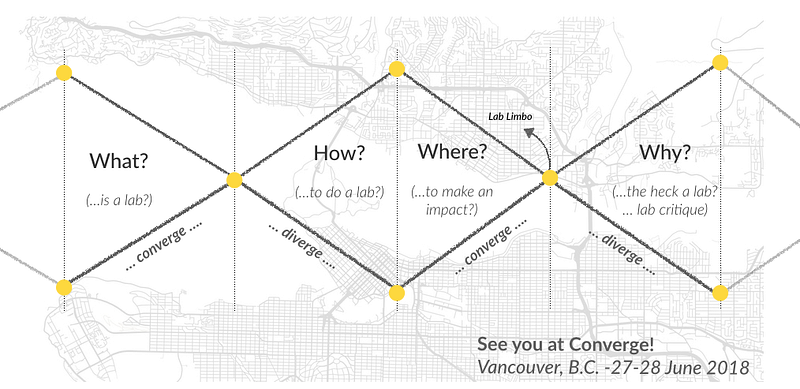
‘Converge’ is coming up in Vancouver this week. The event brings 100 Canadian ‘social innovation lab practitioners’ together for 2 days to discuss all things ‘lab’.

I always look forward to these kind of events. Working in the ‘lab trenches’ can feel like a never ending battle in the vast, muddy field called ‘social innovation’. We work away endlessly to create “little epiphanies that represent down payments to transformative possibilities” (Unger, 2013) but are plagued by misunderstandings, upstream resistance and setbacks. Events like these wipe the mud of our visors and reveal new ‘labscapes’ by reflecting and reuniting with like minded folks driven to make a societal impact for people of all walks of life. It’s a community with which to share stories, hearsay, trials and tribulations. And, more importantly, it’s a place to exchange knowledge, methods and lessons learned to avoid wasting resources in replicating efforts and conversations. Thank you for convening the pan-Canadian lab community, Radius SFU and McConnell Foundation a.o.!

But what shall we converge on at Converge? And maybe more importantly, where do we, will we, or should we diverge? In this blog I reflect upfront on the ever so intriguing lab concept and propose 4 topics to converge/diverge upon. What are yours? Looking forward to the conversation at Converge!

(Update July 12th 2018: Read my follow-up blog “Converging and Colliding, Together — here!)

1. Let’s converge on the what (… the social lab concept)
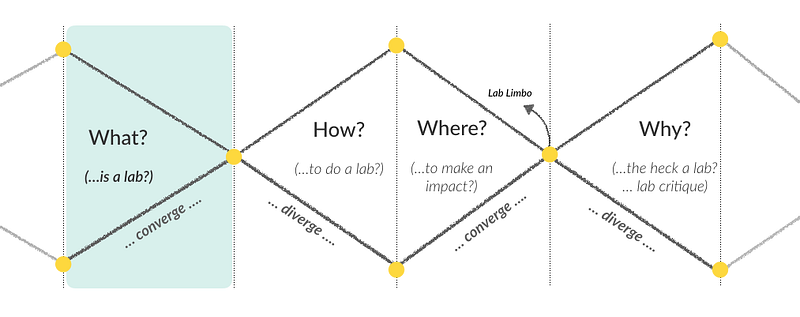
The question ‘what is a (social innovation) lab?’ is as old as the lab community itself and seems to return at every (social innovation) lab gathering. It came up at the very first event of its kind (Kennisland’s Lab2: Lab for Labs, Amsterdam 2013) and has been debated at every consequent event ever since under hashtags like #socinnlabs, #sociallabs and #psilabs (see MaRs’s Labs for Systems Change — 2014, Nesta’s Labworks — 2015, EU Policy lab’s Lab Connections — 2016 and ESADE’s Labs for Social Innovation — 2017).

However, the concept has remained roughly the same since we saw the first wave of labs (Helsinki Design Lab, MindLab and Reos’ Change Labs) in the early 2010’s. Social innovation labs are permanent or short term structures/projects/events that use a variety of experimental methods to support collaboration between stakeholders to collectively address social challenges at a systemic level. Stakeholders range from citizens and community action groups to businesses, universities and public administrations. Their specific characteristics (e.g. developing experimental user-led research methods, building innovation capacity building, convening multi-disciplinary teams, working to reach scale) and shapes (public sector innovation labs, social innovations labs, digital service labs, policy labs) are well described in many publications (e.g. Lab Matters, 2014; Labs for Social Innovation, 2017).

As Nesta neatly shows innovation labs are part of a family, or a movement of connected experimental, innovative approaches like service design, behavioural insights, citizen engagement, and so on.
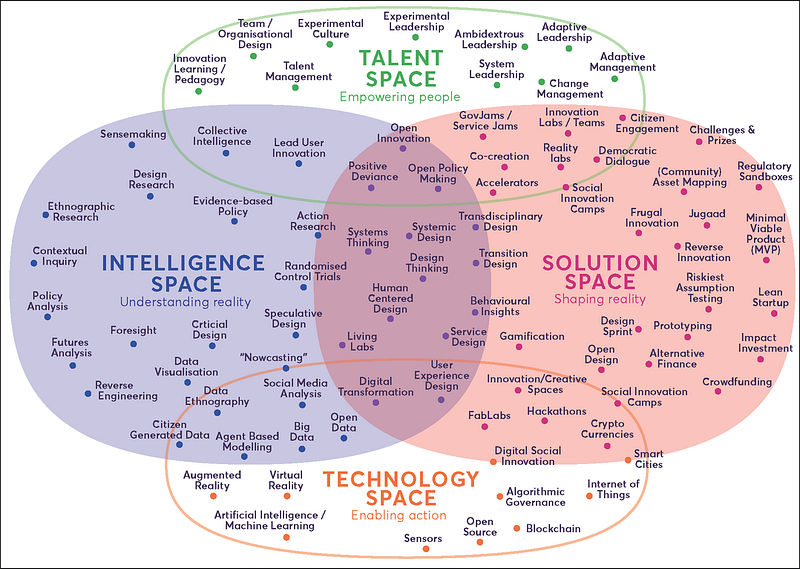
Spot the labs (Source: https://www.nesta.org.uk/blog/landscape-of-innovation-approaches/)

So why does this question keep coming back? The roots of the confusion and debates may lie in the word ‘social’. The medical, technological, and business sectors know exactly what they aim for in their innovation labs. They are ‘controlled-for’ environments where experimentation leads to developing, testing and scaling futuristic (mostly for profit) products, like self-driving cars, cancer medicines, drug test strips and cultured meat. Some of these products contribute to a more just, equal, sustainable world, while others don’t.

For working on societal issues like climate change, immigration patterns or a drug overdose crisis, lab settings are and should be unmistakably more open and porous. Complex, systemic challenges are impossible to capture between four lab walls, nor should we even try as they arguably arose from isolated, closed, and disconnected socio-economic interactions. Value creation for these type of challenges therefore lies outside closed, competitive, measurable spaces: in forging new collaborations, open-sourcing methodologies, encouraging curious mindsets and diversifying social movements. Consequently social lab outcomes are less measurable and concrete, ranging from reframing existing (socio-cultural) paradigms, to designing new procurement procedures and policies, to delivering new (digital and non-digital) public services. Try to ‘randomize-control-trial’ that!

Let’s take the ongoing opioid crisis in Canada as an example of a complex, societal challenge. Last year nearly 4.000 people succumbed to an opioid drug overdose in Canada. To uncover positive pathways forward one has to simultaneously address the complex, interconnected roots of the opioid crisis as well as try and curb the immediate negative outcomes on the ground. Social labs can help to find ways to redirect the conversation at a societal level, away from criminalization and the war on drugs and towards how people stigmatize each other and how modern society perceives and handles physical and emotional pain. For example, it means designing new policies that restrict pharmaceutical companies from influencing public health practitioners, or that encourage media to stop stigmatizing people who use drugs. It means diversifying public services (like supervised consumption sites in residential buildings) and innovating new services (like grief therapy). And while the inventions of technology driven labs have saved lives (for example by developing Fentanyl test strips or the opioid antidote Naloxone), it is important to note that they treat the effects of the crisis, not the roots.

In this context an ongoing and imperfect process of exploring, proposing, probing within social labs makes perfect sense. Not one single action of one tech or social innovation lab will eventually take credit for bringing the opioid death toll down, just like no single action was culprit to creating the situation. But the fact that we can’t control and measure social lab interventions like we can products invented in tech labs makes us (or our funders) feel uneasy and make us obsess over capturing their impact in metrics.

At “Converge” I hope we can accept the unease that may come with choosing to work on societal challenges and we can move beyond our seemingly permanent existential crisis on who we are or what we do. Let’s embrace our diversity, and let it play its natural key role in the emergence of new systemic interactions.

2. Let’s diverge on the how (… our lab methodologies)
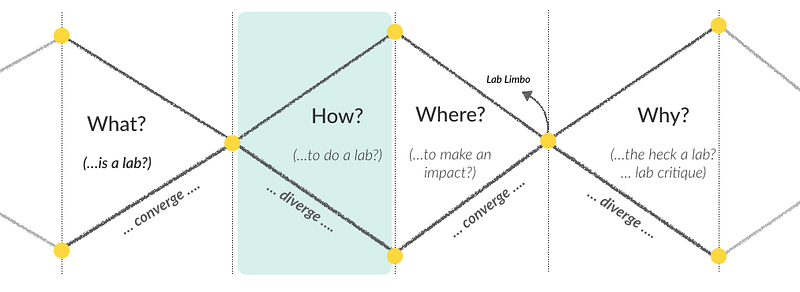
As much as we may converge on the who, the what, and for whom, I hope we will diverge as much as we can on how we do things so that we can learn from each other’s successes and failures. Social innovation labs may be contentious by nature, but that is no excuse to be intentionally vague or unintentional in our approaches. By revealing how we work, in being concrete on how we move from A to B, and by showing actual artefacts and outcomes I hope we can gain feedback, knowledge and ideas on how to move forward in our practice.

Personally it’s been 5 years since I entered the world of labs. I co-organized the first global lab gathering in Amsterdam (Lab2: Lab for Labs), and it’s been 4 years since writing “Lab Matters” and booksprinting “LabCraft”, 3 years since co-developing Kennisland’s lab methodology “Feed Forward Stories”, 2 years since last actively managing labs on co-designing city policies with citizens and 1 year since I left the ‘labbed world’ in the Dutch non-profit sector to focus my efforts on service design in the Canadian public sector. If one were to oversimplify complex adaptive systems as things with boundaries that we could cross, one may say i’ve moved from working ‘in between citizens and the system’ to working ‘inside the system’.
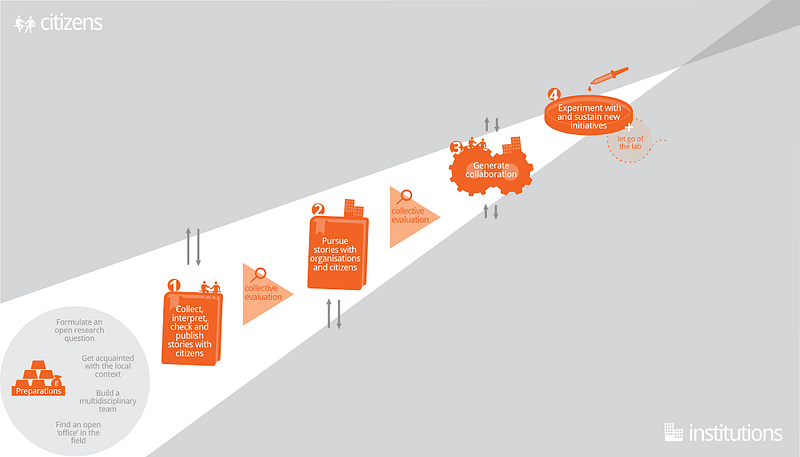
Example of a lab methodology: Feed Forward Stories. What is yours? (Kennisland, 2015)

The great thing about leaving a scene and entering another is that it enables you to critically reflect, compare and learn. I’ve come to the conclusion that leading a service design project for the British Columbia government isn’t too different from leading a social lab for the Dutch government. The process roughly follows the same iterative, non-linear design flow, starting with alignment and research, then moving into prototyping and implementation.

However where my old and previous work scenes diverge is in their approach and underlying assumptions of how change happens. For example, working with people with lived experience on the topic of interest as equal, paid team members (aka ‘peer researchers’) was something common in my Dutch lab context, while it is new in the service design context in the B.C. Government, and possibly in the service design context at large. Vice versa, the political alignment practices of my government service design team are far more developed and advanced than I ever even thought of in my Dutch social labs. And it’s been much more challenging to convene a diverse set of (non-government) stakeholders inside government processes than in social lab processes outside government. I am wondering, why?

So what can we learn from each others thinking and doing at Converge? Are there new tools or methodologies that facilitate breaking away from our own patterns? When does a methodology restrict, instead of liberate systemic issues? I’m looking forward to hearing the latest developments and trends in our field, especially around design anthropology, systemic design and the role of stories and ‘warm data’.

3. Let’s converge on the where (…to make an impact and embrace the lab limbo)
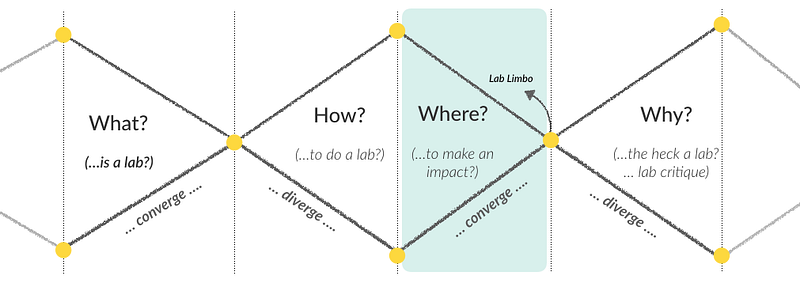
At Converge I hope we converge on where we can (and should) make an impact, and where we can’t.

The bottom line for a social lab’s impact is pretty simple: social labs aim to support humans / people / citizens / end-users in living their best lives. But in order to do so labs have to operate at a systems level (consisting of institutions, processes, beliefs and value sets), the same systems that quite possibly brought about the problems labs are trying to fight, or even more complex: they finance our labs. When moving human-centred work of labs into boardrooms, log frames, metrics, post-its and ego’s can then easily wipe out or warp all human aspects and aspirations of innovation and experimentation efforts. It’s what i’d call ‘the lab limbo’ and I hope we can actively embrace it.

How can labs keep themselves grounded, and keep enabling different outcomes on the ground for-with people while operating on a systems level, in dominant systems that ever so often try to eliminate the proposed change? Escaping the lab limbo might not ever be possible, unless we start labs on Mars. However there are a variety of things we can do to counteract its influence:

  • Hire a peer researcher (people with lived experience on the issue you are working on) onto your lab team to keep tight connections with the field and hold yourselves and the system continuously accountable for ensuring the best outcomes on the ground. Peer researchers can help transcend political power dynamics and show new realities.
  • Hardwire cross-organizational collaboration into your lab design from the start (for example in its governance and finance model) to foster collaboration and avoid singular institutional dominance.
  • Ensure that opportunity-generating processes convene ideas from people in the field, and from people operating on the fringes of a failing system (for example community action groups, burnt-out service providers). Their ideas might be bolder and less dominated by ‘the system’ then ideas generated in decision makers’ boardrooms.
  • Learn from age-old change management practises like the art of ‘context building’. New ideas might be too bold to instantly land in the executive realm, therefore mastering strong alignment practices is key.
  • Apply a post-colonial lens to your lab practices as “design may be complicit in supporting elites” (Otto von Busch and Karl Palmas, 2016). Design thinking risks to adopt “the ethnographic gaze of the late nineteenth / early twentieth century anthropology”, argues Jay Hasbroeck (2018). “[Design Thinkers] frame their inquiries solely in terms of extracting data from consumers.… They seek to uncover ‘hidden’ behaviors and ‘unmet needs,’ capture them, and bring them back to headquarters where others can marvel over these exotic treasures from the field.”. This article on design for (not with or by) First Nations — aboriginal communities in Australia is illustrative: “Co-design with community groups cannot work if government asks for input after the big decisions have already been made or rush consultation” (..) “Without systematic change in mainstream attitudes and practices, and incorporation of Aboriginal peoples in all stages of policy design, health policies will remain unproductive.

What are your ideas to embrace the lab limbo?

4. Let’s diverge on the why the hecks (.. our lab critiques)
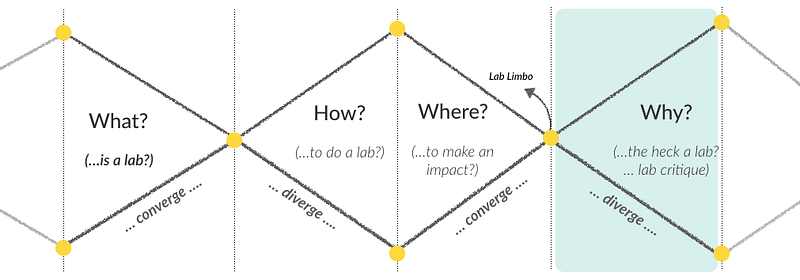
At Converge we’re invited to an honest, safe and conversational place. For once we don’t need to sell or prove ourselves or the social lab ‘brand’ to funders or executives. Therefore I hope that we’ll feel invited to openly put our doubts and assumptions out there, and agree to respectfully disagree with one another as much as we can to further our practice.
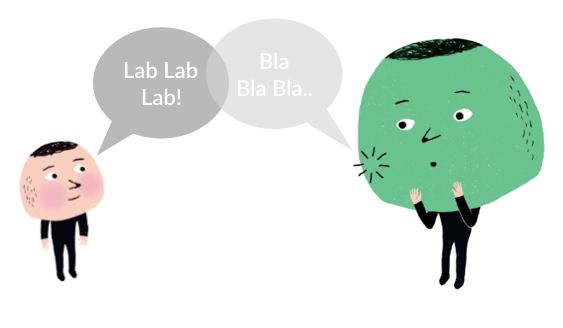
“Bla bla bla — lab lab lab. Let’s have sharp conversations!” (image designed by me, illustration modified from: National Film Board Canada — bla bla production http://onf-nfb.gc.ca/en/press-room/photo-gallery/new-releases-2/?film_id=553664)

But let’s be nuanced in our disagreements, keep questioning each other on grand systems change claims and let’s not eschew the political aspect of our labs work. What is the role of social labs in the current immigrant crisis at the Mexican border? Is there a role for social labs? That’s a difficult question, but that doesn’t mean we shouldn’t seek answers.

And, last but not least, let’s be critical readers and writers. Reading and writing critical literature about social lab theory and practice is vital to advancing our work field, yet I have seen very little of it lately. Was last year’s ‘The Challenge of Public Innovation Labs’ by Indy Johar the last piece? C’mon Converge, we can do better than that. Let’s write up and share our insights and thoughts after the event.

Ok, that’s my two cents, labbers. Congrats on making it to the end of my ramblings. See you at Converge (or Twitter @marli_k) !

(Update July 12th 2018: Read my follow-up blog “Converging and Colliding, Together — here!)

Social Innovation
Social Labs
Systemic Change
Service Design
Public Sector
Recommended from ReadMedium