
New Era Defined by the Idea of Decentralization
Decentralization of everything. Is this a strategy, or just waste of time?
Since the dawn of civilization, societies have dealt with the advantages and disadvantages of centralization. Short-term centralization helps get things done faster, yet long-term decentralization is the key to scale and stability.
Decentralization is not just about blockchain; it is also a trend in workplaces, government, software, and business development. It is the process of dispersing decision-making authority among people, citizens, employees, applications, components, or other elements of an organization or architecture.
Decentralization enables the democratization of the world’s most valuable resources

I would like to summarize decentralization in:
- Software Development is Agile
- Financial Transactions is DeFi
- Artificial Worlds is Metaverse
- Software Development is Open Source
- Application Services is SOA(Service Oriented Architecture)
- Software Applications is Microservices
- Online ecosystem based on blockchain is Web3
- Governments is subordinate, quasi-independent authorities
- Business is Outsourcing and Gig Economy
Agile Teams
The pandemic has forced the transition to virtual work for many organizations, making it necessary to explore its possible effects on self-organizing agile teams. Ideally, distributed agile teams should adopt robust methods and practices and scale them across their organizations.
Agile teams are self-organizing and cross-functional — they choose how best to accomplish their work, rather than being directed by others outside of the team. It’s an environment in which employees feel empowered and have control over the work they perform, allowing them to have more fun.
DeFi — Financial Transactions
Decentralized Finance (DeFi) is an emerging financial technology based on secure distributed ledgers similar to those used by cryptocurrencies. The aim of decentralized finance is to create an entirely new financial system.
Decentralized finance uses the blockchain technology that cryptocurrencies use. With DeFi, the markets are always open and there are no centralized authorities who can block payments or deny you access to anything.
Decentralization of Metaverse
Conceptually, the Metaverse is decentralized. But for now, as with Web 2.0, it is still owned or controlled by a few companies.
As new entrants to the market carve out a vision for the Metaverse, it is important that decentralization and shared ownership are prioritized. The current service providers ( e.g. Meta, Amazon) are centralized identity providers, meaning that users’ digital identities on their platforms are created and stored on centralized systems. They are the predominant technology provider, decision-maker and data-houser for their services. Metaverse should learn from the failures of Web 2.0.
Open-source Development Communities
Software, especially operating systems, were once jealously guarded secrets, subject to patent and licensing disputes and charges of intellectual property theft. Open-source development communities made it decentralized.
SOA & Microservices
Mainframes, monolithic applications running in a single code block, central government authorities and everyone working in the same high-rise buildings coincide with the same period. Afterwards, the transition to distributed systems, modular applications, pieces of code running on clients emerged. While SOA (Service Oriented Architecture) is the architecture that everyone wants to achieve, at the same time, more powers were given to provinces and municipalities, while we expanded into large working areas such as silicon valleys.
Today, decentralized structures have become a trend. The software is designed as distributed or edge computing accordingly. If you haven’t started microservices, you’re staying old-fashioned. We can observe similar situations in government administration. Business life has also started to encourage working from anywhere.
Decentralization in Online Ecosystem — The Web 3.0 & P2P Protocols
“Decentralized Internet” and “Internet decentralization” represents the concept of applying possible decentralized approaches in various levels and into any Internet components (e.g., decentralized protocols, applications, and infrastructure) in general and particularly for Web (so-called Decentralized Web, dWeb or Web 3.0). [1]
The original Web 1.0 introduced communication with Hypertext Transfer Protocol (HTTP) and established static web pages as content on the Web. Web 2.0 allowed users to collaborate and utilize server-side scripting to allow online services to proliferate. It is due to the growth of online services that led to the conceptualization of Web 3.0 being decentralized. The concept of Web 3.0 has been around since the early 2010s. Web 3.0 centers around user autonomy and not being reliant on centralized services, essentially having users be responsible for their data. [1]
The success of P2P file sharing protocols contributed to the rise of anti-copyright movements and changed many commercial practices. Blockchain has created a global value transfer network outside of existing institutional frameworks. Without distributed protocols, we wouldn’t have access to the internet and such critical digital technology as distributed computing infrastructures from P2P networks. The currently fashionable web 3.0 discourse also tends to present decentralization as a solution to a number of social, economic, and political problems.
Decentralization in Government
At the heart of successful decentralization, lies a network of integrated processes to manage information, and ensure that it is accessible by key knowledge workers, wherever they are, to make business decisions.
Decentralization in authorities is about reshaping relationships between the central government and subnational governments towards a greater cooperation and a strategic role for national/federal governments.
Decentralization of Business
The two cliche examples for decentralization of business are;
AirB2B — The world’s largest accommodation provider owns no real estate and,
Uber- The world’s largest taxi company owns no vehicles.
Instead of doing everything with internal resources, outsourcing movements and the “gig economy” are also decentralized types of doing business.
Why decentralization matters
Decentralization is not a new concept. The rationale for decentralizing measures derives from diverse origins and is intended to contribute to democratization.
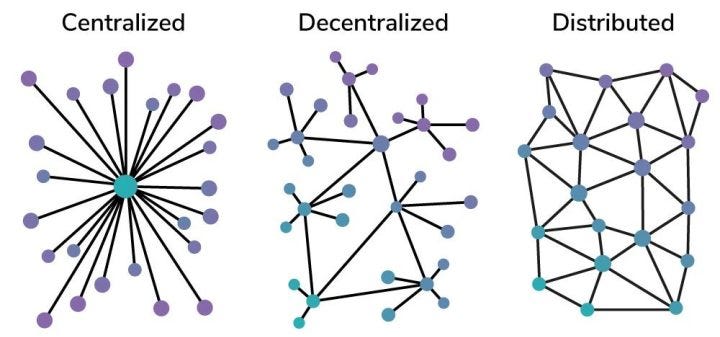
When creating a technology solution, three main network architectures are typically considered: centralized, distributed, and decentralized. By distributing the management and access to resources in an application, greater and fairer service can be achieved.
Decentralization typically has some tradeoffs, such as lower throughput, but ideally, the tradeoffs are worth the improved stability and service levels it produces. However centralization is mostly killing tech innovations.
In the past, decentralized structures were generally criticized for their inefficiency, duplication, and lack of consistent strategic direction. They require efficient administration and good governance.
Benefits of decentralization:
- Provides a trusted environment
- Improves data/information reconciliation
- Reduces points of vulnerabilities
- Optimizes the distribution of resources
What else? Please leave a comment if I missed any decentralization area to mention.
References:
https://link.springer.com/article/10.1007/s10586-021-03301-8


