THE DARK SIDE OF PUNCTUATION, PART 1
New Discoveries Reveal the Darker Side of Punctuation Marks.
Family unearths deceased psychiatrist’s notebook and publishes a scandalous tell-all.
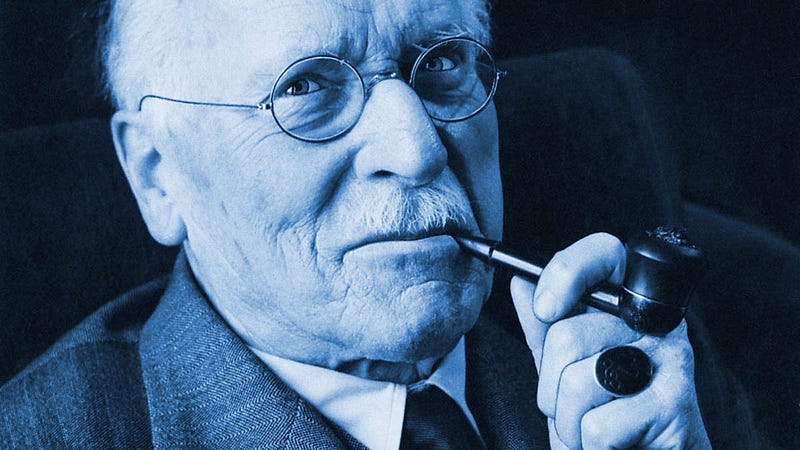
Editor’s note: just before Carl Jung’s death in1961, the groundbreaking Swiss psychiatrist began to study other parts of the human psyche, such as fonts (“Helvetica is boring”), and abstract art (“Why did Picasso give that woman two heads? Which one of them has schizophrenic tendencies?”) before settling in to do extensive research on human speech patterns.
Here is the world’s first view of the case notes from his work with punctuation marks.
The Period
Patients are serious, responsible, organized and fastidious — they like to make a statement by never leaving a task unfinished.
This punctuation mark is the first of four critical archetypes needed for written language.
While the healthy period works well in a structured environment, some individuals may become overzealous and intrusive.
Symptoms include running run around and minding everyone else’s Ps and Qs, dotting I’s, and badgering innocent en-dashes to cross other people’s Ts.
With proper therapy, the period can lead a well-adjusted life and feel the love and respect of all text, as they form the backbone of the community.
Warning: in the case of deeply disturbed periods, psychopathy manifests itself with extreme displays of grandiosity, as evidenced by horrible modern literary trends including, but not limited to:
“This.”
“Best. Movie. Ever.”
and the ever blasphemous
“Oh. My. Fucking. God.”
These particular little grammar Nazis must be stopped at all cost if the human race ever hopes to communicate like adults.
(Note: I don’t want to live in a world where my grandchildren start conducting conversations solely with strings of letters or crude drawings.)
The Comma
Patients are extroverted, social, and have an inborn love of networking.
As the second punctuation archetype, the comma also plays a fundamental role in maintaining the structure of written language, especially acting as a buttress, or counterweight, to complex and often heavy-handed dependent clauses.
Commas generally exhibit a high level of self-esteem, contending the world would be a simple, mechanical, overly structured, and generally dull place without them.
Warning: countermeasures may be necessary when drugs or alcohol are introduced as they will band together with other members to form massive public displays that run on for days.
In these situations, commas show little regard for other people’s desire to sleep at night, and they live by the mantra “always, always, always, always, always room for one more.”
The Colon
Colons represent the leadership archetype of punctuation.
Though their numbers are small, colons exercise far more power than the period, as they will always have an organized group of followers.
In some cases, they may sit at the head of a massive list of information.
Because of their relative scarcity and the position of power they hold, colons are one of the more stable and consistent forms of punctuation.
They never party hard, as they know they will be expected to lead an army of other punctuation marks and words at any time.
Their only personality drawbacks can be a dysfunctional family and no sense of humor as they are too busy with organizational tasks.
The Question Mark
Patients suffer from a permanent crisis of faith. About everything.
As the final archetype in written speech, question marks don’t even qualify as good atheists, as they’re unsure of their disbelief.
Question marks are known for being unable to commit to relationships.
[Transcription of couples therapy interaction]
Male: Why are you always getting so mad?
Female: Don’t you know anything about how I feel?
Male: What am I, a mind reader?
Female: Did you see that, Dr. Jung? Why does he always deflect?
Male: Oh, and you think I’m the only one who does it?
Female: What are you talking about?
Male: Didn’t I ask you to marry me?
Female: Why do you keep coming back to that?
Dr. Jung: I sense multiple levels of frustration due to the sublimation of your shadows, and an unconscious projection of inner doubts on your partner. Perhaps, we should begin alternative forms…
Both in unison: Could you shut the hell up, already?
[End transcription]
Without question, the question mark is a key to the written and spoken word.
Man’s quest for knowledge begins and ends with the question mark, but it would be nice if they could make up their damn minds for once.
The Semicolon
Semicolons suffer from deep-seated insecurities.
As a hybrid, bastard child of the colon and the comma, this lower level punctuation suffers from an inferiority complex due to its ambiguous role in written language.
The symptoms manifest as a mild form of bipolar disorder, as the semicolon boldly wants two join two sentences together, then falls in line as part of a list in its depressive state.
On occasion, the semicolon will suffer from grammar dysphoria as it battles with its primordial tail and tries to blend in with the other commas.
At other times, it will attempt to start a list but fail miserably, as other semicolons see it for the fraud that it is.
These patients require intense and prolonged therapy but pose no real threat to society.
The Exclamation Point
These patients are highly excitable and can fly off the handle at any moment.
The exclamation point is afflicted by the same inferiority complex as the semicolon, due to its status as a lower level punctuation mark.
However, these patients react in an extreme way to the same stimulus on the manic end of the psychopathological spectrum.
Even without drugs or alcohol, exclamation points resemble coke heads on steroids, as they scream at any perceived personal slight, exaggerate their accomplishments in a crowded bar or proclaim the end of times on a soapbox in the town square.
Warning: due to their volatility, exclamation points can explode at any time.
Exercise extreme caution with the exclamation point, as under no circumstances should these patients interact with groups of capital letters.
This volatile combination could result in terrible damage to letter writers everywhere.
Editor’s note: at this point, Dr. Jung’s notes became far sketchier.
He remarked simply that dashes and hyphens had separation issues, and that quotations merely copied others’ thoughts.
He grouped the behaviors of brackets and braces with parentheses and noted that further thoughts or qualifying remarks were still to come.
Any comments on the nature of apostrophes or ellipsis were omitted…
Editor’s update: Part 2 of the DSP-5 (The Diagnostic and Statistical Manual of Punctuation Disorders) has been published!