
New Challenge! Building a Portfolio with biweekly 500$!

FATPIGSIGNALS and I are starting a new challenge! From now on, I will present my Portfolio Builder together with you every two weeks. I am going to invest 500$ biweekly in the crypto market. Together we will build a portfolio.
“Don’t put all your eggs in one basket” — this is an old stock market adage. In other words, don’t invest all your money in a single asset — diversify your investments and thus your risk. The term “portfolio” describes one’s investment basket, in which different assets or different titles of an asset can lie, in which one has invested.
What exists in the traditional financial markets naturally applies to the crypto markets as well. Most investors tend to build a crypto portfolio by investing in several well-known cryptocurrencies and possibly lesser-known altcoins.
What crypto portfolio as an investment strategy is all about, what you should consider when building your crypto portfolio, and what the optimal mix in a crypto portfolio might look like — all that we will discuss in this post.
Subscribe to Coinmonks Youtube Channel to get daily crypto news.
What is a crypto portfolio?
A crypto portfolio is the basket of all your investments in individual cryptocurrencies. Your crypto portfolio describes how much money you have invested in which cryptocurrencies and how these shares relate in value percentage to the total value of your portfolio.
Whether you actively pursue the construction of your crypto portfolio or not — in principle, as a crypto investor, you have a crypto portfolio if you do not merely put your entire investment into a single asset such as Bitcoin or Ethereum. So whether you invest in two or twenty different cryptocurrencies, you have a crypto portfolio in both cases.
The idea behind a crypto portfolio is primarily the principle of risk diversification. An investment in 1 cryptocurrency is riskier than, say, an investment in 5 cryptocurrencies — if one value drops sharply, the performance of the other cryptocurrencies can still save the overall value of your portfolio or compensate for personal losses.
Here is a simple example of a crypto portfolio:
Lukas has invested EUR 5,000 in cryptocurrencies on Jan. 1, 2021. Of this, he buys BTC for EUR 2,000, ETH for EUR 1,000, and LTC and DOT for EUR 1,000 each.
So at this point, the value of his portfolio in percentage terms is distributed as follows: 40% BTC, 20% ETH, 20% LTC, and 20% DOT.
As you can see, a portfolio is usually viewed in percentage terms by assets and by its total value or their development over time.
More than 5,000 crypto tokens to choose from
Putting together one’s crypto portfolio is especially difficult because even a glance at Coinmarketcap reveals that there are currently more than 5,000 different crypto tokens. Of course, more than 95% of these are unknown and essentially meaningless altcoins in terms of value, while most of the market cap is accounted for by the top 20 coins and more than half by Bitcoin.
First of all, it should be noted that the asset class of cryptocurrencies is associated with exceptionally high volatility and should therefore already be considered a hazardous investment. Nevertheless, there is a precise gradation between the risk level of the individual coins.
This article is sponsored by the world’s largest crypto signal provider, Fatpigsignals. If you’re interested in growing your coins, this is the perfect place to go.
Now it’s your turn to earn FAT returns on the crypto market! Our crack team of professional traders will send you daily trading signals. Now you can trade cryptocurrency like a professional trader … without spending all day in front of the charts! JOIN GROUP
Bitcoin, Top 20 Coins, and Altcoins
In the traditional financial market, one usually asks what percentage should go into bonds and what percentage should go into stocks — bonds are safer and lower-yielding, stocks are riskier but can deliver higher returns. Here, a 50:50 allocation can be considered a risk-neutral portfolio.
The iron law of the capital markets is the risk-reward ratio — the higher risk goes hand in hand with higher return potential and vice versa. This law so applies to cryptocurrencies as well — but how exactly?
The most significant coins like Bitcoin, Ethereum, DOT, Cardano, etc., can also fluctuate under high volatility, but compared to completely unknown or new altcoins, they can be considered relatively safe and stable. One could extend the statement to the top 10 or top 20 coins at all — they are all sufficiently well known, their projects analyzed, and given enough liquidity on numerous exchanges to ensure a relatively manageable performance between trading days.
The risk, and thus usually the volatility, is even much higher for new altcoins that have just been issued or are only traded on a handful of Exchanges at all.
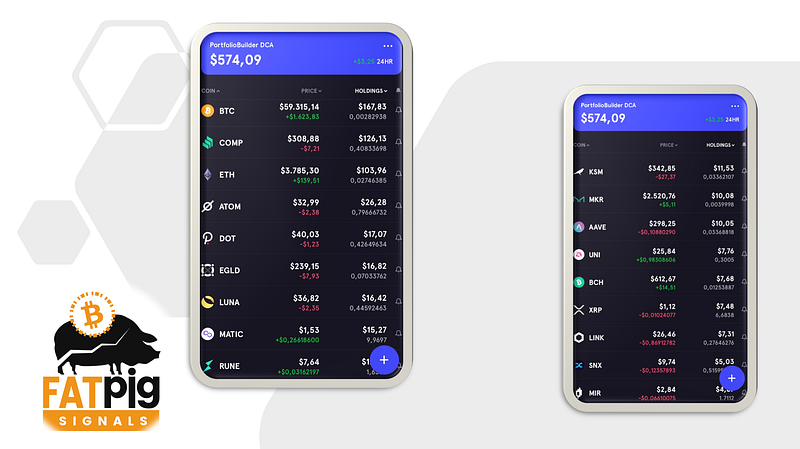
So how should you allocate your crypto investments in percentage terms in your crypto portfolio? There are no general recommendations for this — the essential factor to consider is your risk tolerance. It is tough to find the right risk strategy. The professional analysts at FATPIGSIGNALS have a portfolio builder that is updated every month.
Every two weeks, I will now show my portfolio development on Medium. Currently, risk-sharing looks like this.
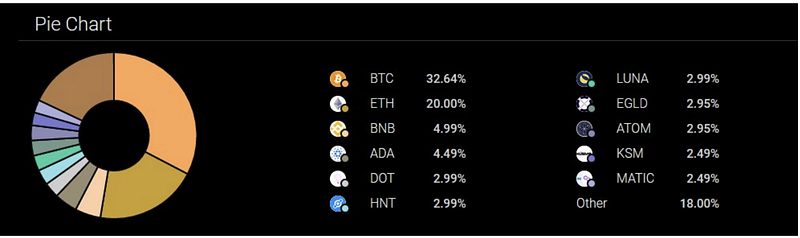
With more than 30% in Bitcoin and a large part in Ethereum. I speculate on a higher return in Ethereum than in Bitcoin in the coming months.
In the following articles, we will go into why it is crucial to diversify your portfolio.
For more updates and forecasts, follow Fatpigsignals
To predict fluctuations, you need to examine the past, which requires technical analysis and also this fundamental analysis of what we are talking about the whole crypto market. The research involves using graphs and charts to look at the value of a coin over a specific period. To detect statistical trends for short-term trading or the Portfolio Builder, you need to use a suitable timeframe. You may need to look at trends over hours, days, weeks, or months. It also involves historical research. When analyzing the market, we consider how coins have performed in the past and how quickly they course-correct after a significant shift up or down.
Fatpigsignals create crypto trading suggestions based on careful research using the steps discussed. You can count on skilled traders to make the most accurate predictions!
Guys, please join my private Telegram group! You will get great content and alerts!
I share more intimate thoughts in a monthly newsletter that you can check out here. Please let me know in a comment, and let’s build your crypto universe via Patreon. Join me on various social media platforms:
Twitter ● Instagram ● Patreon ● Homepage● LinkedIn ● Telegram
Join Coinmonks Telegram Channel and Youtube Channel learn about crypto trading and investing
Also, Read
- ProfitFarmers Review | How to use Cornix Trading Bot
- How to buy Bitcoin Anonymously | Bitcoin Cash Wallets
- Binance vs FTX | Best (SOL) Solana Wallets
- How to Swap Crypto on Uniswap? | A-Ads Review
- Cryptocurrency Savings Accounts | YoBit Review
- Botsfolio vs Napbots vs Mudrex | Gate.io Exchange Review
- CoinFLEX Review | AEX Exchange Review | UPbit Review
- AscendEx Margin Trading | Bitfinex Staking | bitFlyer Review
- Bitget Review | Gemini vs BlockFi | OKEx Futures Trading
- AscendEx Staking | Bot Ocean Review | Best Bitcoin Wallets
- Huobi Review | OKEx Margin Trading | Futures Trading
- Sparrow Exchange Review | Nash Exchange Review