7 New Board Games to Help Pass the Time While You’re Stuck at Home
Need a new family game? From card slapping to dice rolling, code words to tapestry building, there’s something for everyone!
MY FAMILY LOVES NEW BOARD GAMES. Like, we love new games. When I’m home over Christmas, my family averages at least three to five games a day for three straight weeks, and that’s probably on the conservative end. Our family game room has an entire wall of board games. I’m guessing… at least 200 of them? Maybe more? It’s a lot.
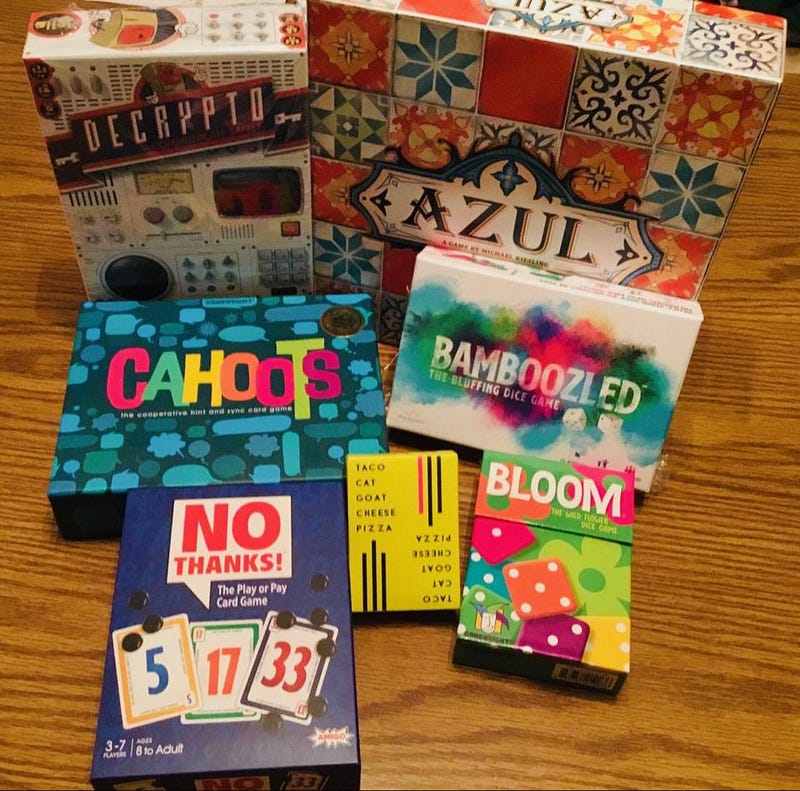
It’s starting to look like all of us might be spending a lot more time at home the next few months, and games help pass the time. This Christmas, our family got seven new games and, as per tradition, played them to death. Most of these are new from the last couple years, so I thought I’d share our findings.
For each of the seven games, there’s a brief description and a few highlights and rankings. How hard is the game to learn? How often will you want to play again, and does it easily adapt for different ages or numbers or players? Is the game design pretty? How much strategy is involved? And, of course, there’s an overall rating at the bottom. All from one to five stars.
There’s a bit of everything here — games of chance or skill, card games, dice games, party games, and more. See if you can find one you like, and if you have any questions or recommendations, add a comment at the bottom!
Don’t forget to check out last year’s 10 game recommendations while you’re here…
Taco Cat Goat Cheese Pizza
You’ll genuinely be hard pressed to find a more ridiculous game than Taco Cat Goat Cheese Pizza.
Yes, that’s really the name: Taco Cat Goat Cheese Pizza. And you best remember it, because you’ll be repeating those five words in order over and over.
The deck is full of hilariously fun cards of, uh, tacos, cats, goats, cheese, and pizza. Divide the deck evenly among players. On your turn, flip your top card onto a central pile and say the next TCGCP word. If the word matches your picture, everyone has to slap the deck. Last one to slap takes the stack of cards, first one out of cards wins.
But wait! The crazy is just getting started. There are a handful of other cards too. Anytime a gorilla comes up, everyone has to pound on their chest and slap the pile, or take the stack if they’re last. Narwhals mean clapping your hands over your head, and groundhog means knocking on the table before slapping. There will be bruises, plus wrong motions at wrong times.
And I promise you, it will be *hilarious*.
I rolled my eyes when I read about Taco Cat Goat Cheese Pizza. What was this, some kind of child’s game? And then we played. And we laughed. And we laughed, and laughed again, and we cried from laughing so hard. And it happened every time.
TCGCP is fun for all ages and especially great for a youth group activity or a family fun night. It’s goofy and simple, and guaranteed to make you laugh.
Difficulty Level ★ Game Design ★★★★ Adaptability ★★★★ Strategy ★ Easy to Learn ★★★★ Replayability ★★★★★
Overall Rating ★★★★
Bamboozled
You’ve probably played Liars Dice or some variant of that game from Pirates of the Caribbean 2, right? Bamboozled is the new lightning-quick version.
On your turn, you secretly roll two dice and combine them into a two-digit number; two and four become 24 or 42, your pick. You declare a number, real or fake, and pass the dice. The next player can call your bluff or choose to roll themselves, but their declared number must now be higher than yours. Each round continues until a bluff is called, and the loser gets a strike. Two strikes and you’re out.
There are twists, of course, and they add to the game but also make it significantly more confusing. The first is that the order of numbers in this game is not sequential. Doubles rank higher than non-doubles, and 21 is the jackpot. That means the numbers, from lowest to highest, rank something like 12, 13, 14, 15, 16, 23, 24, 25… 64, 65, 11, 22, 33, 44, 55, 66, 21. It’s a kind of unnecessary twist and certainly takes some getting used to.
There are also cards that give you some options. Some let you incorrectly call a bluff without penalty or choose to skip your turn. Other cards affect your dice, like allowing you to increase one of them by one or doubling your dice so 3-5 becomes 33 or 55. If you lie on your turn, or “bamboozle” the opponent, you earn more cards to help you.
It’s all a bit more confusing than it needs to be, and both the rounds and the game end a bit too quickly. You might just want to stick with Liars Dice.
Difficulty Level ★★ Game Design ★★ Adaptability ★★★★ Strategy ★★★ Easy to Learn ★★ Replayability ★★★
Overall Rating ★★
Cahoots
Cahoots is a restricted communication co-op game. Think The Mind, but lots of bright colors and far more talking.
The game comes with two decks, one with bright orange, pink, purple, and green numbered cards, and another with goals. The goals are something like “alternating piles of purple” or “sum of orange cards is 9.” At the start of the game, four numbered cards are turned face-up and four goals are revealed.
Everyone must work together to hit those goals. You can only play a card in your hand if it matches that pile’s number or color, and you’re all working together to hit a certain number of goals. Easy enough, right?
The restricted communication is what makes the game, but it’s also what keeps me giving it a high rating. Players are allowed to talk about goals but not about the cards in their hand, but it’s much harder than you think to decide what goes and what’s out of bounds — especially when you’re all on the same team and competitive. It makes Cahoots fun but also makes it tricky.
Difficulty Level ★ Game Design ★★★★ Adaptability ★★★★ Strategy ★★★ Easy to Learn ★★★ Replayability ★★★
Overall Rating ★★★
Azul
Azul was the crown jewel of our Christmas haul, emphasis on jewel, because this game is absolutely gorgeous. I didn’t even know I cared about board game beauty until Azul, and it’s no stretch to say that I literally added the “Game Design” category to my rankings this year specifically because of it.
Azul attempts to mirror the aesthetics of Moorish Portuguese art and does so beautifully as player artisans compete to decorate the walls of the Royal Palace of Dvora with beautiful hand-crafted tapestries.
Wait, what?
Basically, you are picking up tiles and placing them strategically on your board to score points. You need to pay attention to colors and patterns, plan ahead, and play defensively as you put your board together. It’s a beautiful and colorful game but one that is also rich in strategy and thought.
If you’re this far into a games article, you’ve probably heard about Azul. After all, it won the prestigious Spiel des Jahres in 2018, along with pretty much every other board game award in the world. Maybe, like me, you avoided it, confused what you were getting yourself into.
Avoid no more. Azul is beautiful and rich, strategic and fun, playable for both young and old. It’s the one game on this list you absolutely must own, and there are already a couple spinoffs you can add to your collection too.
One piece of advice: watch a video or two before playing, as that will capture Azul better than any number of instructions. It’s not the easiest start-up.
Difficulty Level ★★★ Game Design ★★★★★ Adaptability ★★★ Strategy ★★★★★ Easy to Learn ★★ Replayability ★★★★★
Overall Rating ★★★★★
No Thanks
In No Thanks, there are cards numbered 3 to 35 and a stack of black chips. Each player begins with something like 11 chips, and a card is revealed. On your turn, you must either take the card or say “No thanks!” by putting one of your chips on the card. Play continues until someone decides to take the card, along with all the chips on it. The next card is revealed, and so on, until the cards are gone. Add up all your numbers, subtract one for each chip, and the lowest score wins.
How bad do you want to avoid that 32? You only have four chips left. Should you pass once more around the table? Take it now, along with the 15 chips you’d gain? It’s a numbers and probability game, and you must anticipate your opponents, too. There’s as much strategy as you want to put into it.
Cards in sequence only count as the lowest number, and before the game, nine cards are secretly removed to create a slightly different deck every time and add in some unknown. It’s a simple game, and rather plain looking, but it does the trick, and three to seven can play. If you’re a numbers person, you’ll like it!
Difficulty Level ★★ Game Design ★★ Adaptability ★★★ Strategy ★★★★ Easy to Learn ★★★★ Replayability ★★★
Overall Rating ★★★
Decrypto
Decrypto was the one game on this list that really fell flat. Disappointing, considering it’s the #1 party game at Board Game Geek, and the one I was most excited for. A friend told me this was a lot like Codenames but better. I don’t think it’s very similar, and we definitely didn’t think it was better.
Two teams get a quartet of secret words. The goal is to give clues that lead teammates to your secret words without giving those words away to the opposing spy team. On your turn, you draw a key card, something like 4–2–1, and that tells you to give clues that turn for the fourth, second, and first secret word. Your clue can be any word or phrase, but it’s very important your teammates will be able to correctly map your clues to all three words, and just as important that your opponent cannot.
If it all sounds a bit confusing, it’s because it is, and it took us awhile to get the hang of Decrypto. We got better as we played, but this was always the game we least wanted to play of the seven. It ended too quickly, before we got any rhythm, and it’s really difficult to find the middle ground between making your clues too obvious or too obscure.
Others really like Decrypto, and perhaps you will too. It just wasn’t for us.
Difficulty Level ★★★★ Game Design ★★ Adaptability ★★ Strategy ★★★ Easy to Learn ★★ Replayability ★★★★
Overall Rating ★★
Bloom
Bloom is the latest pocket Gamewright game — think Qwixx, Zoinx!, or Qwingo. All nice, small dice games that don’t take up much space, nor time to learn or play.
In Bloom, each player tends a garden of flowers on a small notepad. The flowers are colored orange, yellow, purple, red, and teal and clustered in groups of two to five, with one die to match each color. It’s a bright and colorful game and might even double as gifting a “bouquet of flowers” to the right game lover.
Each round, the dice are rolled and each player chooses in succession which die to use. If you select the purple three, you get to “tend” to three adjacent purple flowers on your garden. Rack up points by tending to all of your flowers of one color and complete as many garden beds as possible. It’s short and sweet, and there’s more strategy than you might first think.
Difficulty Level ★ Game Design ★★★★ Adaptability ★★ Strategy ★★★ Easy to Learn ★★★★ Replayability ★★★
Overall Rating ★★★
Any questions about the games above? Any game recommendations? Leave a comment below!!
Follow Brandon on Medium or @wheatonbrando for more sports, television, humor, and culture. Visit the rest of Brandon’s writing archives here.