
“Nevertheless, She Persisted” — and Finished a Ph.D. at Oxford University
Fighting racism and ageism honey badger style

Honey badger don’t care…honey badger don’t give a shit.*
It is a truth universally acknowledged that when you grow up as a late Boomer, Asian-American daughter of tiger parents, you are primed from the get-go to be the best and brightest. And under the narrowest of conditions, too.
That is to 1) attend an Ivy, preferably what is deemed an “upper Ivy” (Princeton, Harvard, Yale), and 2) become a doctor, engineer, or lawyer.
Truth be told, the third option wasn’t even truly available when I was growing up since the sciences were regarded as the be-all and end-all of all possible careers during the 1970s. Yes, that was Asian parent pride and prejudice at work!
And so, that’s how my sights were set just then — when I still wanted to please my parents.
But alas, it didn’t happen — starting with the schools. Although I wasn’t terribly disappointed at my rejections from Princeton and Harvard (didn’t apply to Yale) and had my sights set on Smith after receiving long, friendly phone calls from students there, a part of me still felt…well, stung.
Perhaps because I had heard one too many stories from my parents about how so-and-so’s son or daughter got into Princeton. Another into Harvard Medical School. One who had just completed a Ph.D. at Cornell. (That’s one reason why parents should never compare their children to others!)
It wasn’t until decades later that I realized those lucky applicants were, in fact, sons and daughters of Princeton and Yale professors, while another attended a private school that served as a pipeline to the most prestigious colleges and universities because that’s the way the Ivy+ operates (and it’s arguably much worse today!).
But neither my parents nor I were aware of any of the significant advantages associated with faculty and prep school perps. We decided I would just work harder and get into one of those universities for graduate school.
(Poison) Ivy dreams: The hunt for graduate admissions
Some years later, after completing a master’s and dipping my toes into the corporate world via temping, I itched to return to academia. Maybe if I got a Ph.D. I would have better luck with scholarly publishing?
That’s when the application process started all over again at the ripe old age of 28. This time, however, I felt absolutely assured: Hadn’t I done better, grade-wise? Scored 200 points higher on the verbal section, placing me in the top 1%? I felt absolutely assured of stellar recommendations.
But more to the point, unlike my younger self, I was pursuing a subject that I genuinely wanted to study. No more trying to fake an interest in medicine or any of the sciences!
Honey badger don’t care…honey badger don’t give a shit.
At this point, I also knew I had done better than a number of those who had gotten into the universities I aspired to. I thought of those professors whose published papers sounded almost juvenile with their plodding subject-verb-object sentences.
How on earth did they get into Yale? This time, the world was going to be my oyster.
Wrong. Given my expectations, I naturally felt much more bitter — particularly when I was even turned down by a university that had accepted me as an undergraduate. Was it my race? (There was already talk of discrimination against Asians in higher education admissions during the 1990s.) Was it my age? After all, the younger, the “more brilliant” you are, as our youth-oriented society decrees.
I still remember those days when I received the letters. Every single one. Every day was overcast — as if a harbinger of a dark future. And every day after reading them, I would head to the sofa and call up Mom in Taiwan, sobbing. When she heard “suicide” one day, she decided to return home.
I had only barely considered seeking help. Who would take me seriously? I thought to myself it would be just my luck to find a shrink who had attended one of those universities — and I would inevitably feel jealous. In retrospect, I realize I was foolish for putting so much stock into this obsession with name.
Yet, as if mocking my fate, every article I’d read in the newspapers, journals, and magazines seemed to be penned by graduates from Stanford, Brown, or Columbia. Or focused on graduates from such universities.
It didn’t help either that friends from my graduate school couldn’t find positions. Some were even told by other peer universities that they only selected candidates from the topmost universities — that sliver of what are referred to as Ivy+ institutions. Go Ivy or bust it seemed.
Giving my finger to American academic pride and prejudice
But I also couldn’t help but notice that nearly everyone studying English literature or even comparative literature studying at these universities had distinctively Western surnames.
That was perhaps the real kicker — feeling that I had been discriminated against.
Indeed, a late 1980s journal article on discrimination against Asian applicants seemed to confirm my suspicions. Later on, with the advent of the internet, I would notice that nearly every single faculty member was white — except for those teaching Asian- or African-American literature. (This may not be as far-fetched as it seems if you read this.)
With righteous anger burning within me, I began holding up those thin envelopes to the light. As soon as I detected the words “we wish you luck in your next…” I would cross out my address and write, “F*CK YOU — return to sender.”
I once added “4th-rate Ivy” to an Ivy address, and in another, I drew a little pile of poo because there was no space to write “4th-rate Ivy.” That’s right — a little dung for your ding letter!
Honey badger don’t care…honey badger don’t give a shit.
But perhaps even more bizarre was my determination. You could call me the honey badger of the grad school application process, getting stung repeatedly by bees while digging for larvae. Risking being bitten by a venomous cobra.
You see, I finally decided to apply to la crème de la crème of all graduate schools for English literature — Oxford University — in May after that most recent rejection. Yes, fools rush in where angels fear to tread…right?
Not that I expected much — but I was absolutely determined to win. Surely someone would recognize my talent?
I should add that I was not applying to Oxford solely for prestige itself but at least as much because I wanted to study with the foremost Romanticist who had supervised all the scholars I admired. She had just been appointed the first female head of one of Oxford’s thirty-some colleges — J.R.R. Tolkien’s, as a matter of fact — and was notoriously choosy in picking her doctoral students.
Honey badger don’t care…honey badger don’t give a shit.
I realized I was all but demanding the sun, moon, and stars…when I couldn’t even scale an ivory tower. How was I going to get a celebrity prof at the top-ranked program for English literature— after being turned down by 8 universities?
And so I begged Mom to return home from Taiwan in August when decisions were supposed to arrive. This way, if I got depressed or worse, she would be by my side.
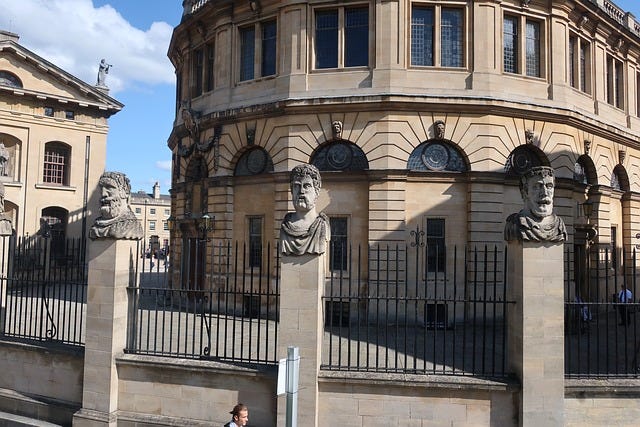
Admission Dreams come true at the Dreaming Spires
The day I received the news was an unlikely one. After arriving at the library, I realized I had somehow managed to forget the very book I was supposed to renew. Damn, maybe I am truly stupid! I would have to return tomorrow.
And then, when boarding the train, I discovered that I had lost my transfer ticket. I was fortunate that the conductor let me on as he patted me on the shoulder, adding, “Everyone has bad days.” And naturally, when I got off the train, it began to rain.
So imagine my reaction when I reached into the mailbox to find a depressingly skinny envelope from Oxford.
“Hey, Mom, another rejection!”
My first impulse was to take out a pen and scrawl my customary F*CK YOU, etc., before realizing that since it was trans-Atlantic, it would probably just be ignored.
Oh well, I sighed to myself — what’s new? Let’s see how Oxford phrases their rejections. As I opened the envelope, I caught sight of the words, “We are pleased…” Now I had to read the entire letter.
I was not mistaken: Holy shit, it was an acceptance! Then, in the following week, the famous Romanticist and head of Exeter College herself wrote to me, accepting me as a doctoral student. I couldn’t believe my luck.
But, of course, every graduate student is aware that admissions is only part of the game — especially when more than 50% of the student body can be weeded out.
Persistence pays off: the hunt for teaching opportunities.
I found myself beset by depression again a few years later when I discovered how nearly everyone had teaching opportunities — except me. Was it even worth it to finish my degree if I couldn’t get any experience tutoring undergraduates in English literature— which was more or less expected when searching for an academic job in the US? I was so close to dropping out of the Ph.D. (or D.Phil as it’s referred to) program.
Again, my racism antennae went up as I wondered if I was being rejected for teaching English literature because of my surname. Again, why was it that everyone with consonants and vowels in the right places was getting teaching opportunities at the various American college satellite programs and Oxford colleges? All the Andersons, Carrolls, Fosters, Smiths etc.
But just like when applying to grad school — the angrier I got at the thought of discrimination, the more persistent I got. Damn their pride and prejudice! So, in one fell swoop, I spent a morning and afternoon drafting a CV and writing to nearly all of the thirty-odd Oxford colleges.
Honey badger don’t care…honey badger don’t give a shit.
There were few replies: the ones who did explained that they already had their teaching arrangements, but if anything changed, they would let me know, etc. Three months later, I flooded the colleges again with queries. Still no luck — even though I had just won an award for best graduate paper in the US.
There was one undergraduate six months later, followed by two more in two weeks. Three more in the following term and then 14 more the term after. For a foreigner at Oxford, I was not doing too badly.
So this time, others were shocked. Although many American and Canadian students had no trouble in securing teaching with American satellite programs, few were able to get teaching positions at the Oxford colleges — the complete opposite of my experience. It was their turn to ask me, “How did you do it?”
At this point, I was not only receiving teaching offers but also offers to review books and write lengthy articles for a new online platform. Evidently, the faculty members got hold of me from those letters and CVs I sent off so relentlessly.
Learn to be fierce, fearless, feisty, and ferocious!
Nonetheless, every once in a while, bitter thoughts of my American rejections would cross my mind. You see, at Oxford, I happened to meet many other students from those very universities which rejected me. They had not only been accepted at several Ivies but were offered sizable stipends. Why did I have such poor luck getting into my coveted American universities?
Yet, nearly all of these Ivy graduates had been “sent down” from Oxford or unofficially kicked out, while others dropped out. (In retrospect, I believe it may have been grade inflation at those universities that prevented them from doing well at Oxford, but I digress.)
Or maybe…they didn’t channel their fierce, fearless, feisty inner honey badger? The willingness to hunt down every necessary book and stay up all night? To attend lectures even when not required?
Honey badger don’t care…honey badger don’t give a shit.
Perhaps that’s how I wound up getting my first proposal for a history/poli sci textbook accepted by a major academic trade press — despite my Ph.D. in English literature. And how I ultimately finished it — despite caregiving for an elderly father with dementia.
And perhaps that’s also how I got the second book proposal accepted by a major university press. The commissioning editor claimed that it was the best proposal he had ever read there.
The only publisher who did reject a proposal wrote to say that they never had much luck with literary studies and suggested I try a more prestigious publisher. Ironically, I chose them because I feared to submit to a more prestigious one! Perhaps I should have channeled my inner honey badger then?
So here’s some advice from me: stop being discouraged or depressed by rejections. Get angry! Double down!
Stride confidently. If you have faith in the quality of your work and support from the gurus in your area (and yes, feedback is necessary because that’s how you learn!), keep trying. Rejections should never be regarded as a “final judgment” on your abilities.
Just remember: don’t let pride or prejudice get a hold of you. Honey badgers are great not just because they’re adaptable or one of the smartest animals that knows how to use tools. Honey badgers are seriously great because they’re badass — the most fearless animal according to the Guinness Book of World Records. They don’t let anything disturb their loose, thick skins.
So be the honey badger. Because the honey badger don’t care. Honey badger don’t give a shit. It just takes what it wants!
© Frances A. Chiu, February 29, 2024


