
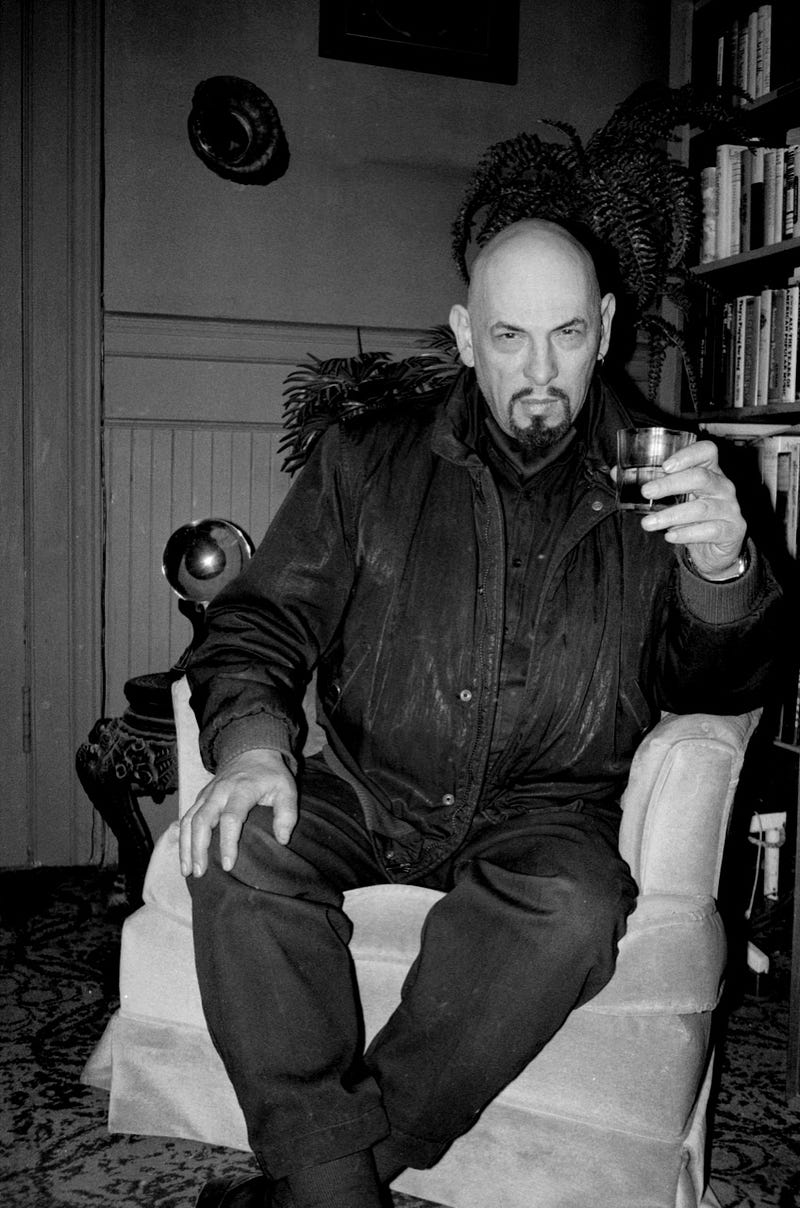
Never Underestimate Anton LaVey
How modernity’s premiere Satanist changed our culture
Amid the occult’s late-1960s entry to bestseller lists, how-to guides, and even toy aisles, it could be fairly asked: were the “dark arts,” or their most popular variants, growing grandmotherly?
Not if Anton LaVey had anything to say about it. “There is always a risk to underestimate LaVey,” writes sociologist Massimo Introvigne of modernity’s best-known Satanist. [1]
On the evening of April 30, 1966 — Walpurgisnacht, a Christian holiday that coincides with pagan rites of spring (sometimes considered the witches’ sabbath) — the goateed San Franciscan shaved his head and declared the founding of the Church of Satan, designating 1966 “the Year One,” Anno Satanas. In the Year Two, secular New York City novelist Ira Levin published his classic Rosemary’s Baby — soon widely known for Roman Polanski’s screen version — with coven leader Roman Castevet declaring at a New Year’s celebration: “To 1966, The Year One.” The die was cast.
With his founding of the Church of Satan, Anton became the first spiritual rebel to attain superstar status since Aleister Crowley. No one since Anton’s death in 1997 has filled that role. New Agers and self-helpers have hit bestseller lists, run for president, and attracted millions of screen viewers. But no outsider occult figure — one unfit for weekend seminars or headset-wearing TED talks — has upended our cultural assumptions, exposed moral hypocrisies, and embraced outcast iconography as he did.
LaVey was born Howard Stanton Levey in Chicago on April 11, 1930. From nearly that point forward, in true showman fashion — a designation he embraced — everything about LaVey’s biography is either self-invented, from his playing the Devil in the 1968 screen version of Rosemary’s Baby — a myth echoed in the press to this day — to his torrid affairs, including with Marilyn Monroe, or simply difficult to pin down, such as his background as a circus roustabout to his work as a crime-scene photographer for the San Francisco Police Department.
The widely repeated tale of his playing the Devil in Rosemary’s Baby gained traction in 1969 when a Wall Street Journal article repeated the magician’s plausible but invented claim, demonstrating — in a move that reflected Anton’s trickster wiles — that you can get a major news outlet to affirm nearly anything if it is presented credibly enough. [2] The uncredited role of Satan was actually played by actor Clay Tanner (1931–2002) who appears in on-set photographs in his scaly Devil costume in the illustrated This Is No Dream: Making Rosemary’s Baby by James Munn and Bob Willoughby (Reel Art Press, 2018).
In another oft-repeated tale, Anton said he acted as a technical advisor on set; I’ve found no supporting evidence for this and several crew interviews to the contrary. In a development that probably would have made Anton smile, he is credited as both Devil and tech advisor in his 1997 obituary in Variety. Anton is accurately credited as a technical advisor on the 1975 horror film The Devil’s Rain in which he and then-partner Diane LaVey (née Hegarty) have small roles.
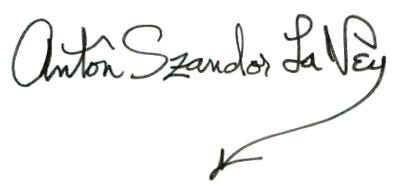
For all that, Howard Levey’s alter ego Anton LaVey led an existence impressive enough for any ten public-facing figures. Indeed, once the thirty-six-year-old Western migrant (his parents relocated from Chicago when Anton was a teen) launched his counter-church, journalists thrilled to claims and exploits of the caped and sometimes horned-costumed man who seemed to resemble the mind’s eye image of Mephistopheles. LaVey played His Satanic Majesty — this time for real — in director Kenneth Anger’s 1969 short film Invocation of My Demon Brother, a movie that almost certainly, if more quietly, influenced as many filmmakers as Polanski’s classic (its Moog soundtrack by Mick Jagger is minimalist splendor); in 1969 Anton published the perennially selling mass-market paperback The Satanic Bible that placed his byline in mall stores across the world; and at his peak hobnobbed with celebrities like Jayne Mansfield and Sammy Davis Jr. — the singer recounts his flirtation with Satanism with admirable candor in his 1989 memoir, Why Me?
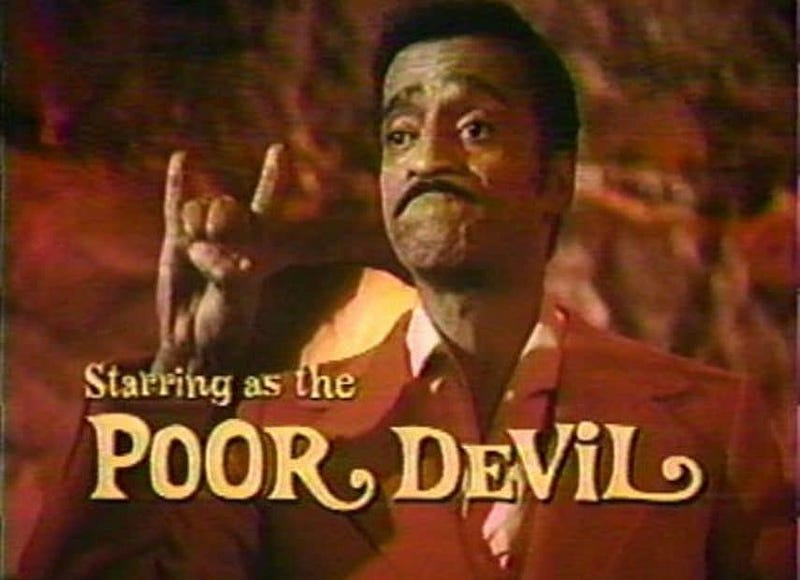
Davis’s earlier memoir, Yes I Can from 1965, shows up prominently in the screen version of Rosemary’s Baby, at one point visibly read by its tragic heroine played by Mia Farrow. Davis did not come into contact with the yet-unborn Church of Satan until 1973, as recalled by Anton’s widow Blanche Barton in We Are Satanists: The History and Future of the Church of Satan (2021). Davis gratefully accepted an honorary membership when Anton’s one-time confederate Michael Aquino wrote the entertainer to praise his TV comedy film Poor Devil.
On grimmer terms, Davis recounts at least titular introduction to Satanism through his barber and friend Jay Sebring, who was murdered along with Polanski’s wife Sharon Tate and two house- mates by followers of Charles Manson on August 9, 1969. The timing and circumstances of the murders pose endless rumors and speculations, the finest and most responsible treatment of which appears in director Jay Cheel’s episode on Rosemary’s Baby for the 2022 documentary series Cursed Films II.
In modern Left-Hand Path spirituality, if Aleister Crowley was Ancient Greece — deeply read, martial, and refined — Anton was Ancient Rome — given to intellectual borrowing, unfettered in conquest, and without restraint. And it worked.
In P.D. Ouspensky’s 1949 record of his work with G.I. Gurdjieff, In Search of the Miraculous, the teacher observes: “truth can only come to people in the form of a lie.” Indeed, Satan is sometimes called the Lord of Lies. In that sense, Anton was a Holy Liar. And yet — I pause over that designation. A lie implies malice — of which, critics be damned, his work is absent. Anton, like many popular artists, not only provoked but also mediated. He successfully brought decades of readers, including teen witches and goth kids, to ideals of protean self-creation when they might otherwise have had few accessible sources. As Alfred, Lord Tennyson put it in 1850 in his In Memoriam A.H.H.: “Truth embodied in a tale shall enter in at lowly doors.”
Some readers, among them role-play gamers, tricksters, anarchic magickians, goths, metal heads, and a few credulous, took this principle further and crafted a full-throated (and often cohesive) religious scenario around horror eminence H.P. Lovecraft’s (1890–1937) “Cthulhu Mythos,” which forms the backstory of several of his tales, as well as the author’s dramatized grimoire the Necronomicon (“Book of Dead Names”). The latter includes, among other versions, one intentional and long-selling “folly” edition, created in 1977 by imagineers at New York’s defunct Magickal Childe bookstore.
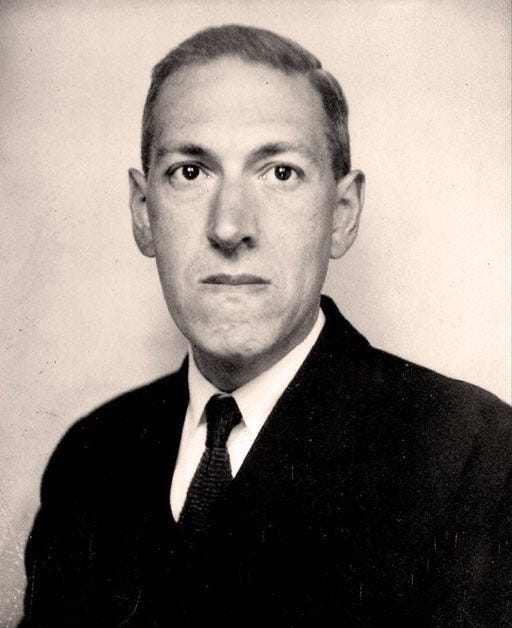
Anton’s The Satanic Rituals, the 1972 companion to his first book, features, among other Lovecraftian adaptations, the ceremonial “Call to Cthulhu.” Erik Davis calls these “the first overtly Lovecraftian rituals to see print.” [3] Davis continues:
The word “fan” comes from fanaticus, an ancient term for a temple devotee, and Lovecraft fans exhibit the unflagging devotion, fetish- ism and sectarian debates that have characterized popular religious cults throughout the ages. But Lovecraft’s “cult” status has a curiously literal dimension. Many magicians and occultists have taken up his Mythos as source material for their practice. Drawn from the darker regions of the esoteric counterculture — Thelema and Satanism and Chaos magic — these Lovecraftian mages actively seek to generate the terrifying and atavistic encounters that Lovecraft’s protagonists stumble into compulsively, blindly or against their will.
That Lovecraft himself was sterile physicalist who disavowed mysticism of any sort only heightens the meta-experimentalism of revisioning his work into occult practice. Another anarchistic religion grew as an underground movement starting in the mid-sixties, Discordianism, communicated through its unholy text Principia Discordia and popularized in Robert Anton Wilson and Robert Shea’s 1975 Illuminatus! Trilogy. Discordianism is a cut-up faith holding, with both whimsy and why-not? seriousness, that everything, from ancient gods to consumer culture to invented words, is at once meaningful and meaningless. It has a loose sister group in the satirical/sincere Church of the SubGenius. Discordianism’s core value appears in Wilson’s observation: “The idea that all ideas are partly true, partly false, and partly meaningless is partly true, partly false, and partly meaningless.” [4]
Returning to Anton, the provocateur was probably the first modern who put forth Satanism as an ethical and religious philosophy. The Satanic Bible is, at its heart, a paean to individualism, and offers a set of ethics not much different from some of what William Blake explored in The Marriage of Heaven and Hell. Detractors assert that Anton’s celebration of self-attainment lacks ethics. Not exactly. Reciprocity, loyalty, respect, and rejection of non-provoked violence form the Satanist’s code. His core ethic could be defined as: Thou shalt leave another alone — unless intruded upon.
Other critics dismissed his mass-market paperback as a bastardization of Nietzsche and Ayn Rand, with occult frosting — to which a defender might reply: so what? Much religious and philosophical writing is syncretic, and I see LaVey’s work as an effective popularization of those writers combined with his own shrewd insights into human nature. In his 2022 Anton LaVey and the Church of Satan, artist-author Carl Abrahamsson — Anton’s finest chronicler — embraced rather than fled the critical refrain (something Anton would’ve smiled on), calling the Black Pope “America’s own pop-Nietzsche.”
To clarify Anton’s outlook, he neither believed in nor worshipped Satan as a literal entity. Rather, he defined Satanism as the ethic of radical non-conformity and defiant selfhood. In his eyes, the Satanist is history’s rebel, romantic, and iconoclast — but with a razor’s edge of self-determination, captured in the statement famously (if loosely) attributed to street-fighting philosopher Ayn Rand: “The question isn’t who is going to let me; it’s who is going to stop me.”
But Anton could not be called a Randian Objectivist, in the vein of the philosopher’s ultra-individualism and utopian capitalism. Anton also believed in the power of rite and ritual, anathemas to the hyper-materialist Rand. Nor was Anton in line with the mystical and extraphysical outlook of his aesthetic antecedent Aleister Crowley. Anton’s attitude toward metaphysics was ambiguous and creatively tense; he neither disavowed nor embraced them, often allowed colleagues latitude for their own approach, provided it didn’t cross into mewling numinosity: his system had no room for chin-stroking but only for results. Anyone ponderous enough to ask, “What do you mean by results?” would quickly be shown the door at his San Francisco lair, the Black House.
I call his system Positive Thinking Weaponized. He took the principle of positive-mind philosophy — thoughts are causative — and wed it to a sense of theatricality, costume, and self-invention. Anton believed that well-wrought fantasy — heightened through real-life garb, designed surroundings, and even life-sized dolls (he was a philosophical pioneer of virtual reality) — was superior to settling for unsatisfying sexual relations or lame outer experiences. He termed his invented realms “total environments.”
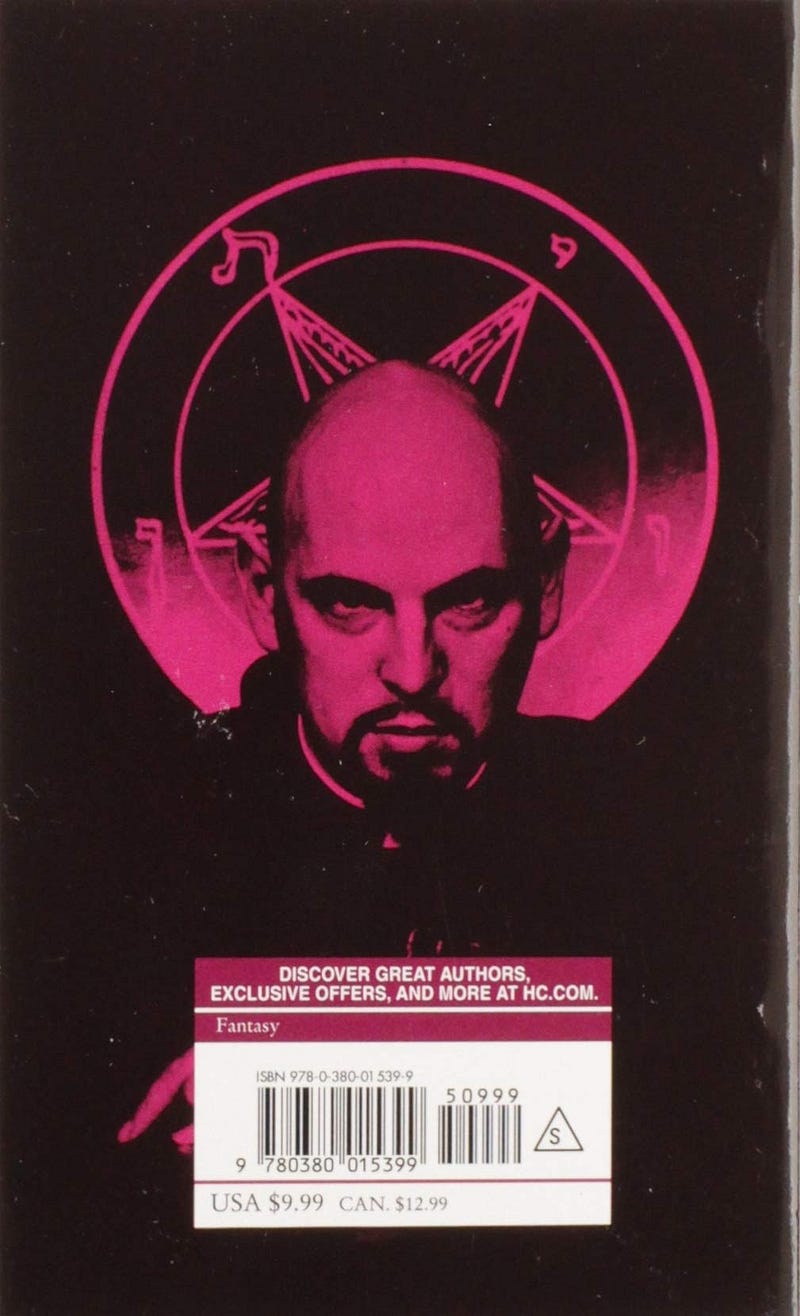
Anton’s magick called for self-awareness of a kind rarely found in modern occult literature. In The Satanic Bible he wrote of the Balance Factor: “One of the magician’s greatest weapons is knowing himself; his talents, abilities, physical attractions and detractions, and when, where, and with whom! . . . The aspiring witch who deludes herself into thinking that a powerful enough working will always succeed, despite a magical imbalance, is forgetting one essential tool: MAGIC IS LIKE NATURE ITSELF, AND SUCCESS IN MAGIC REQUIRES WORKING IN HARMONY WITH NATURE, NOT AGAINST IT.”
Historian Stephen E. Flowers, Ph.D., adds in his 2012 Lords of the Left-Hand Path that LaVey’s is pragmatic magic — “All elements in his magical system are there to act as triggers for certain psychological events.” And further that the practitioner aims at “making only slight alternations in the right place at the right time to ‘tip the balance’ in one’s favor.”
Anton’s approach to ritual was similar to artist and magickian Austin Osman Spare’s chaos theories. Rites could assume nearly any form — he used a potpourri of historical Satanic references, self-devised dramas, and sometimes an adapted system of the Enochian alphabet — but the nonnegotiable ingredients were passion and what might be called creative forget- fulness. Anton believed that a ritual or ceremony must immerse you in feeling satisfied that you have gained the thing wished for. In this regard, sexuality and self-sexuality were core tools in his rituals. Once you experience the longed-for sense of satedness, you drop the matter. “Burn every bit of desire out of your system,” he wrote in his essay “Ravings from Tartarus” from his 1992 collection The Devil’s Notebook, “and then, when you no longer care, it will come to you.”
If you don’t experience satisfaction, your fantasy or ritual must be performed again. Or you must find another way of diverting yourself from futile distraction with your aim. Rituals fail, he wrote, “Because it matters so much to you.” Again, Anton:
How can one avoid caring? There are many tricks which can be employed. Creativity is one. When you are in the process of creating something your brain must function on a creative level, not on a rote or repetitive one. Your mind cannot be possessed by one thing and yet entertain new thoughts — unless the object of your creation happens to be in the likeness of your obsession. Here we find an ideal combination, for if the hands can create a facsimile of the desired objective with such dexterity as to be convincing then it is as good as done.
As he suggests, the point of chaos magick, sigil work, and related techniques is to bypass the rational apparatus of the mind and allow the depths of the subconscious to perform. Another valuable hint for effective magickal practice appears in Anton’s concept of Erotic Crystallization Inertia or ECI. In short, the practitioner peels back memory to determine the earliest instances of sexual arousal. In Blanche Barton’s 1990 biography The Secret Life of a Satanist, ECI is described as the “point in time and experience in which a person’s emotional/sexual fetishes are established.”
ECI moments also harken to when the individual experiences key feelings of vitality, at-homeness, and conscious ease. This can occur in social situations and during tasks or efforts when you feel distinctly competent, seen, understood, capable — and hence powerful. He encouraged the recreation of these moments and settings in both personal rituals and general surroundings, further clarifying the notion of “total environment.” This also means avoiding settings, people, and situations that detract from your sense of vitality. Relationships between parties who possess complementary ECIs can prove remarkably propitious and satisfying.
Understanding ECI provides a key help in working with both sigils and Napoleon Hill’s practice of “sex transmutation.” But there is more. Settings that evoke power, potency, and vitality appear to have measurable therapeutic benefits. In studies by Harvard psychologist Ellen Langer — the subject of controversy but their results never refuted — elderly subjects experienced physical and mental improvements — including increased strength and flexibility, recovered memory and cognitive function, and improved mood and vitality — when immersed in nostalgic settings populated with stimuli from their youth, including vintage books, music, and movies. In Langer’s work, settings that evoke feelings of youth actually seem to summon the reappearance of youthful traits, extending even to improved eyesight. [5]
As some of Anton’s students observed, the very act of “costumery” can evoke similar feelings of well-being. This implies dressing and comporting yourself in a manner that affirms idealized self-image. Too often our wished-for concepts of self are disrupted by therapeutic or spiritual truisms about what we are supposed to value, thereby short-circuiting authentic exploration or restricting it to familiar patterns. A more radical and, I believe, helpful approach is to trust your self-estimation, test it, and permit no one to summarily take it away. In other words: verify, not as a toothless truism but actually.
As I was completing this piece, I heard from a thoughtful reader and freelance producer of reality shows, Leslie Spann, who offered an impromptu recollection that touches on this topic. This kind of propitious correspondence is not uncommon as I am wrapping an article or book. It appears with her permission:
I worked on a weight loss show — the show was about eighteen-year-old kids who graduated from high school and were going off to college. These kids had been overweight all of their young lives and they were wanting to lose weight, with a personal trainer, before they started their “new” lives as college students. Long story short, I was working with one of the girls who had been told her whole life she had a “pretty face.” This is something many overweight girls/women hear and most of them hate hearing it because it really means, “You have a pretty face. Too bad about your fat body though.” While talking to this girl, I asked her why she really wanted to lose weight. We were in the presence of her parents and her trainer. Her trainer had been really frustrated with her because she wasn’t “giving it her all” during her workouts. When I asked why she wanted to lose weight, she gave the standard answer many people give, “For my health.” I said to her, “That’s bullshit. You are eighteen years old and are tired of being told you have a pretty face. You want to be hot. That’s what you dream about when you think about losing weight. It ain’t because of your health, because you’re eighteen for chrissakes. Of course you want to be hot! That is part of what someone who is eighteen and going off to college to start her life SHOULD want — and that is absolutely nothing to be ashamed of. Embrace that and really understand that there is ZERO shame in wanting to love the way that you look and feel in your body!”
Well, this was transformative for her. Her whole face lit up and there was a palpable shift in her energy from then on. She was literally set free in that moment. She needed permission to want what she actually wanted — rather than to want the thing for the socially acceptable lame-ass reason. I tell you this because I feel like it’s such a beautiful example of what I’ve heard you talk about . . . when you are discussing the power of being honest about what one wants in their deepest heart of hearts.
At the core of Anton’s philosophy is clarity of aim, wish, or desire. I have observed that as you pursue your aim, you may find that friends and coworkers are always trying to distract you with media or events that interest them but not you. We can absorb and retain only so much. What appeals to you in media, as in company, usually involves expanding your sense of self. (Or, more plainly, your sense of power.) This cannot occur if you are bound to other people’s agendas. Anton put it this way in his 1986 essay “Don’t Recycle Your Brain” from his newsletter The Cloven Hoof:
I refuse to partake of trendy or pop input. Not so much because it usually replaces valued old information, but because it will “mediocritize” me. It will dilute my special kind of knowledge bank (which has allowed me to remain unique) to a sort of common knowledge catchall. It will render me more adaptable to the common denominators of the herd, but much less adaptive as a role model to others. Rather than being possessed of data that gives me social distinction, I will be able to discuss the same movies, plays, singers, TV shows and stars, current events, sports, etc., as everyone else. Thus, I won’t look like everyone else, but the moment I open my mouth, I’ll sound like them.
Anton’s principle is that new intake must be “augmentive” of your valued ideas, concepts, and techniques. This does not mean you shouldn’t experience something wholly new; such a break provides fresh perspective from which to measure your ideas and thought forms. The point is you don’t give away your attention to whatever comes along or whatever peer activity beckons. You view media, entertainment, social outings, design, clothing, and so on, as units that augment your aim, style, personhood, total environment — and power.
Author and magician Alan Moore has spoken eloquently about the connection between fiction, language, and magic. [6] Moore has mentioned — and I can affirm — that anyone who’s been writing for a while has a file of extraordinary coincidences in which experience follows story. I expect this holds true across the arts in general. Hence, Anton’s concept of “make believe” is powerful in ways we may not always suspect.
Before Anton LaVey founded the Church of Satan in 1966, there really was no cohesive Satanic tradition in Western culture. There were individuals, rebellious figures who made counter and esoteric readings of some of the foundational Western myths. Some of these very individualized readings appeared in Romantic literature and other variants. There were figures like French novelist J.K. Huysmans (1848–1907) and others who wrote about black masses and related things that were largely fanciful, although they might have picked them up from self-styled Satanists in some reaches of bohemian or fin de siècle culture.
But spiritual tradition requires liturgy, lineage, foundational literature, and, in some cases, a congregation. None of this has been true for Satanism although I do venture an esoteric historical reading in my Uncertain Places. Satanism is an anarchistic movement. With regard to elements like a black mass, there is no longstanding practice that extends back centuries or millennia, in the same way that we point to liturgical traditions in Buddhism, Islam, Judaism, or Christianity.
For the most part, charges of Satanism (in a negative sense) were directed by early church fathers against remaining pockets of paganism in late antiquity; the church wished to define religious hold- outs — already on their way to vanquishment — as forces against which military and judicial power could be wielded. As the early church grew, and Christianity became Rome’s officially sanctioned religion, the fading pagan powers were depicted as demonic (this was once a neutral term) and Satanic. They were described by labels they had never applied to themselves. Had pagan powers prevailed, they would have done the same thing to the early church. In matters of religion, at least, victors write the dominant history.
I must clarify a further historical point — one with a deep hold on contemporary pop culture (I deal elsewhere with the grotesque fantasies of the Satanic Panic, a tragedy of historic proportions): Satanism and cases of possession. Historian Massimo Introvigne provides a typically clarifying note:
It could be said, in general, that Satanists seek the Devil, while the possessed claim they have been “found” by the Devil, whom normally they had not consciously sought. The Satanists would like to encounter the Devil, and some of them use specific rituals for calling or evoking him. On the contrary, the victims of spectacular demonic possessions have often been pious and devout Christians, very far away from the ideology and the activities of Satanists.
For several years recent to this writing, the Vatican has more than quadrupled the number of church-certified exorcists in the United States. The number has risen from about 12 to 50. [7] Church authorities generally blame this wave of demand on New Age culture, popularized occultism, Ouija boards, and so on. Another, probably likelier facet is entertainment. Horror is among the few movie genres that coincide with belief due to congruency between many of its themes and spiritual or religious concepts, ranging from ghosts to after-death survival to demon possession.
Hence, the 1973 movie version of The Exorcist — one of the most talked-about films ever made and without which I doubt most people would even know the term exorcism — produced myriad spinoffs. How an idea goes viral remains mysterious but that perception and screen coincide is a given.
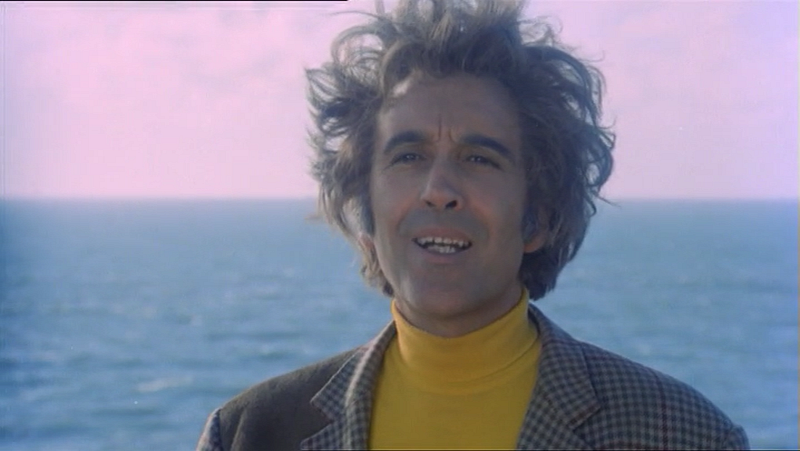
Although less of an immediate blockbuster, the enduring classic The Wicker Man, released the same year as The Exorcist, about a Scottish island preserve of pagan practitioners, is widely considered one of the most historically authentic occult films ever made. The Wicker Man stands in polarity to The Exorcist, which takes a religiously condemnatory view of the occult. In more admiring terms, screenwriter Anthony Schaffer said in the 2021 documentary on folk horror, Woodlands Dark and Days Bewitched: “Paganism has a habit of surviving.”
This article is adapted from the author’s forthcoming Modern Occultism.
Notes
[1] Satanism: A Social History (Brill, 2016).
[2] For the reference, see “Strange Doings: Americans Show Burst of Interest in Witches, Other Occult Matters” by Stephen J. Sansweet, Wall Street Journal, October 23, 1969. The most recent repetition of the claim that I have seen in news media is “Did the Devil kill Jayne Mansfield?” by Helen O’Hara, The Telegraph, May 9, 2018.
[3] “Calling Cthulhu: H.P. Lovecraft’s Magick Realism,” Gnosis magazine, Fall 1995; I am quoting from an expanded version the author posted online.
[4] RAW Art by Bobby Campbell (Weirdoverse, 2017)
[5] See “What If Age Is Nothing but a Mind-Set?” by Bruce Grierson in The New York Times Magazine, October 22, 2014. Researchers often dispute older studies, such as Langer’s 1981 aging study, based on newer standards of methodology. But this phenomenon affects our view of all past clinical work, as it will affect how future researchers view today’s practices, since methods inevitably progress.
[6] “Language, Writing and Magic,” talk delivered September 6, 2016, YouTube.
[7] “Leading U.S. exorcists explain huge increase in demand for the Rite — and priests to carry them out” by Rachel Ray, The Telegraph, September 26, 2016.


