
Never Procrastinate Again
3 Tips I swear by to eliminate Procrastination and Achieve Your Business Goals

Email, Facebook, Instagram, Youtube, Netflix, snap….whatever! It is all designed to grab our attention as quickly as possible and take it away from what is actually essential.
With smartphones and those addictive notification pings, buzzes, and little bell symbols, it is now easier than ever to think; “I’ll just take a quick look”. 15–20 minutes later you manage to drag yourself away and sort of get back into what you were doing until you realize 10 minutes later you need a coffee or to use the bathroom — does this sound familiar?
I know it does to me and when I started my business and had no boss or manager watching over me it became 10 times harder because I was solely responsible for my focus at work.
However, there is light at the end of the tunnel, let me share with you the 3 tips that guarantee I get more done in 4 hours than 8!
1. Put your phone on flight mode and put it in a draw
“I need to have my phone with me” I hear you say. No, you don’t! There may be a few jobs or situations where you absolutely must be contactable at all times but otherwise, 99% of the time, you only think you need to have your phone with you.
The vast majority of what’s on your phone can be done via a PC or laptop and there is barely anything that can’t wait for your response for between 30 minutes and 1 hour (more on why those particular times in the last point).
I urge you to try it! This one thing alone will make a world of difference to how productive you are.
Flight mode, draw….do it!
Start with 30 minutes if you really are that anxious about trying this, then build it up to longer periods of time.
My draw of choice is the kitchen draw:
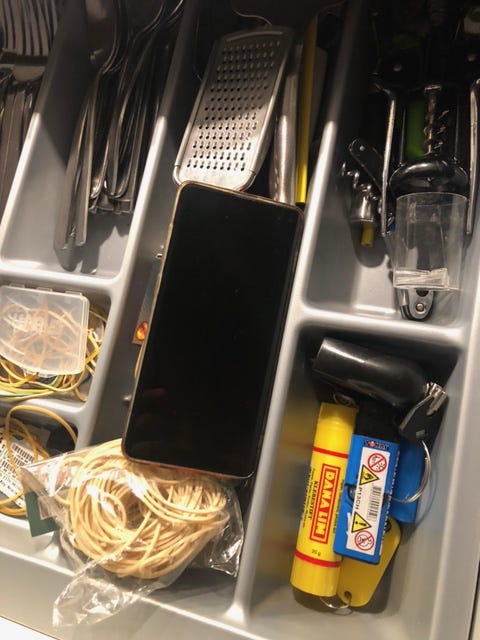
I bet that you find that everybody and anybody can wait between 30 minutes and 1 hour for a response and they don’t even “bat an eyelid”!
Let me know how you find it in the comments — I’d love to hear from you!
2. Time block
So, utilize some form of calendar….whichever works best for you. For me, it’s Google Calendar because I can easily access it and have it open.
Then, allocate a task to every part of your work day on your calendar — i.e. Block it off. That includes the time you take for lunch — have it all on your calendar. There shouldn’t be a single space of free time. If there are no tasks for a particular block of time allocate it to learning or self-improvement.
Ideally, this should be done at the start of each week. I do it Sunday night because there are no distractions and I am able to allocate time sensibly with a clear head. You might find it better to do this Monday morning but then you run the risk of being distracted by a “so-called” emergency or emails etc.
Then, all of a sudden, you are off and running fighting fires and your week doesn’t get planned.
The reason this is so important is because if you know exactly what you are going to be doing next you don’t waste any time trying to figure out what you should do next or what is the next most important thing to do.
In that situation I found I would slip into checking and responding to unimportant emails or chatting on one of many of my social media apps, basically just wasting time, and suddenly an hour has gone by and I haven’t achieved anything significant.
Here is a screenshot of my next week's calendar for you:
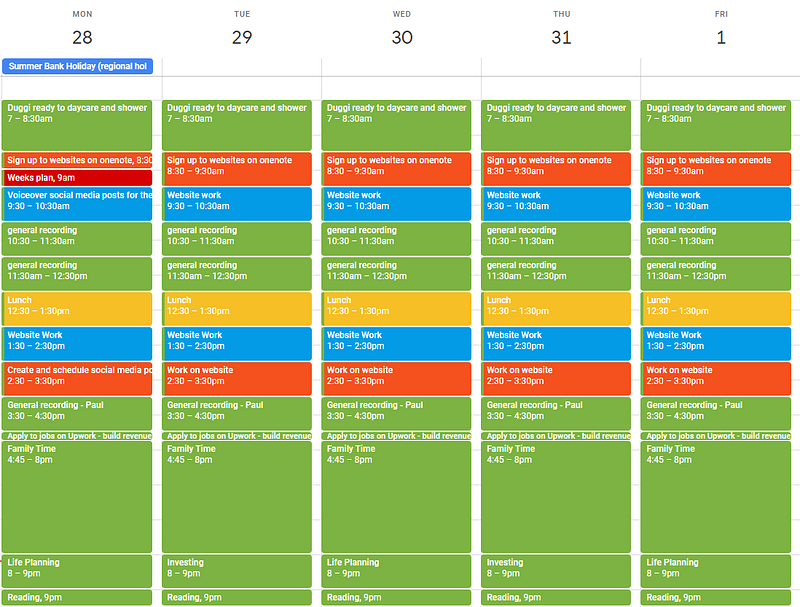
You can see I go the extra mile and allocate things I will be doing in my free time as well. That’s because I have found I get more out of life by doing this — I have stopped, for the most part, planting myself on the sofa and “doom scrolling” or watching Netflix! Of course, I am human and this still happens from time-to-time but it happens far far less frequently than it did before.
3. Live by the Pomodoro Technique
Lastly, use this technique religiously! Let me break it down for you:
a. Get a timer — an egg timer or normal clock works perfectly. If you only have your phone that can be a temporary solution but ensure it is on flight mode at all times
b. Set the timer to 25 minutes and then undertake focused work on your predetermined task in your calendar for those 25 minutes.
c. Take a 5-minute break when the timer goes off — again this should be timed — no slipping into 7–10 minute breaks here. 5 minutes and then right back into your next focused 25 minutes.
Now, before we get into the nitty-gritty of why this works so well, after 4 sessions of 25 minutes (or what’s known as pomodores) you can have a longer break — that might be a 15–20 minute coffee break or your lunch break e.t.c.
This has absolutely changed my life!
I get more done than I could have ever thought possible!
So why does it work?
Firstly: It makes it easy to get started on the task you are about to work on
I have found it so much easier to get into something knowing (even in the back of my mind) that I will only be working on it for 25 minutes and then I have 5 minutes to relax.
In that way, a big task is automatically broken down and I find my mind switches into the thought process of;
“I’ll just see how much of this task I can get done in the next 25 minutes”.
The genius of the 5-minute break is that it is just enough to reset your mind and have a rest but not enough for your brain to lose focus on the task you were working on.
So then I came back into the task with a fresh energy and perhaps a new perspective on what I was working on.
One thing I want to mention here: Try to make sure you don’t look at your phone or emails in the breaks (allocate an actual time slot for that if you have to). The break is about giving your brain a chance to rest, especially if your work involves working in front of a computer intensively.
Secondly: You avoid distractions
This is of course aided drastically by your phone being in flight mode and in a draw and also your time blocking. Thus, you know exactly what you need to work on in your next 25-minute session so you can get straight into it and there should be nothing that can distract you from that task.
I have found that it can take me 5–10 minutes to really get into a task and then, if I get distracted, it can take me 20 minutes to get back into what I was doing. All of a sudden, I’ve lost up to 30 minutes of productive time. Imagine that happening a number of times during the work day and you are looking at 1–2 hours of productive time lost!
Thirdly: It subconsciously turns your projects into game
All of a sudden I am trying to get as much of the project done as I can in those 25 minutes and competing against myself to see how much more I can do than in the previous 25 minutes.
This can make boring tasks a little bit fun and give them a slightly different edge.
Lastly: You are relying on consistency instead of motivation
Motivation waxes and wanes no matter who you are. Sometimes you are super motivated, other times you simply can’t be bothered, even many times within the same day, seemingly without any explanation.
However, with the Pomodoro technique motivation is taken out of the equation. Your goal becomes; not to finish the task or project per se but to simply work on that task or project for 25 minutes.
That’s a goal that requires hardly any motivation at all — even at your lowest level of motivation, you can work on something for 25 minutes! The best thing is; that once you have worked on it for 10 or so minutes your motivation will begin to increase.
The 5-minute break is not enough time to lose that motivation so over the course of the 3–4 pomodores (25-minute sessions) your motivation will increase dramatically simply by taking action!
Next, check out what I would do if my business failed:
Okay, so there you have it. 3 golden tips that will drastically boost your productivity and allow you to get more done in 4 hours than you have been in 8!
It worked wonders for me and it can for you as well.
Thanks so much for taking the time to read the article. I’d love for you to leave a clap and a comment — ask me a question or just let me know what you think — it all greatly helps!
☕Buy me a coffee: https://ko-fi.com/christianneale
I appreciate all your support and look forward to writing the next one for you.
See you soon,
Christian