
Neurotech’s Mind Control Is Scarier Than Biotech’s Drug Addiction
We must each learn to be our own authority on matters of the mind, & Get Fit Mentally


“The Perils of opening the mind”, by Amanda Pustilnik, Boston Globe, February 23, 2020 “With neurotechnology proliferating, we need new protections for data derived from the brain”.
Taking power over our own minds is a critical goal of the 21st century, especially since authorities in government, technology, health-care, education, etc. are taking power over us, because we allow them to without questioning. There are benefits in authorities’ decisions, but it is becoming increasing perilous to accept them, especially in technologies, without knowing how those decisions affect each of us personally. How do we do it? — By knowing and loving ourselves, and Getting Fit Mentally.
Neurotechnology definitions
University of Freiburg: “Neurotechnology could be seen as any artificial means to interact with the workings of the brain.”
Wikipedia: “Neurotechnology includes technologies that are designed to improve and repair brain function and allow researchers and clinicians to visualize the brain. … Neurodevices are any devices used to monitor or regulate brain activity. Currently there are a few available for clinical use as a treatment for Parkinson’s disease. … Cognitive liberty refers to a suggested right to self-determination of individuals to control their own mental processes, cognition, & consciousness including by the use of various neurotechnologies and psychoactive substances.”
Just like biotech there are benefits and perils as Amanda Pustilnik explains in her article. She implores us to become more aware, especially of the perils, and to push government and business to start regulating now. However, if we study what has happened with biotech’s power, regulation is not enough. We must each become our own authority on matters of the mind.
Know and loving our own minds

Let’s begin to really know our own minds and how they work for us individually. The energy that motivates the mind is the emotions. There is no right or wrong in emotions, only balance and imbalance. There are too few people who understand their emotions and their power. Let’s not give power over to authorities as many people have done with biotech’s drugs. We need to talk and open up discussions in small groups, listen to authorities, but deeply question any impositions over the mind as to what is said and how it affects our own individual minds.
Past Experiences
In my personal life I know what it is like to fight the authoritarian mental health system. In the 1960s after my mother’s death, I was thrown into a mental institution, given ECT (shock treatments) and many diverse drugs that destroyed who I am.
After a couple of decades in the 1980s I discovered MPLF (Mental Patients Liberation Front) and joined them. It was started and run by Judi Chamberlain, who wrote the book, On Our Own 1988. “The story explores her experiences while being a patient as well as the lessons she learned while using services controlled by the patients themselves”. We expressed much anger at the mental health system. We called ourselves psychiatric survivors and were anti-drugs, and wrote booklets on the adverse affects of many psychiatric and psychotic drugs

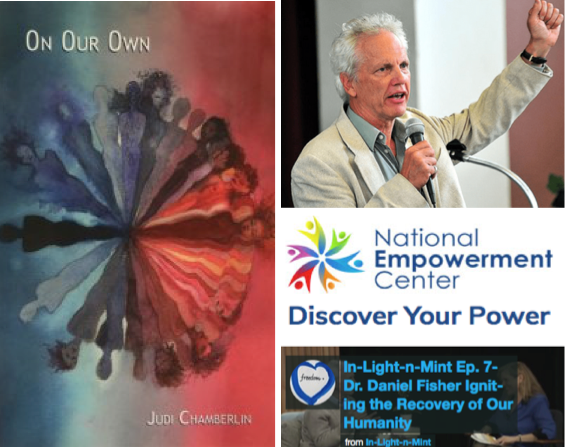
Dr. Daniel Fisher, a psychiatrist, was connected to MPLF, was an ex-patient with schizophrenia and founded the National Empowerment Center, where “research has shown that people can fully recover from even the most severe forms of mental illness. In-depth interviews of people diagnosed with schizophrenia have shown that these people are capable of regaining significant roles in society and of running their own lives. In most cases they no longer need medication, and use holistic health and peer support to continue healing.”
Prevention
My own nature compelled me to go further. I was a teacher, a corporate CEO, and began doing volunteer work in the mental health system to see what I could do to help those patients overwhelmed by the system. My experiences gave me insight into others having difficulty with emotions leading to mental illness. I became determined to talk about prevention in the general public.
In 2018 I wrote my 3rd book to guide others in my industry, Past, Present, Future: A Fashion Memoir, 70 Years of Design, Manufacturing, Engineering, Education & Technology. The successful results induced me to become a writer of my life experiences with a committed target to help others. In 2019 I began writing for Medium.com, and my target area now is the emotions. It is unbelievably the best timing for expanded research and exploration into the mind and emotions. There is much happening in the science, health and technology areas. There are a lot of prevention ideas in physical health — but no prevention ideas in mental health. My experiences are living proof that everyone can benefit from mental/emotional exercises to prevent mental illness. All my posts in Medium discuss that belief.
· Philosophy of Emotion, Studying my inner mind and life experiences
· Get Fit Mentally, Keys are Awareness and Balance, Know Yourself and Love Yourself
· Uniqueness and Differences, Ego is really eqi-different
· Dying and Awakening to Who I Am — By ridding oneself of past trauma
Initiating Get Fit Mentally programs
In the Get Fit Mentally article in Medium I talked about a program at the Quincy YMCA. I am meeting next week with Katelyn Szafir, Associate Executive Director, to work out the details. We will develop mental/emotional exercises wholistically with physical exercises.
Julie Sedivy, author of Language of Mind: An Introduction to Psycholinguistics, in Nautilus says, “Perhaps people living in medieval societies were less preoccupied with the intricacies of other minds, simply because they didn’t have to be. When people’s choices were constrained and their actions could be predicted based on their social roles, there was less reason to be attuned to the mental states of others (or one’s own, for that matter). … The ability to accurately grasp the thoughts and emotions of others [empathy], or mentalizing ability, varies quite a bit from person to person — and there’s growing evidence that complex mentalizing skills are culturally transmitted through a slow learning process, much like reading or playing chess.”
I call this empathy and social cognition, and they will be important parts of the mental/emotional exercise in Get Fit Mentally.
Ralph Waldo Emerson — “The purpose of life is not to be happy. It is to be useful, to be honorable, to be compassionate, to have it make some difference that you have lived and lived well.”


