Nergis Mavalvala — The Pride of Pakistan.
Nergis Mavalvala named Dean at School of Science at MIT
Astrophysicist and associate head of the physics department will succeed Michael Sipser.
Awards are shy of her. Her achievement has no conspicuous parable. This day is the happiest day of my life. As a Pakistani i accept her achievement with open heart and celebrate it with my peers from my nation.
Congratulations to Pakistan.
Mavalvala will be the first woman to serve as Dean in the School of Science at MIT.

Not sure how else to say this. This makes me SO PROUD.
The News!
The proud moment for our nation.
Nergis Mavalvala named Dean of School of Science at MIT. Nergis Mavalvala is a Pakistani-American astrophysicist known for the role played by her research in the detection of gravitational waves.
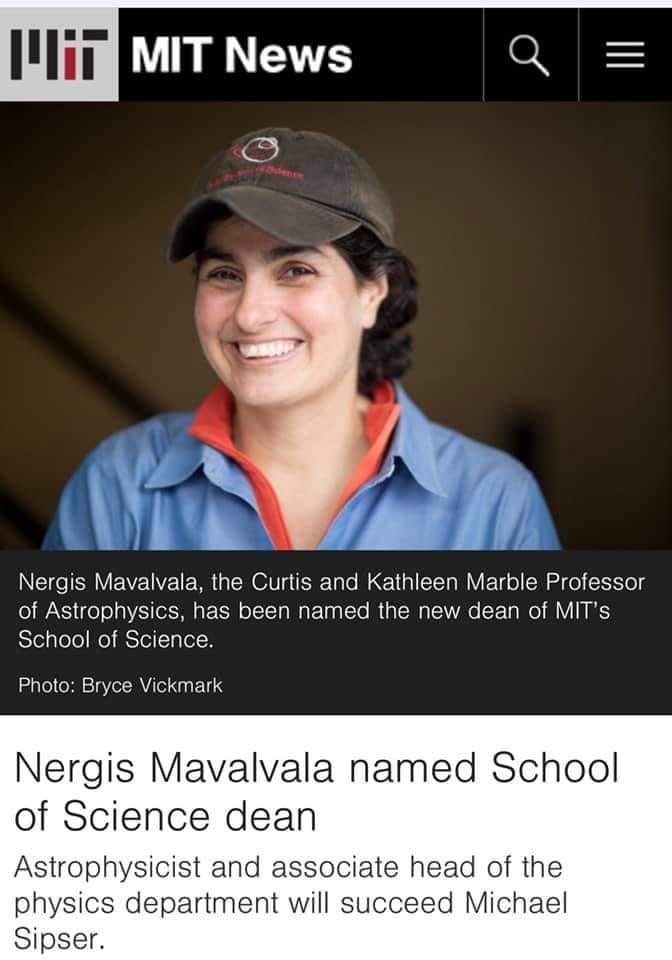
Nergis Mavalvala (born 1968) is a Pakistani-American astrophysicist known for her role in the first observation of gravitational waves. She is the Curtis and Kathleen Marble Professor of Astrophysics at the Massachusetts Institute of Technology (MIT), where she is also the Associate Head of the Department of Physics. She was awarded a MacArthur Fellowship in 2010.
Mavalvala is best known for her work on the detection of gravitational waves in the Laser Interferometer Gravitational-Wave Observatory (LIGO) project, but she has also obtained prominent results on other physics problems that evolved out of LIGO: for example, she has performed pioneering experiments on laser cooling of macroscopic objects and in the generation of squeezed quantum states of light.
What does the MIT President say about her:
“Nergis’s brilliance as a researcher and educator speaks eloquently for itself,” says MIT President L. Rafael Reif. “What excites me equally about her appointment as dean are the qualities I have seen in her as a leader: She is a deft, collaborative problem-solver, a wise and generous colleague, an incomparable mentor, and a champion for inclusive excellence. As we prepare for the start of this most unusual academic year, it gives me great comfort to know that the School of Science will remain in such capable hands.”
Provost Martin Schmidt (shares responsibility with the president) announced the news today in a letter emailed to the MIT community, writing, “I very much look forward to working with Nergis and to benefiting from her unerring sense of scientific opportunity, infectious curiosity, down-to-earth manner and practical wisdom. I hope you will join me in congratulating her as she brings her great gifts as a leader to this new role.”
Life
Mavalvala was born in Lahore but primarily raised in Karachi, Pakistan. She attended the Convent of Jesus and Mary, Karachi, where she received her O-Level and A-Level qualifications. She moved to the United States in 1986 and enrolled at Wellesley College, where she received a bachelor’s degree in physics and astronomy in 1990. Before she graduated in 1990, Mavalvala and her physics professor, Robert Berg, co-authored a paper in Physical Review B: Condensed Matter. She also helped set up his lab. She went on to do her PhD in physics from MIT in 1997.
Born to a Parsi family, Mavalvala was the younger of the two children. Mavalvala’s parents highly valued their daughters’ educational experiences and encouraged Mavalvala to pursue higher education overseas. Mavalvala was always interested in math and science as a child and believed that she was intrinsically good at it, in contrast to the humanities.
Mavalvala is often viewed as a role model for aspiring female scientists of South Asian descent. As a young child Mavalvala was always involved in handy work and was not bound to stereotypical gender roles in South Asian culture, due to the way her sister and she were raised. Mavalvala states that a lot of her success is accredited to good mentors in both the United States and Pakistan that encouraged her academic ability. In a television interview in 2016, Mavalvala stated that “When everyone has access to education that’s when all the other things come into place… People should just do what they enjoy most and i think for all of society whether it’s in Pakistan or elsewhere we have to create opportunities for young girls to do what they’re good at and do what they love to do must cultivate the sense of wonder in a child”.
Mavalvala was among the team of scientists who, for the first time, observed ripples in the fabric of spacetime called gravitational waves. Mavalvala has been working on gravitational waves since 1991. It was announced to the public on 11 February 2016. The detection confirmed a major prediction of Albert Einstein’s 1915 general theory of relativity.
What is a message she has for Pakistanis?
During an interview with Pakistani newspaper Dawn, after the detection of gravitational waves, she claimed that she was baffled by the public interest in her research in Pakistan. She said “I really thought of what I want people to know in Pakistan as I have garnered some attention there. Anybody should be able to succeed — whether you’re a woman, a religious minority. It just doesn’t matter.”
Mavalvala has also worked on the development of exotic quantum states of light, and in particular the generation of light in squeezed coherent states. By injecting such states into the kilometer-scale Michelson interferometer of the LIGO detectors, her group greatly improved the sensitivity of the detector by reducing quantum noise; such squeezed states also have many other applications in experimental physics.
Read more: https://massivesci.com/articles/nergis-mavalvala-physics-gravity-queer/
Thank you. The article ends here.
— — — — — — — — — — — — — — — — — — — — — — — — — — — — — — — — — — — — — — — — — — — — — — — — — — — — — — —
Further Reading For Scientists
Nergis Mavalvala says in an interview:
If you want to design a detector to measure any effect, the first thing you have to ask is, “What does the effect do? What happens when a gravitational wave passes by us, here on Earth?” On Earth, and anywhere in space, these ripples shrink and stretch space itself. It is like a rubber sheet — it expands when pulled, and contracts a little later.
Space itself is like a rubber sheet — it expands and contracts
The principle behind detecting gravitational waves is to measure this change in distance between two points caused by such a passing gravitational wave. Easy, right? Take a ruler, measure the distance, and if that distance gets shorter, the ruler will tell you. But the problem with gravitational waves is that they are really weak, and incredibly faint. When you are trying to make measurements at magnitudes 1/1,000 the width of a single proton, you cannot buy anything from the shop. Everything has to be made by us.
When I started graduate school with Rai Weiss, he told me that LIGO [the Laser Interferometer Gravitational-Wave Observatory] was about to be built and that I could probably get data from the first instruments that were built. That data did not come until 20 years later. But I didn’t feel impatient or discouraged because there were so many discoveries along the way.When I started graduate school with Rai Weiss, he told me that LIGO [the Laser Interferometer Gravitational-Wave Observatory] was about to be built and that I could probably get data from the first instruments that were built. That data did not come until 20 years later. But I didn’t feel impatient or discouraged because there were so many discoveries along the way. We were constantly innovating. We were building the most precise ruler in the world. [LIGO’s advanced lasers have been used to build LED chips, iPhone printed circuit boards, and Intel microprocessors.]
On September 14, 2015, gravitational wave GW150914 reached Earth; 1.3 billion years ago, two black holes had collided into each other, emanating ripples through the universe. She saw the signal….
Play the video to listen to the signal.
https://www.youtube.com/embed/TWqhUANNFXw
..
..
Being a Pakistani woman physicist, were there personal or professional barriers placed that make/made it difficult, because of those labels?
[Mavalvala laughs] I am the type of person who does not notice barriers. So if there are any, I tend to walk right through without noticing I crashed into one. — Nergis Mavalvala — [interview ends]
I guess I agree with Nergis Mavalvala on this, I have never even noticed barriers, let alone be affected by them.
I would like to thank the Massachusetts Institute of Technology for transcending the barriers of race, creed and nuance while giving us a chance for discovery.