
Neocolonialism: How Western Corporations Are Exploiting Africa
The ongoing cycle of poverty in Africa and the failure of development.

The African continent has the natural resources and commercial power to become the richest continent in the world but oppression, bribery, and exploitation by the west hinder its’ development.
Neo-colonialism is no doubt the number one problem to Africa’s economic development. Many would think that Africa gained independence from the imperialist western countries, but to what extent? It is very much debatable.
This term was coined by the first president of independent Ghana Kwame Nkrumah, he defined the term as:
‘The essence of neocolonialism is that the State which is the subject to it is, in theory, independent and has all the outward trappings of international sovereignty. In reality, its economic system and thus its political policy is directed from outside.’
This was written in his book ‘Neo-colonialism: The Last Stage of Imperialism’ in 1965 but it attracted a lot of criticism. Consequently, he was overthrown by a military coup abetted by Washington. Even from this example, one can see how much the USA is embedded in political decisions in Africa.
How France is siphoning money of African states
The 14 African States declared independence from France, these are Benin, Burkina Faso, Senegal, Cote d’Ivoire, Mali, Niger, Togo, Cameroon, Central African Republic, Guinea Bissau, Equatorial Guinea, Chad, Congo-Brazaville, and Gabon.
When those states declared independence from France, the French government put all the former colonies in a group called ‘compulsory solidarities.’ This meant that those independent states would need to pay 65% of foreign currency reserves to the French treasury and 20% for their financial liabilities. So each colony has only 15% left to use from their own money (Mawuna Koutonin 2014).
Though last year, France did try to loosen up the control of ‘colonial’ West African currency. The currency in those countries is called French Colonies in Africa or CFA. Thus, CFA countries will plan to no longer keep more than half of their reserves in Paris (The Financial Times 2019).
A currency reform is underway this year and 8 West African countries plan to launch a regional currency called ‘Eco’. This is a symbolic change but it does not undo the years of exploitation and the forcing of those states to be indebted to France.
In March 2008, former French President Jacques Chirac said:
“Without Africa, France will slide down into the rank of a third [world] power”
Foreign trade as a form of exploitation
Foreign trade is just one of the ways that fuel labour exploitation. This was shown by Nkrumah who asserts that unfair trade deals are a “device” for entrenching neo-colonialism.
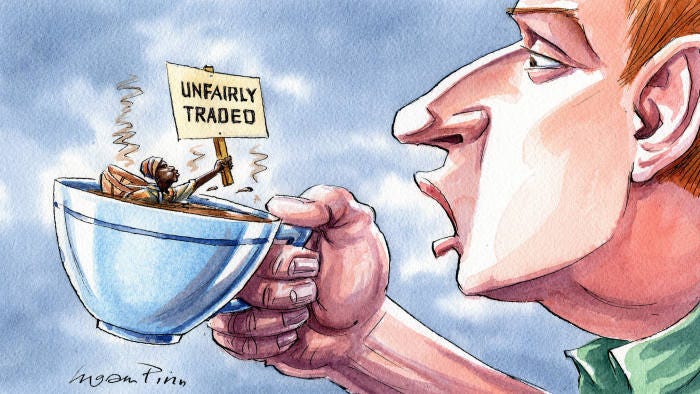
Some examples of unfair trades
Cocoa
West Africa is known for producing one-third of the world’s cocoa, mostly in West Africa including Ivory Coast and Ghana. But, most of it is obtained with unfair trade deals and child slavery.
A reporter and investigator spent 15 days in Ivory Coast and found out that child labour is still profound in cocoa farms, even after 20 years of pledging to eradicate child labour. As a consequence, the well know brands Hershey, Mars and Nestlé — could not guarantee that any of their chocolates were produced without child labour (Whashington Post 2019).
Coffee
Ethiopia’s ‘Arabica’ coffee is the biggest exporter in Africa, then comes Uganda, Kenya, Tanzania and Cote d'Ivoire. But it is said to be those coffee farmers in Ethiopia sell up to $4 for a kilogram of coffee while large coffee corporations make up to $200 for each kilogram of coffee. This means foreign investors and corporations like Starbucks make millions as a result of slave labour.
Gold, Diamonds and Platinum
Africa is full of profitable natural resources that the West always wanted to exploit.
Mark Curtis a Journalist released a report on the ‘Britain’s scramble for Africa’s energy and mineral resource.’ He talks about how British companies have mining operations in 37 sub-Saharan African countries. They collectively control over $1 trillion worth of Africa’s most valuable resources.
British gold companies like Acacia Mining Plc and Randgold Resources control 12.5 million ounces of gold
Mining companies such as Anglo American and Petra Diamonds produce more than one-third of the world's diamonds.
Platinum is also concentrated in South Africa and mainly controlled by Anglo American plc and Jubilee Platinum.
There are obviously other western companies that invest in Africa's natural resources, but the corporations above are the main ones that should be taken into account. The crucial fact is that under the guise of helping African in its economic development, it is instead a continuation of the colonial narrative.
It is widely known that many children especially in the Democratic Republic of Congo are forced to work in dangerous mines with little or no pay. Some of them die from tunnel collapses or suffer from injuries.
Many tech giants like Google, Apple, Dell, Glencore and Microsoft should be held accountable. There is evidence to suggest that these companies are aware that the cobalt they use in their products is sourced by child labour but clearly aren’t doing enough to stop it.
‘Blood Diamond’ Movie 2016
Filmed in Sierra Leon featuring Leonardo Di Caprio and based on true events. This movie gives us a good idea of the corruption and bribery that goes on in blood diamond trades.
The story plot is set in the Sierra Leon Civil War between 1991- 2002. It illustrates the illicitly mined diamonds that were being used to finance wars in Africa.
As a result, in 2003 human rights advocates helped to establish the ‘Kimberly Process’ where diamond companies had to provide an international certification that the diamonds were ‘conflict-free’.
Conflict diamonds are still an issue for certain African states.
In a 2015 study, the Enough Project said the main armed groups in the Central African Republic profit anywhere between $3 million and $6 million annually from blood diamonds that fund violent factions.
In conclusion, the main problem to Africa’s economic development comes from multinational corporations that benefit from slave labour and commercial exploitation. Kwame Nkrumah was right to say that globalisation and capitalism in the post-colonial era only bought dependence and financial obligation towards the neocolonialist nations like Britain, France, Belgium and the USA.
Sources
https://blogs.lse.ac.uk/africaatlse/2017/11/15/lets-talk-about-neo-colonialism-in-africa/


