
Negligence Nearly Killed My On-Stage Costar in Front of a Packed House
Slammed: a Memoir — Chapter 11 Part 3
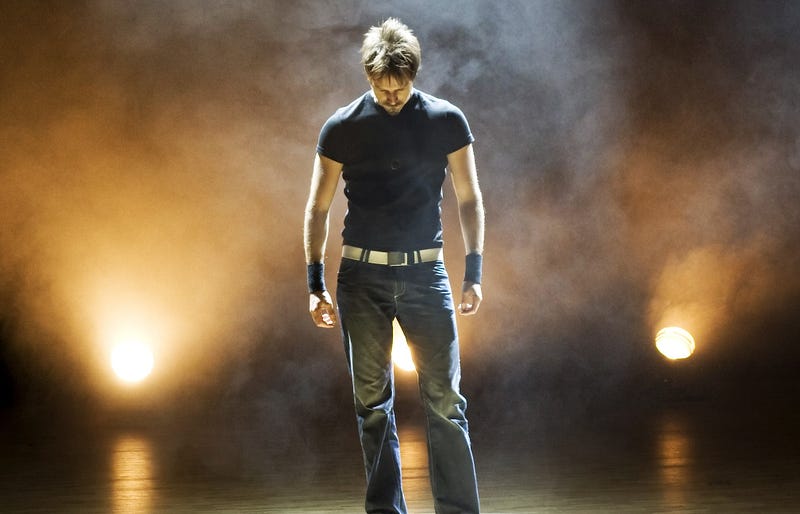
I arrived at the dinner theater near Dayton, Ohio a day before rehearsals for Jesus Christ Superstar. Though I was ready to play Simon Zealot, the weight of understudying both Jesus and Judas was starting to hit me.
The first to arrive, I parked and made my way into the front lobby to check in with the artistic director.
The lobby was dark save for the sunlight coming through the glass doors. There was a ticket counter on one side and a gift shop on the other. The shop sold Broadway posters, theater kick knacks like porcelain miniatures of The Phantom of the Opera mask, as well as non-theater kitsch you could find at any Hallmark store. The beige walls, frosted sconces, and conservative furniture gave the lobby an undefined midwestern feel.
“Welcome back, John,” said the artist director. He was about fifty, well over six foot, thick around the middle, with a round head of silver hair that reminded me of a character from the Family Circle newspaper comic. “Before we get you settled in, we need to have a talk.”
Uh oh, I thought. I started racing through my brain for what I could possibly have done.
“We need you to play Jesus.”
“… What?”
“The actor we hired quit so I need you to do it.”
“Oh! Oh? Um…ok. Sure?”
“Good, now let’s get you settled. You remember where cast housing is.”
And that was it.
I was now Jesus.
I was the lead.
I was the lead?
I was the lead!
What?!
If I had any presence of mind, I would have said “Then I need a new contract and we need to talk about money.”
But I didn’t. I was too shocked.
I went outside, called Jason, and screamed my news at him like an excited Muppet. As more of the cast arrived and the inevitable questions of “Who are you playing?” started flying around, I said “Jesus”, trying to be nonchalant and not grin from ear to ear like an idiot.
It wasn’t until the next morning as we gathered for our first rehearsal that the weight of my job really landed.
I was the lead.
I was the title character.
I was the fucking lead.
I was … the Superstar!
It was the first time in my professional career — outside of Springfield Rep — that I was a lead in a professional production.
I’d played Jesus, so I knew I could sing the role, but that had been an amateur production.
Was I good enough for a professional production?
I knew I could sing. I was fairly proud of my instrument. But this was eight shows a week for two months.
Could my voice handle it?
It was already warm on the August morning of our first rehearsal, and it was only going to get hotter. Our rehearsal studio was the scene shop behind the theater. It smelled of sawdust and paint. Its metal walls and roof made it an oven.
As I wiped the sweat from my brow — the first of many times that day — a tall guy came in and sat down next to me.
He was gorgeous!
Dreamy doesn’t even begin to describe.
He had near-shoulder length light brown hair, dark piercing eyes, and a strong angular jawline. He had the kind of mischievous smile that made it difficult to look him in the eye without giggling.
New thought: Was I attractive enough to be in this show?
“Hi, I’m John,” I said, offering my hand.
“Dan.”
“Jesus,” answering the question before it was asked.
“Judas.”
Inside, I skipped for joy that I’d be spending my time with such an attractive betrayer, wondering if Jesus could keep from giggling.
As we conversed, the topic of shows we’d just done came up.
“I just got off the Rent tour.”
“As?”
“Roger,” he said nonchalantly.
Oh fuck off.
The other male lead in the show had just left the tour playing the lead of the rock musical of our generation.
Fuck my life, forget attractive enough. Was I talented enough to hold my own against someone like Dan?
Was this a mistake?
Rehearsal began with welcomes from our director Jacob and music director Brad. They were clearly good friends and an interesting visual pair. Jacob was as short as Brad was tall.
As rehearsal began in earnest, we started with the first ensemble number, “What’s the Buzz.”
I had a minute to wait as Brad worked with the ensemble for a few minutes. I couldn’t help but spy Jacob off to the side. He was pacing. He seemed tense. When I’d introduced myself to him again earlier, if he had any concerns about me taking over Jesus, I couldn’t tell. Still, I had to wonder, was my taking over as Jesus his idea or at least something he agreed to? Or had the artistic director forced the choice on him? Having worked at this theater before, I knew the latter was definitely more on brand.
“John, you ready to go into the verse this time?”
“Yes.”
Brad laid into the music.
The cast came in strong. “What’s the buzz?/Tell me what’s-a-happening/What’s the buzz?/Tell me what’s a happening.”
Adrenaline pounded through my body. I gripped my music binder so hard it bit into my fingers.
I’ve done the show before. I’ve sung this part before. Just do what you did before. Just do that.
My entrance got close. I inhaled.
“WHY should you want to know?/Don’t you mind about the future./Don’t you try to think ahead./Save tomorrow for tomorrow./Think about today instead.”
It came out strong, exactly as I wanted it to, exactly as I had done it before.
I looked up to see surprise on Jacob’s face. “Ok,” he said as he relaxed. “Ok,” he said again, visibly lighter. A question had clearly been answered.
Maybe… I was good enough to be here.
For the next two weeks we crafted the human story of Jesus.
Dan was as talented as he was gorgeous and a great scene partner. Together we created a relationship of two best friends whose dreams of changing the world had drifted apart.
Mary was played by a beautiful young woman with long, straight black hair. She had a clear and soul-filled sound, both sounding and looking like she’d been plucked out of the height of the ’60s American Folk revival movement.
And I held my own with these two beautiful artists and collaborators.
In the beginning of the second act I sang “Gethsemane,” an absolute beast of a song. With my HIV diagnosis barely a year old, “the song’s central question of “why should I die?” became my nightly catharsis. While the audience watched Jesus struggle with his fate, asking God to “take this cup away from me,” I was challenging God as to why I had been put through the trauma of the last two years. It was my therapy and my favorite part of the show.
My first professional lead was turning out to be an absolute joy. I like to say that we gave those edge-of-the-Bible-Belt audiences The Passion of the Christ: the Musical!
It was the kind of artistic experience I’d always dreamed of.
Until halfway through the run.
In the 2nd Act, after Jesus is arrested, I would leave the stage to change into a loincloth in preparation for the last stretch of the show: the trial and crucifixion. Off stage I would get into the headspace to die on the cross while also thanking the gods I’d embraced a fitness routine when I did.
While I was off, Dan took the stage as Judas. Wracked with guilt for what he’s done to Jesus, he confronts the Pharisees and God about being saddled with his role, being played for a puppet. The section climaxes with Judas’ suicide. Judas cries “You have murdered me,” putting a noose around his neck and killing himself.
In our production, a fake noose was flown in from above. It was a hangman’s knot: a loop hanging out of a long, thick spiral of rope.
Dan’s feet never left the stage. Instead, Dan would put the loop around his neck, step forward, say “You have murdered me” one last time, then the female ensemble dressed in dark robes would swarm him and whisk him off stage à la the shadow demons in the movie Ghost. Then I would enter and take my place center stage, ready for the trial and crucifixion.
Everything worked perfectly for four weeks.
Then one night, as I hid behind the set waiting to enter, I heard Dan say, “You have murdered-erch!”
I couldn’t see what happened.
The female ensemble entered, but they didn’t leave as quickly as they should have.
I entered anyway, ready to slip into place, only to find that Dan was still onstage. He and the female ensemble were frantically trying to do something.
They were trying to… free Dan.
The noose.
It wasn’t fake.
It was a working slipknot noose!
When Dan stepped forward the noose closed around his neck.
What’s worse, the technical director — in charge of creating the noose — weighted it with a metal bar hidden inside the noose neck.
For the better part of a minute — though it felt like an hour — Dan, the female ensemble, and I tried to pull the noose off of him. We struggled against the heavy metal bar to loosen the rope.
At last, we got the noose loose enough where Dan could pull it over his head, though not without the rope scraping his face.
Finally, Dan and the female ensemble fled the stage, leaving me as I should have been, laying center stage in a loincloth.
The rest of the show was a blur. I had trouble focusing, stunned over the tragedy that had nearly happened in front of a full house.
To say that the cast was angry wouldn’t give them enough credit.
We wanted blood!
None of us had a very high opinion of the theater or how it was run, even before this incident.
But the audacity. The negligence. To put your actors in real danger.
To tie a real, working, goddamn noose!
Immediately after the show, Dan got the technical director on the phone, telling him what had happened.
Instead of any acknowledgement of responsibility or apology, the technical director told Dan it must have been something Dan had done since “it worked perfectly fine till now.”
And that was it.
The cast never received any explanation, assurances, or apology from anyone. Not from the technical director, not from the artistic director, no one. We were simply expected to show up and do the next show as if nothing had happened.
And we did.
We were a non-union company, so nobody had our backs. The theater did have a guest Actors Equity contract agreement that they didn’t happen to be using with this show. There was talk about reaching out to Equity to report the incident, seeing if maybe we could get that agreement revoked, but as far as I know, no one pursued it.
We just showed up and did the show again.
But it was different. The show was different.
As far as the audiences were concerned, the show didn’t change. Everyone was enough of a professional to keep doing their jobs.
But that’s what it became for almost everyone from that point on: a job.
The energy, the personal investment into the storytelling by the company as a whole was gone.
For most of the cast, it was no longer about telling a story. It was about just getting through it.
What I didn’t appreciate at the time was sometimes a job is just that: a job. Not every gig is going to be artistically fulfilling. Hell, most won’t be. It’s a job, a line on a resume, a step on the ladder of your career. If you’re lucky enough, it pays the bills.
But not for me.
Barely months after crawling out of a deep, dark rabbit hole of meth, I’d been granted a chance for redemption, an opportunity to lead. The fates had blessed me with a vehicle into which I could pour all my rage, all my desperation, all my trauma, all my passion, all of me.
I’ll be damned if I was going to take a single performance for granted.
I was too committed to telling this story, too committed — perhaps even addicted — to the nightly catharsis each show was giving me. I mean, honestly, you can’t just phone in Jesus. You can’t just “get through” being crucified. As far as I was concerned, it was either 100% or not at all.
Consequently, it felt like it was left to the three of us — Jesus, Judas, and Mary — to carry the show. I still enjoyed doing the show, but it was so much more exhausting.
I started counting the days till closing.
Till I could get back to New York.
For all the wrong reasons.
Next Chapter
Closing Jesus Christ Superstar, Meth Found Me Again
Slammed: a Memoir — Chapter 11 Part 4
medium.com
Chapter Guide
A lot of heart, time, and work goes into each piece. One way you can support me is by signing up for a $5/month Medium Membership. Use this link and I’ll get a percentage of your subscription fee. Huzzah for supporting artists!