
Need inspiration? Then train your ideas muscle
A new creative habit: 10 ideas a day teaches your brain to play
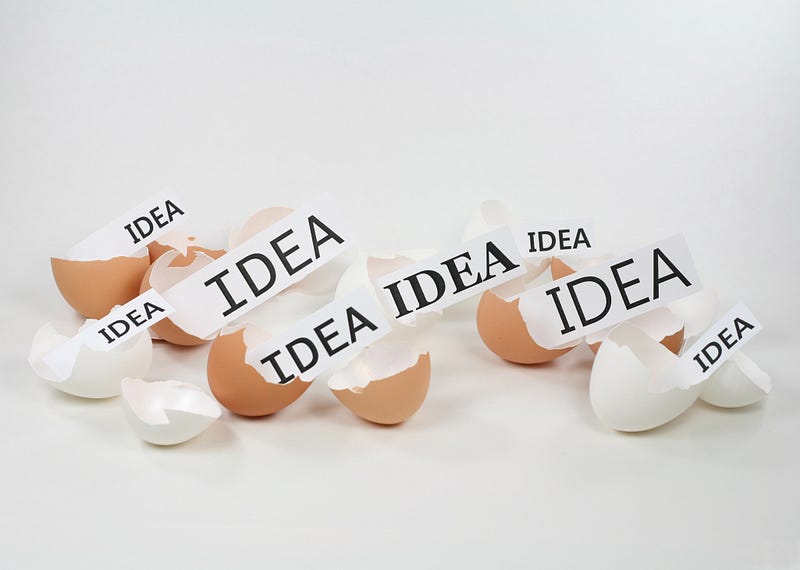
Instead of making the usual list of New Year resolutions that I knew I’d break before the end of January, this year I set out to gradually introduce 12 new creative habits, one for every month of the year.
It was harder than I thought.
As it turned out, 2020 just wasn’t the best time for establishing new habits. Not when all our existing routines were turned upside down.
Still, I’ve succeeded in quite a few. I’m now seeing the benefits of regular meditation and journaling, a daily walk and more focussed learning.
Last month, I wanted to try a habit recommended by James Altucher in his inspiring book Choose Yourself. He talks about exercising your idea muscle, by getting your mind into the habit of creating at least ten new ideas a day.
There are two steps to this.
1. Feed your mind
He recommends that every day, you read/skim chapters from books about at least four different topics.
I’ve made sure that I always have a pile of books to dip in and out of, and I also have a swipe file with articles I’ve bookmarked, podcasts or talks — anything that looks interesting.
This needn’t take long. You’re not trying to go deep, to read or listen to the whole thing. You’re just giving your mind a few tasty new morsels to chew on, the chance to make new connections.
As Altucher says, “Ideas mate with other ideas to produce idea children.”
2. Write down ten ideas a day
I do this every day in my journal, as part of my Morning Pages practice. So it was easily added into my existing routine. But you could also do it on your phone on the way to or from work, in a coffee break: any regular time you have 10 minutes or so to think.
Some of the lists I’ve played with:
- Ten ideas that are too big for me
- Ten ways to change the world
- Ten ideas that are too scary for me
- Ten ways to improve my workspace
- Ten books I could write
- Ten courses I could teach
- Ten podcasts I could create
- Ten inventions I wish existed
- Ten alternative lives I’d like to have experienced
- Ten new ways to sell my work
- Ten systems I could put in place to save time
- Ten people I should know
- And ten ways I might connect with them or be useful to them.
You can write down 10 random ideas, or have a theme that carries on over a few days.
The point is to stretch. The last few ideas should be a bit of a push, just as the last few reps in the gym are harder. And, of course, they are the ones that actually build new muscle.
Let go of judgement
Nothing is too ridiculous, rude, absurd or ambitious to write down. You don’t have to put these ideas into action (not all of them, anyway). You’re just training your brain to sift through what it’s learned, and become accustomed to creating new ideas, constantly.
Altucher reckons it takes 6–12 months to become an ideas machine. After doing this for the past five weeks, I feel more like a machine that has been left outside to rust, but is just getting a little oil to lubricate its seized-up cogs. It’s creaky and stiff, but I can see it will start to move more easily with use.
More ideas to explore
Want to be more healthy? List 10 small changes you could make. Do that every day for two weeks, and you’ll have 140 suggestions — at least some of which you’ll want to implement.
Short of ideas for your blog/your art/your songs? Ten a day for a week is 70 new potential ideas. That gives you good odds on finding some that will actually be worth trying.
Not earning enough? Think of 10 different ways you could make or save money, every day. A month of that will give you 310 cash-generating ideas. Some of them will be absurd. A few might even be offensive. But some of them will be things you could really do. Remember small changes make a huge difference, over time.
You won’t find your genius overnight
If you don’t come up with a good idea immediately, you haven’t failed. The aim is to have thousands of ideas — good, bad and indifferent — over time. To develop your creativity and turn your mind into an endlessly productive ideas machine.
I’m not there yet, but I’m going to persist with this one. So far, I’ve made myself laugh out loud quite a lot. I’ve already found a couple of ideas worth using. And the huge, guilt-inducing backlog of books and articles I want to read is turning into a smaller, much more manageable pile of stuff I want to return to and read more deeply.
But mainly, this new habit is fun. Which tends to be the ones that stick.
Sheryl Garratt is a writer and a coach helping creatives to get the success they want, making work they love. Click here for my free 10-day course, Freelance Foundations: the secrets of successful creatives.


