
Need an Idea? Read an Old Book
Old books, new discoveries
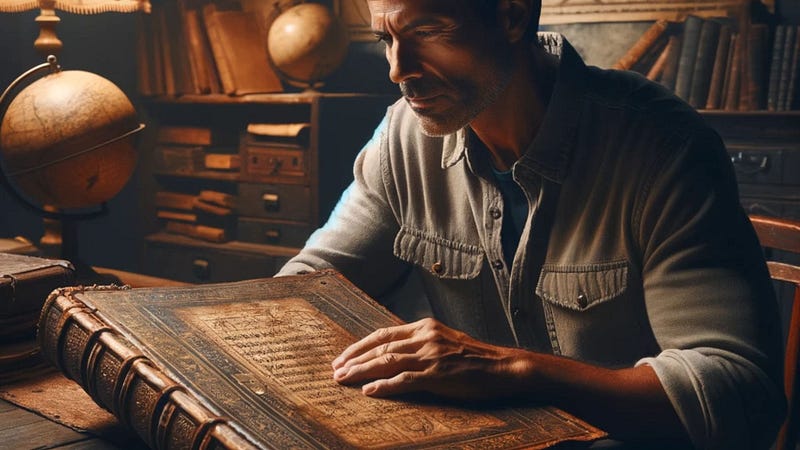
As solopreneurs, we are always eager to try out unexplored and creative ideas.
This often leads us to endless scrolling for information and fleeting trends.
I go around in circles when I sit at my desk and think about new ideas.
The search for new ideas or insights to guide me through the complexities of life is a journey of discovery for me.
I have dreamed of something more substantial, more lasting.
If you have been following my posts for a while, I am currently reading the book “Think Like a Monk” by Jay Shetty.
One of the quotes in that book made me realize something very significant.
“If you need an idea, read an old book”
The answers we are looking for may have been written down long ago.
The people who lived before us had the same questions and problems as we do.
They wrote their thoughts and ideas in books to better understand life.
According to Jay, these old books are like hidden treasures full of wise advice that still applies to our generation.
I thought, why not go back and read what they wrote?
This inspired me to read the “Bhagavad Gita (The Song of God)”.
I decided to read this holy book not just because of my religious faith but for several reasons.
Firstly, since childhood, my parents and relatives have always advised me to read it at least once.
In the book “Think Like a Monk,” Jay also refers to some of the best wisdom quotes of Lord Krishna that touched me deeply.
The Bhagavad Gita is an influential religious text in Hinduism that takes the form of a dialogue between Prince Arjuna and Krishna, an avatar of the Hindu deity Vishnu.
The Bhagavad Gita is a conversation between Prince Arjuna and Krishna, his leader, in the midst of a dharma war.
Arjuna is angry and confused about fighting his relatives and considers giving up the war.
Krishna advises him to fulfill his dharma (purpose or duty) as a warrior.
Many spiritual and moral issues are raised in their dialogue.
The story is like a metaphor for the challenges of life.
It made me think that my life revolves around the same problems.
I thought there couldn’t be a better time to read this book.
His words can help us sort things out in our own lives.
Starting with the Bhagavad Gita and Think Like a Monk, I immersed myself in these ancient books that blend with the modern world.
Here I am already in the middle of reading “Think Like a Monk” and have read a few pages of the sacred Bhagwad Gita.
Every day, I feel like discovering the timeless wisdom that is as relevant today as it was centuries ago.
A surprising find
Reading a book for at least half an hour every night before going to bed has always been on my wish list.
I also mentioned it in one of my previous posts about a month ago.
Fortunately, I have kept that promise.
I was in an old-fashioned little bookstore in our neighborhood, roaming aimlessly through the aisles.
I was looking for something that might ignite a spark in me.
I picked up the book by Jay Shetty because the title (Think Like a Monk) caught my eye.
It was intriguing and promised a mix of old and new, which I found very appealing.
When I held the book, I was overcome with curiosity.
I felt connected to the words that seemed to jump at me as I flipped through the pages.
It was as if the book was calling me on a journey into a world where the wisdom of the past meets the challenges of the present.
I felt more drawn to the idea of exploring ancient wisdom to find answers to today’s questions.
The first few pages
Jay begins by addressing the fast-paced, information-overloaded world we live in.
A world where original ideas are rare.
Everything he says in this book is based on his experience as a monk in an ashram (monastery) in Mumbai, India.
He talks about what prompted him to spend time in the ashram instead of the pubs during his annual vacation at college in London.
He argues that old books are treasure troves of wisdom.
They are waiting to be rediscovered and applied to our modern lives.
That is why his mentor (Guru Gaurang Das) in the ashram advised him to serve and give back to society and not to be a monk all his life.
Applying ancient wisdom to modern life
One of Jay’s first examples is Marcus Aurelius’s “Meditations”.
He explains how this Roman emperor’s thoughts on stoicism can help us deal with stress and anxiety today.
Seeing how advice from almost two thousand years ago can be so relevant today was fascinating.
I was particularly impressed by this part.
Applying Aurelius’ principles taught me to focus on what I can control and let go of what I cannot.
This has significantly changed my approach to daily challenges.
Lessons from the East
Jay delves into Eastern philosophy throughout the book.
He draws beautiful parallels between ancient texts such as the Bhagavad Gita and modern life.
He talks about his experiences with these texts and emphasizes how they taught him about dharma (purpose) and karma (action).
It made me rethink my professional and personal goals and align them more closely with my inner values.
The art of living from the ancient masters
Another chapter that I particularly enjoyed is about the Renaissance period.
Here Jay draws lessons from the lives of artists such as Leonardo da Vinci and Michelangelo.
He talks about how their curiosity and dedication to their craft can inspire us to pursue our passions relentlessly.
This was particularly motivating.
I started writing on Medium in 2019.
I wrote stories at random and then disappeared for months.
I liked this platform since the day I joined.
But somehow, I could never write consistently over a long period
I had to work on this procrastination.
Inspired by their stories, I finally took the plunge and started to write about them based on whatever lessons I was learning through reading these books.
I’m not just writing on Medium; I’ve also set up my newsletter and website.
I have many things on my wish list for next year, and I am convinced I will tackle them when the time is right.
Practical wisdom for everyday life
Jay’s book is appealing because he balances deep philosophical insights with practical advice.
He tells us what is written in the ancient books and how we can apply these teachings daily.
The book offers actionable insights based on ancient wisdom, from dealing with relationships to finding our purpose.
A personal transformation
As I approached the middle of the book, I realized how much my perspective had changed.
I began to see challenges as opportunities to apply this newfound wisdom.
I began to take time each week to read ancient texts like the Bhagavad Gita and found that each reading brought new insights.
Final thoughts
Old books are the true companions to rediscover the wisdom of the past and illuminate our present and future.
Whether you are feeling creatively stuck, looking for a new direction in life, or simply seeking a deeper understanding of the world, there may be an answer in the old books.
Pick up an old book, be it a religious, philosophical, classical, or historical account.
You may find the idea or insight to change your life, as it did for me.
Old books are not just about the past but also about unlocking the potential of our future.
Enjoyed the story? Don’t miss out on future stories — Subscribe Now!
Did the story resonate with you? Join my free email newsletter for bite-sized wisdom and insightful productivity tips.
Inspired or moved? Show your support — Buy me a coffee and make my day!
Originally published at my blog: https://hardikraval.com