
Seven reasons why Nazis are not Socialists
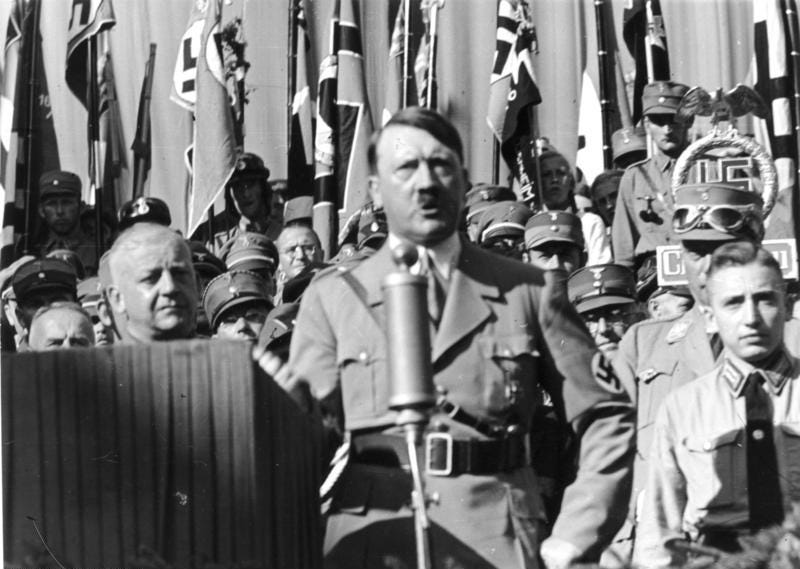
1. “National socialism” is a contradiction in terms. Socialism is international.
The socialist motto is “workers of the world, unite,” not “workers of the world, fight each other.” But socialism was very popular in the Weimar Republic, so in 1920, the German Workers’ Party changed their name to the National Socialist German Workers’ Party. If you think Nazis are socialists because the word is in their name, you must think the Democratic People’s Republic of Korea is democratic.
2. The basic definition of capitalism shows Naziism is a form of capitalism.
capitalism: an economic and political system in which a country’s trade and industry are controlled by private owners for profit, rather than by the state.
Nazi Germany’s trade and industry were controlled by private owners for profit. Though they were regulated by the state just as capitalist businesses are regulated in capitalist countries, capitalists thrived in Hitler’s Germany.
3. Socialists support nationalization. Nazis support privatization.
From Privatization :
The first mass privatization of state property occurred in Nazi Germany between 1933–37: “It is a fact that the government of the National Socialist Party sold off public ownership in several state-owned firms in the middle of the 1930s. The firms belonged to a wide range of sectors: steel, mining, banking, local public utilities, shipyard, ship-lines, railways, etc. In addition to this, delivery of some public services produced by public administrations prior to the 1930s, especially social services and services related to work, was transferred to the private sector, mainly to several organizations within the Nazi Party.”
4. Hitler admitted their idea of socialism was not like anyone else’s.
“Our adopted term ‘Socialist’ has nothing to do with Marxian Socialism. Marxism is anti-property; true Socialism is not.” — Adolph Hitler
Hitler, like all capitalists, didn’t distinguish between personal property and private (or venture) property.
5. The Nazis’ first victims were communists.
First they came for the socialists, and I did not speak out — Because I was not a socialist. Then they came for the trade unionists, and I did not speak out — Because I was not a trade unionist. Then they came for the Jews, and I did not speak out — Because I was not a Jew. Then they came for me — and there was no one left to speak for me.
— Martin Niemöller
6. Capitalists supported Hitler’s rise to power.
From Fritz Thyssen :
In 1923, Thyssen met former General Erich Ludendorff, who advised him to attend a speech given by Adolf Hitler, leader of the Nazi Party. Thyssen was impressed by Hitler and his bitter opposition to the Treaty of Versailles, and began to make large donations to the party, including 100,000 gold marks ($25,000) in 1923 to Ludendorff.
From Adolf Hitler’s wealth and income:
While hyperinflation of the Weimar Republic had crippled the German economy and plunged millions of German workers into unemployment, Hitler and his party received lavish donations from wealthy benefactors at home and abroad. The iconic American car maker and anti-Semite Henry Ford was reported to be one of the foreign supporters. Helene Bechstein, part of a rich aristocratic family who sold pianos, supported Hitler financially and gave him a top hat and business suit. The Ruhr steel barons Fritz Thyssen and Gustav Krupp donated almost five million Reichsmarks to the Nazi Party over the course of the war. The Berghof, Hitler’s private retreat, was renovated at a massive cost, all of it paid for with Nazi Party donations
Much of the party donations were used to pay off many of Hitler’s private projects, such as the Berghof and Eagles Nest. He caused a minor controversy within leading elements of the party when he, in 1925, purchased a luxury Mercedes-Benz and a chauffeur to drive it for a total expenditure of 20,000 Reichsmarks. After examining Hitler’s tax records from the Bavarian State Archives in Munich, economics journalist Wolfgang Zdral said, “He’s driving a Mercedes, which cost incredible amounts of money at the time, can afford to go on travels and has enough money to finance his propaganda appearances. All of this is financed through a system of slush-funds, essentially the donation of larger and smaller benefactors.”
From American Capitalism Funded Hitler & Nazi Germany:
I.G. Farben (controlled by Rockefeller’s Standard Oil) funded 45% of Hitler’s campaign in 1930
German radio (controlled by GE) was one of the primary distributors of Hitler’s propaganda
Focke-Wulf manufactured military aircraft during WWII (30% owned by J.P. Morgan & Co)
Opel and Volkswagen (controlled by General Motors and Ford, respectively) produced military vehicles. And Volkswagen used good ol’ concentration camp slave labor to make their vehicles.
Vereinigte Stahlwerke (Rockefeller bank) partially funded Hitler’s campaign during 1932 elections and became a major contributor to the Nazi war effort during WWII.
From Ford ‘used slave labour’ in Nazi German plants:
Henry Ford is mentioned in Mein Kampf, and was hailed by Hitler, who kept a portrait of the industrialist above his desk, as “my inspiration”.
7. The 25-point plan or National Socialist Program that the Nazis made in 1920 is a jumble of xenophobia and racism.
Only a few points look vaguely like socialism, and they were ignored when the Nazis came into power thirteen years later. For more, see No, Conservatives, the Nazi 25-Point Program Was Not Socialist.
Later: Why Nazis are not Socialists #8: Conservatives Put Hitler in Power