
GLOBETROTTERS JULY CHALLENGE: CELEBRATIONS AROUND THE WORLD
Navratri (or Nine Nights) Festival
A festival in honor of three goddesses, a festival celebrating girl power
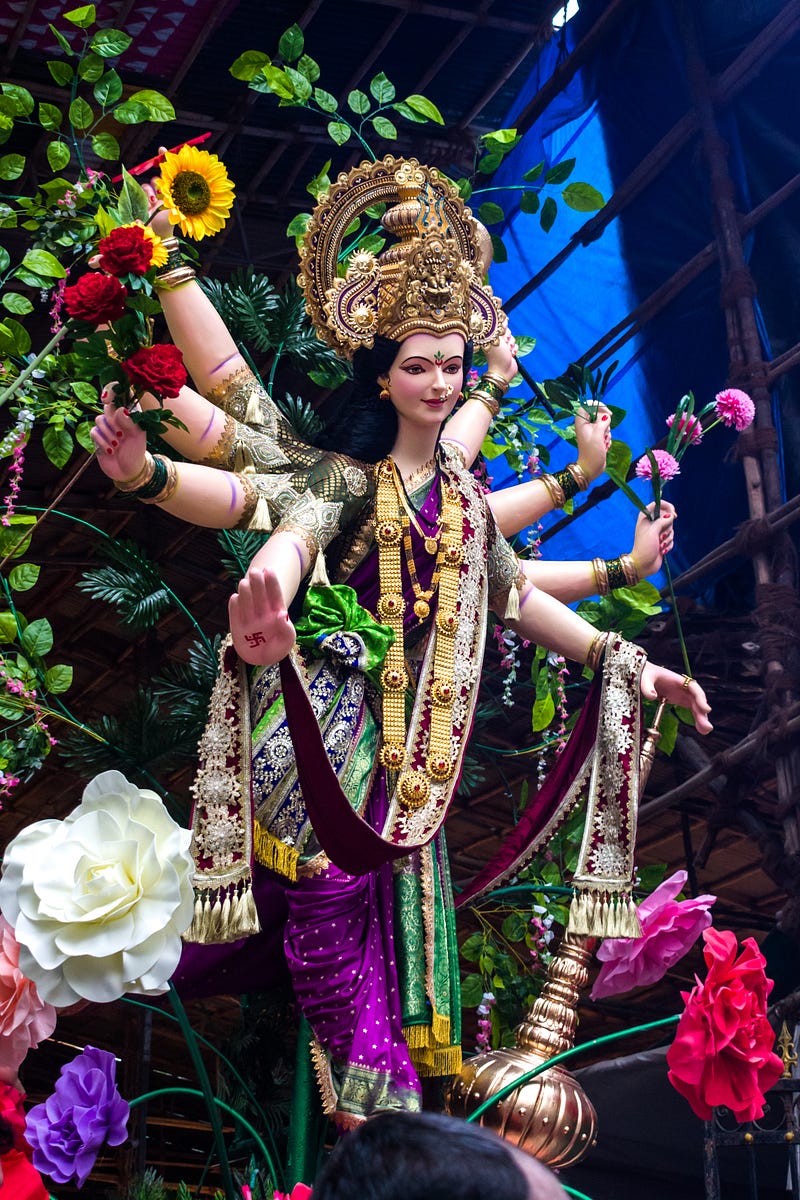
India is a diverse country with different religions and is known for big celebrations in different parts of the country, bringing together a unison of cultures.
The most famous Hindu festival is Diwali or the festival of lights. It’s the equivalent of Christmas for Christians, Eid for Muslims, and Hannukah for the Jewish people. Then you have the Festival of Color called Holi, which is celebrated in north India during the harvest season. Read Darren Weir’s account of Holi here.
As a girl child, growing up in south India, my favorite festival was always Navratri. Translated literally as “nine nights,” this festival falls two weeks before Diwali usually in the months of October or November.
Thanks to popular media you probably have heard of some of the Gods that people worship like Shiva, Ganesh (with the elephant’s trunk), Krishna, Rama, and maybe even Hanuman (with the monkey face). Navaratri is all about honoring the female Gods (aka goddesses). Yeah, girl power!
The festival honors three goddesses for three nights each. The first three nights are for Goddess Durga (to remove barriers and evils), the second three nights are for Goddess Lakshmi (for good fortune and wealth), and the last three nights are for Goddess Saraswathi (for education, arts, wisdom, and learning).
Navaratri has a deep significance beyond the fun and frolic. It is a time when people engage in prayer, meditation, fasting, and even silence. “Fasting detoxifies the body, silence refines speech and calms the mind, knowledge purifies the intellect, and meditation allows us to experience our true nature.” (Madan, 2017 in Deccan Chronicle).
The festival is celebrated differently in different parts of the country. My two favorite ways to celebrate this festival are the Doll Display or Golu and two dance forms called Garba and Dandia Ras.
Golu or Doll Festival
In the South of India, Navaratri is celebrated as a doll festival. We had a collection of dolls passed down from my grandmother which we arranged in steps, usually starting from the top with the gods and goddesses and descending to different scenes of daily life.
Although I left all my dolls behind when I left India, I started back on the tradition when my daughter was born. With adding new dolls each year, my collection has grown over the years. It’s not necessary the dolls have a Hindu reference. In the picture below (bottom right corner), you will see three wise men I bought in China. These men are overlooking a scene of a game of cricket and I even have a zoo in the bottom left corner.
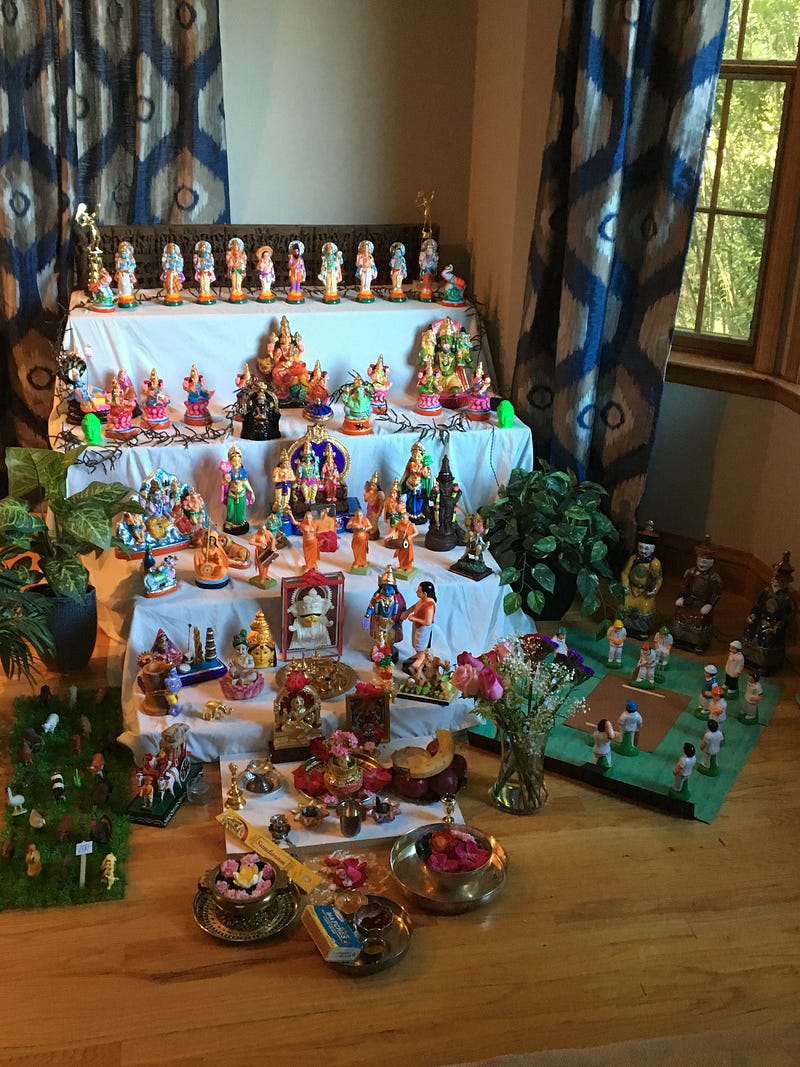
I used to love getting dressed up in traditional clothes (a saree) each day. Each house schedules two days for an open house invitation for friends and family to come to visit and see the dolls. Many people sing and showcase their classical music skills at these open houses.
No festival is complete without special food. The traditional food served at these open houses is called Sundal, a snack made from different kinds of grains like chickpeas, black-eyed peas, dried green peas, etc. We knew which houses had the best Sundal and made sure we asked for a small take-home serving.
Many houses get very elaborate in their collections and display of their dolls. Men and boys of the house participate in the setting up of the display. But in essence, this festival provides an opportunity for women to socialize and share their experiences with the arts.
Garba and Dandia Ras
Garba and Dandia Ras, are two dance forms with origins in the state of Gujarat. The dance itself is performed in circles around an earthen pot with a lamp inside, symbolic of the body and the life within. The circular movements symbolize the circle of life, from life to death to rebirth, leaving the Mother Divine in the middle unchanged and unmovable.
The event usually starts around 8 or 9 pm in the evening and ends around midnight with a prayer and offering to God. Aside from the fact that attending these dances served as a legit way to get parents’ permission to dance through the night, the dance provided a way to bring out our playful side. Dressing up in flowing skirts that twirled with us in the circles, with a splash of vibrant colors, is one of the highlights of the events.
You don’t have to undergo any training to dance, but I love watching the men and women who are graceful naturally. I found this cute video with little ones showing us the dance on YouTube.
Where do I go to celebrate Navratri?
You don’t have to travel too far to celebrate Navratri. Just tune in to the announcements from your local Indian community in the months of October and November and be sure to join in with the festivities.
Did you like what you read? I’d love to read your thoughts in the comments section.
If you’d like to join medium to read my work and that of other writers, you can do so using the referral link.


