
The AI-Human Tango: The Dance of Code and Consciousness
From Fear to Fascination: How Our Relationship with Artificial Intelligence is Shaping the Future of Everything
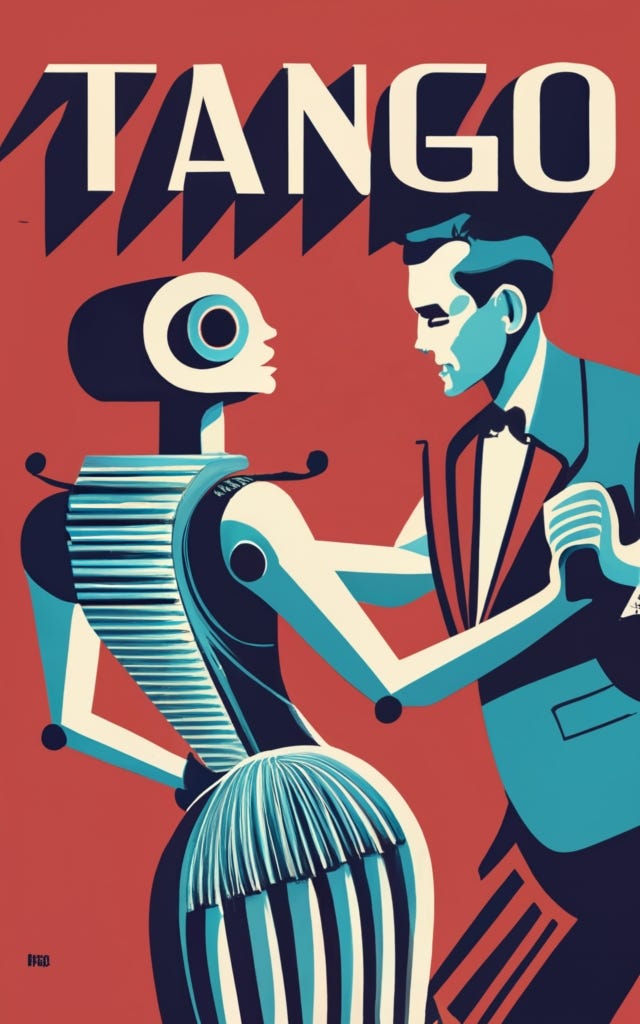
Ah, the classic tale of peanut butter and jelly — a culinary romance that has stood the test of time, despite the inevitable smears and sticky fingers. But let’s graduate from the lunchbox to the lecture hall, shall we? Enter the modern-day dynamic duo: Artificial Intelligence (AI) and Homo sapiens. We’re not just talking about a casual fling; this is a complex relationship that oscillates between infatuation and existential dread.
The Linguistic Tango: AI and Human Discourse
So, do humans and AI even speak the same language? The answer is a resounding “yes,” albeit with a footnote. AI engages us in a dialogue that’s as electrifying as Elon Musk’s Twitter feed, while we respond in a cacophony of accents, dialects, and the occasional emoji. Fear not, for we’re on a quest to decode this intricate pas de deux, dispelling the myths that cast our digital comrades as the villains of a dystopian future.
According to a Stanford study, 72% of experts believe that AI will outperform humans in most activities within the next 50 years. But let’s not get ahead of ourselves; we’re still in the courtship phase.
The Enigma of AI: A Catalyst for Human Potential
What’s tirelessly sifting through the world’s complexities with the ease of a sommelier distinguishing a Bordeaux from a Burgundy? No, it’s not an over-caffeinated barista. Welcome to a future where words are not just pleasantries but a symphony of ones and zeros. Remember those algebraic nightmares you shrugged off in high school? AI is the Newtonian apple that’s hit us square on the head, transforming abstruse equations into the lifeblood of our digital existence.
AI isn’t just a mythical unicorn conjuring rainbows; it’s the unsung hero automating the drudgery of our lives. A PWC report suggests that AI could contribute up to $15.7 trillion to the global economy by 2030. So, let’s retire the tired narrative of AI as the villainous HAL 9000 and embrace a more Baymax-esque archetype.
Beyond the Binary: The AI-Human ‘Fear-Quotient’
Ah, fear — the oldest emotion in the human playbook. But let’s not treat technology as the proverbial monster under the bed. Instead, consider it your first cup of binary espresso, a jolt to your latent potential. A Gartner report indicates that by 2025, AI will create more jobs than it eliminates. So, let’s swap those dystopian goggles for rose-colored glasses, shall we?
The Frankenstein Complex: AI as Our Modern-Day Monster
Mary Shelley, meet your 21st-century counterpart. We’ve traded stitches and sutures for code and algorithms, yet the fear remains. A Pew Research study found that 72% of adults are worried about the impact of AI on jobs. But let’s not forget, fear is often the mother of invention — or in this case, innovation.
The Pop Culture Paradigm Shift: From Terminator to Tony Stark
Remember when AI was the harbinger of doom? Thank Tony Stark and his affable AI, Jarvis, for the cultural rebranding. AI has evolved from a cataclysmic force to a ubiquitous, benevolent presence. A Deloitte survey shows that 65% of people now use some form of AI in their daily lives.
The Final Act: Embracing the AI Revolution
As we waltz into the future, let’s not view AI as a threat but as an amplifier of human ingenuity. It’s time to shed our fears and embrace the limitless possibilities that AI offers. After all, the dance floor is big enough for both of us.
So, there you have it — a whirlwind tour of the AI-human relationship, as complex and rewarding as any classic love story. And just like peanut butter and jelly, it might get a bit messy, but oh, the places we’ll go!