
Navigating the Myth and Reality of the American Middle-Class Dream
Six critical criteria

In the fabric of the American Dream, the notion of a secure, middle-class lifestyle holds a cherished place.
I have been fascinated by socioeconomic status for many years, roughly beginning when I made the transition from junior high school to high school in 1984, forty long years ago, and went from consorting only with lower middle-class people like me and my family at the time to a high school with people ranging from dirt poor to filthy rich.
I even learned what it means to “Come From Money” when I made my first friend from the rich part of E-town.
A recent poll by The Washington Post exposes a stark contrast between the widely shared perception of what it means to be middle class and the harsh economic realities that hinder many from attaining it.
According to the survey, nine out of ten Americans agree on six key indicators of a middle-class lifestyle: steady employment, the capacity to cover emergency expenses, freedom from bill-paying anxieties, access to health insurance, diligent saving for the future, and the ability to retire comfortably.
However, the bitter truth is that just over a third of U.S. adults meet all these criteria, illuminating the disconnect between aspiration and actuality.
Income, often seen as the primary yardstick for measuring middle-class status, must capture the essence of a middle-class life.
While a commonly used definition by the Pew Research Center places middle-class income between two-thirds and twice the national median income, the reality is that earnings cannot solely determine financial security.
This sentiment is echoed in the experiences of many middle-income Americans, who, despite earning within the designated range, find themselves grappling with financial insecurities.
Barriers to achieving middle-class financial security are multifaceted.
Rising housing costs and burdensome student loan payments compound the challenges of saving for retirement, making it a top financial concern for many.
The shift from traditional pension plans to individual retirement accounts has placed the onus on individuals to navigate the complexities of retirement planning, leaving them to “save like hell” and hope for the best, as described by Ben Harris, vice president of economic studies at Brookings.
Despite the evolving economic landscape, the percentage of Americans meeting all six measures of middle-class financial security hasn’t significantly declined over the years.
However, the changing nature of work and economic responsibilities has made achieving these milestones increasingly daunting.
The rise of gig work and uncertainties surrounding government support programs like Social Security and Medicare add complexity to the pursuit of financial stability.
Beyond the economic implications, the allure of the middle class resonates deeply within the American psyche.
Embedded in notions of egalitarianism and meritocracy, the middle class represents not just a financial status but a symbol of identity and belonging.
Cultural historian Larry Samuel aptly describes it as “the perfect model of American identity,” a club everyone aspires to join regardless of economic circumstances.
In essence, the story of the American middle class is a tale of aspiration intertwined with harsh realities.
It’s a narrative that underscores the gap between dreams and actualities, between what we envision for ourselves and the obstacles we face.
As we navigate this complex terrain, it’s essential to recognize that pursuing financial security goes beyond mere numbers — it’s about resilience, adaptability, and the enduring quest for a better tomorrow.
The Washington Post poll delineates specific criteria for middle-class status, including steady employment, the ability to cover emergency expenses, freedom from bill-paying anxieties, access to health insurance, diligent saving for the future, and the capacity to retire comfortably.
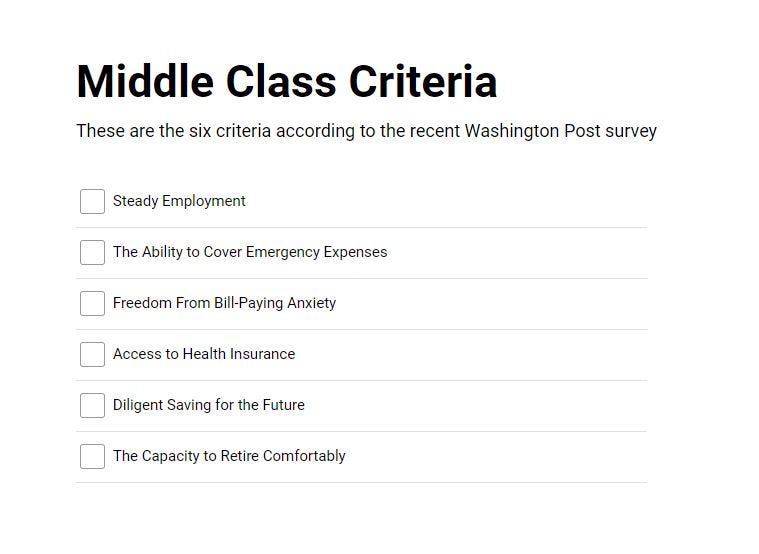
I put a checkmark next to each of the six, although I do experience anxiety when paying bills. I have about $7,000 to spend this coming Friday, and even though I can, it still causes a measure of anxiety.
These criteria offer a comprehensive framework for understanding the multifaceted nature of middle-class financial security, encompassing both immediate needs and long-term goals.
I found it exciting and worth sharing for those who are interested in the topic of social class.


