Navigating The Minefield of Copyright On Social Media
Disclaimer: I am not a lawyer! None of this is legal advice, and a lot of it is probably wrong. Expect mix-ups between copyright and trademark and all sorts of other interpretations that may or may not apply to your local jurisdiction.
This week, the Tolkien Society got themselves into a spot of bother on Twitter.
To summarise: someone posted a photo of Tolkien. The Tolkien Society apparently owns this photo’s copyright and asked the account to take the tweet down. Cue everyone rushing to laugh at the Tolkien Society. And the Tolkien Society go private on Twitter, citing the mental health of their team.
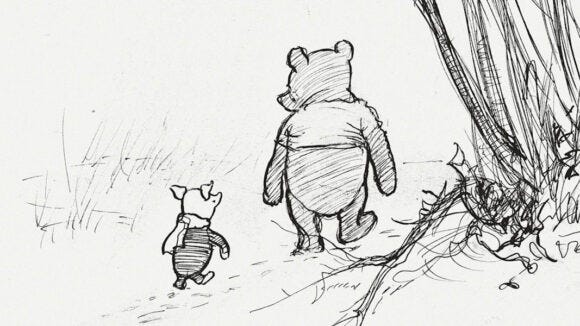
Another thing that happened this week is that Winnie-the-Pooh, as in the original 1926 novel and its characters, entered the public domain this week. This means you’re free to produce your own Winnie content without permission or payment to the Milne estate.
But beware! That only applies to the original “nude” Winnie. Any works after 1926, including all Disney productions, are still under copyright. So make sure your Winnie’s are topless, folks.
But what does any of this have to do with social marketing? Well, it’s a hot topic.
Copyright is a very real thing, and you should care about it
Copyright exists; that’s a fact. As a social media manager, I am not free to post the entirety of Ghostbusters on my channel. Well, I am free, but I would be subject to pretty swift legal follow-ups. So effectively, I’m not.
As I said at the start, I’m not a lawyer, but I understand why copyright is important. As a creator myself, I want the things I produce to be protected. Even stuff like tweets count, and it’s natural to feel a sense of moral outrage when you see big meme aggregator accounts just stealing other people’s content without credit.
So good practice in social marketing is never to post anything you don’t own the rights to yourself. That usually boils down to either stuff you’ve made or stuff you’ve paid for. Not only is that the safest course of action legally, but it’s the moral thing to do.
But that’s not what anyone does, is it?
Enter: “fair use”
There are generally exemptions in copyright law for things like parody and journalism. The Guardian can publish a picture of Mickey Mouse on a Disney story because it helps bring the story to life. The Guardian is not profiting from the image itself, so it’s a ‘fair use’ of the picture.
On the other hand, producing and selling my own Mickey Mouse cartoons would not count as fair use. And that seems pretty clear and straightforward.
But what about if I tweet a meme featuring Mickey Mouse? Or something else, like a clip from Star Wars?
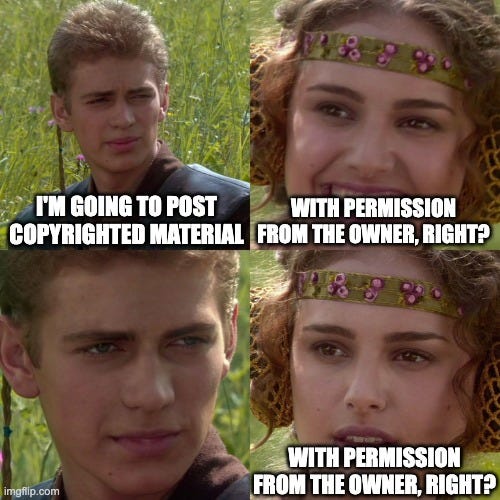
Is this fair use? Arguably, yes. You could say that it’s a parody of Star Wars, or perhaps even some kind of commentary. And if I tweet the meme out, it’s not for any commercial gain myself, but simply because I think it’s funny and I crave engagements.
What about if I have a million followers? What if I make my living by posting memes that get massive engagement? What if the tweet goes viral, and I follow it up with an advert for a galaxy projector lamp? You can see where things start to get murky.
Can branded content ever be considered fair use?
Brands succeed on social by producing content that is authentic to its platform. The more a brand can seem like just another poster, the better. And likewise, the more heavily branded the content they share is, the worse it’ll do. Nobody wants to see brands posting ads.
So it’s no wonder that many brands turn to memes. And yes, some memes can be copy-only funnies, or perhaps in-house produced snazzy graphics like charts and word searches. But memes do best.
Do we think ASOS contacted Paramount Pictures and negotiated a contract to use this clip from Clueless? Or that they contacted Alicia Silverstone for model release rights? I bet they didn’t. They just downloaded the gif from wherever and posted it.
But it goes without saying that everything a brand posts is ultimately for profit. No matter what the content, all marketing exists in order to further a company’s interests. So is it fair use?
But then again, every brand is doing this. Does that make it ok? Maybe not. But it does normalise the practice. And there’s certainly a case to be made that if everyone is posting some copyrighted material, then it’s entered the public domain to some degree.
To be clear, that’s not to say that the Anakin/Padmé scene from Star Wars is in the public domain or has lost any of its copyrighted status. But it somehow feels different as a brand to jump on an existing trend featuring copyrighted material. There’s some strength in numbers defence there, at least.
A quick aside: this is what TikTok is all about
I’ve been frustrated for a while now about TikTok. The advice they give brands is to join in with the trends and use popular sounds. So if everyone is doing the “Stairway to Heaven” challenge, you’re encouraged to post your version of it, too, with the sound attached.
But this is a copyright nightmare. And TikTok seems to know this, as if you have a business account, you CAN’T EVEN ACCESS trending sounds that contain licensed music. Instead, you get a weaksauce library of pleasant but boring tracks.
So brands get around this by either uploading their own version of the sound as an original track or making their absolutely-a-business-account account a non-business one instead. There is also some mechanism for licensing trending tracks? But I’ve never found it and can’t imagine anyone is such a mug that they would do this.
Anyway, I bring that up only to vent. And also because it’s a good microcosm of how copyright is a bit of a losing battle.
Some tips for staying on the right side of your legal team
I must stress again; this is not legal advice. Some of the most successful brands post almost entirely copyrighted material all day long, and nothing bad seems to have happened to them. How exactly you want to broach the complex subject of copyright is entirely up to you and your risk appetite.
I have a medium risk appetite for this kind of thing. And I’ve only received one legal takedown request so far, and that was specifically around a personality that was also appearing in a competitor’s marketing at the time — so fair play.
Tip 1: Avoid the big dogs
You don’t mess with the mouse, that’s for sure. I’d stay clear of posting anything Disney related as they’re known for being the most aggressive in protecting their copyright, which is also basically all media at this point.
We all recall the Baby Yoda / Giphy fiasco:
Of course, in the end, that wasn’t due to any action on Disney’s part. But the mere belief that Disney might do something was enough to spook Giphy into taking ALL the gifs down.
So beware.
Tip 2: Join trends rather than starting them
I have no justification for this, but it certainly feels like joining a meme is better than starting one.
Remember when everyone was posting that picture of Bernie Sanders wearing mittens? This one:
Someone took this photo. And they would own the copyright over its use. So technically, anyone reposting it should seek permission from that photographer. But I’m willing to bet not a single person did.
At that point, joining in — as we did above — feels fair game. The odds of a US photographer coming after a small UK company for a photo that was trending worldwide felt low, and the content itself was non-transformative and inoffensive.
Tip 3: Don’t make it sales-y
Keeping meme content organic-only seems to help a lot. In other words: don’t use copyrighted material in your paid ads.
With organic content, you can say that the post’s objective is just engagement; you’re just posting for fun. But if you’re running something as an ad, the aim is quite different; you’re trying to make some money.
I do still see brands doing this, though. And it does give me a bit of an ick. At the very least, you’d think it’d be against Facebook’s ad guidelines. Whatever converts those users, I suppose.
Tip 4: Have a strategy
My final tip is to be prepared and have had a proper think about it.
You’ll want to decide:
- What your risk appetite is This can be high/medium/low, depending on your confidence and conversations with your legal team.
- What you’ll do if you get a takedown request or further legal attention At the very least, make sure you have a way to take content down quickly and maybe log it.
- What your decision framework looks like You can lose a lot of time asking, “should we post this?”. Come up with a decision matrix so that you can run a checklist and post.
Ideally, you’d say something like, “well, we have a medium risk appetite and this is low-risk, I’ve shown it to another person on the team and it’s fine, and we can quickly take it down if there’s any issue”.
I hope that helps, and happy posting!