
Navigating the Generative AI Maze: Predicting the Tactics of Google, OpenAI, , Meta, Amazon and Budding Startups
Early signs of where each titans is looking to place itself in the long run in this Battle of the Titans
Ok, before we head, some useful info. This article is predictive and speculative. But..the predictions are based on current trends, news and market research on the companies in this article.
Why should you believe me? Well, you shouldn’t. Because this article is supposed to spark some thoughts rather be right upfront, like predicting stock markets. I have good experience in predicting technology and a lot of what we did in my last startup was an outcome of collective brainstorm of where the technology is heading.
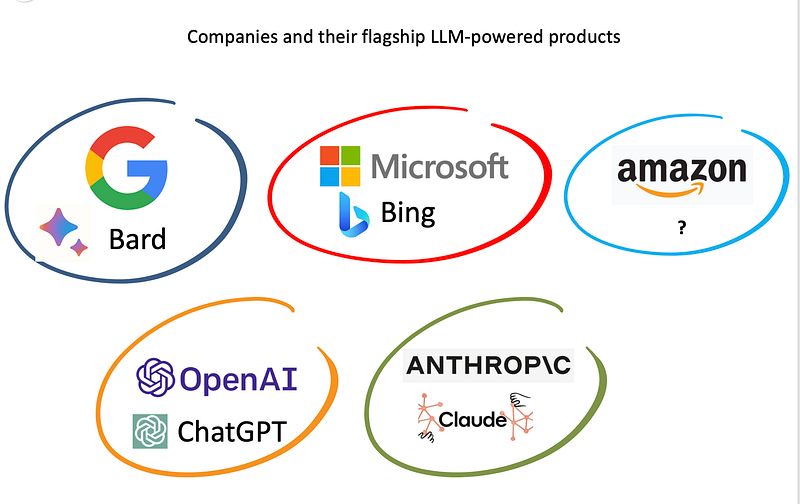
I believe in riding the technology wave rather going against it. This means that before I build a generative AI tool or startup, I would prefer exploring and predicting IF either of the OpenAIs, Googles or Amazons of the worlds have shown sign of getting into that space. If yes, how can I ‘ride the wave’. If no, why not? And do I still want to get into this space?
The Rise of Generative-as-a-Service (GaaS)
Large language models (LLMs) are everywhere, and they are set to become Generative-as-a-Service (GaaS) cloud products. Major cloud providers like Amazon Web Services (AWS), Microsoft Azure, Google Cloud Platform (GCP), and others will develop, partner, or acquire generative AI capabilities and offer them as services. This trend is expected to unfold within 2–3 years, with the productization of LLMs well underway.
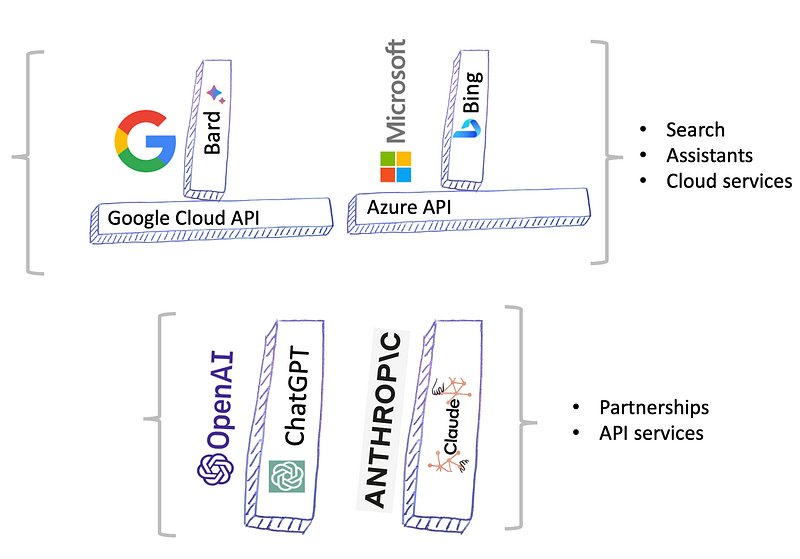
Lets see first how different products are stacked:
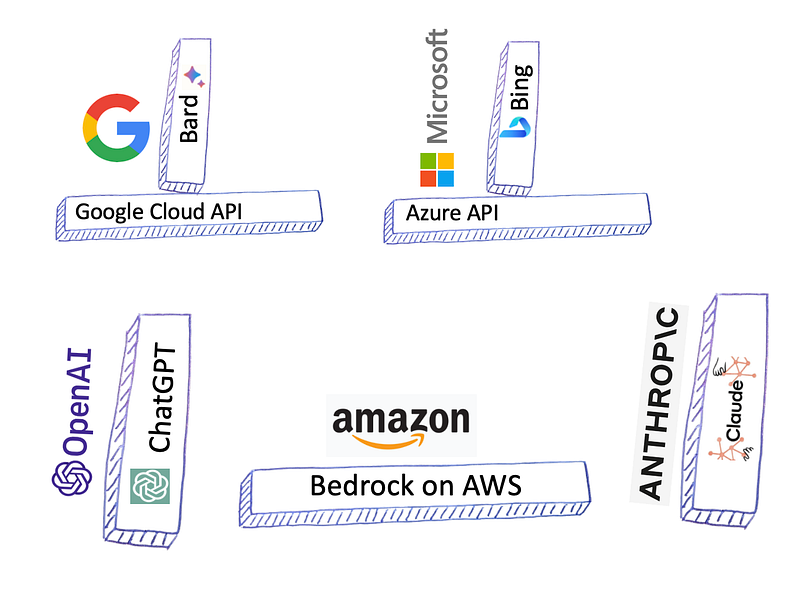
Now, looking at them, all of them have common traits:
- Conversational — AI
- Meant for different tasks — from copywrighting to search
- End-user based — anyone can use for anything.
But one of the Titans is taking a different approach. A less glamorous approach. It is Amazon and it’s product is ‘Bedrock’
Amazon’s ‘Bedrock’: A Different Approach
Now, let’s have a look at the 3 features of Bedrock in layman’s language:
- A platform (powered by LLM fundamentals)
- Meant to ‘build’ products that can ‘solve’ different tasks
- Business-based which can then launch products for end-users
Amazon Bedrock is a fully managed service designed to build and scale generative AI applications with foundation models (FMs). Here's an expanded explanation of Amazon Bedrock in layman's terms:
Bedrock: Generative AI Platform
Amazon Bedrock provides a platform to create various generative AI applications. It allows developers to generate original content like stories, essays, and images, build chatbots, summarize texts, and offer personalized recommendations.
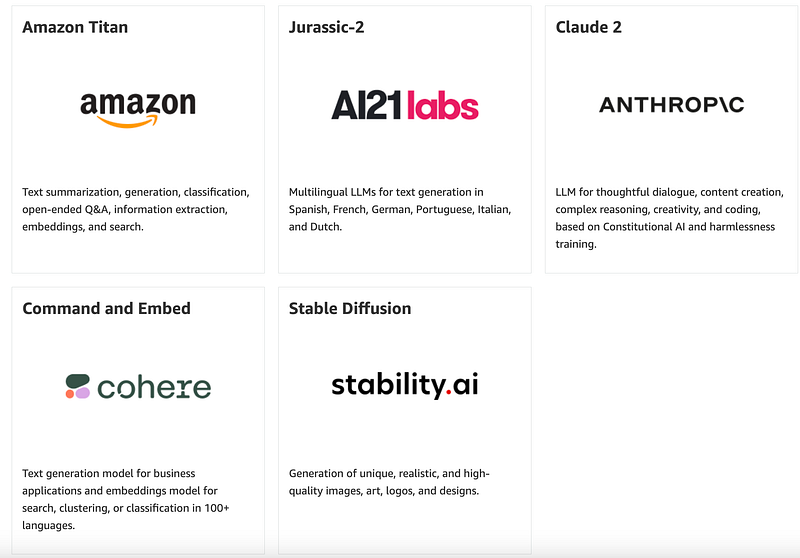
It’s powered by different foundation models from Amazon and leading AI startups, making it versatile for various use cases.
Amazon Bedrock’s approach simplifies the development of generative AI applications, making it a valuable tool for businesses looking to innovate and scale their products.
Ease of Use and Customization
With Amazon Bedrock, developers can quickly get started without managing infrastructure. They can choose from various FMs to find the model best suited for their needs and even privately customize these models using their organization’s data. It integrates seamlessly with AWS tools, ensuring scalability, reliability, and security.
Business-Oriented Solutions
Amazon Bedrock is designed to solve different business tasks. It can create fully managed agents that deliver up-to-date answers based on proprietary knowledge sources. From generating realistic images to building conversational interfaces and synthesizing information, it offers solutions that can launch products for end-users in various industries
Clouds & Ecosystems: The Future of Generative AI
All of the cloud providers will enable the development of GAI. There will also be a GAI ecosystem, consisting of interconnected digital technologies, platforms, and services. Consultants will offer advice around multi-LLM management, LLM security, and prompt engineering. Talent shortages will be a challenge, and universities will scramble to develop new courses and degrees in GAI.
TLDR — Simply Put — How is everyone trying to make money?
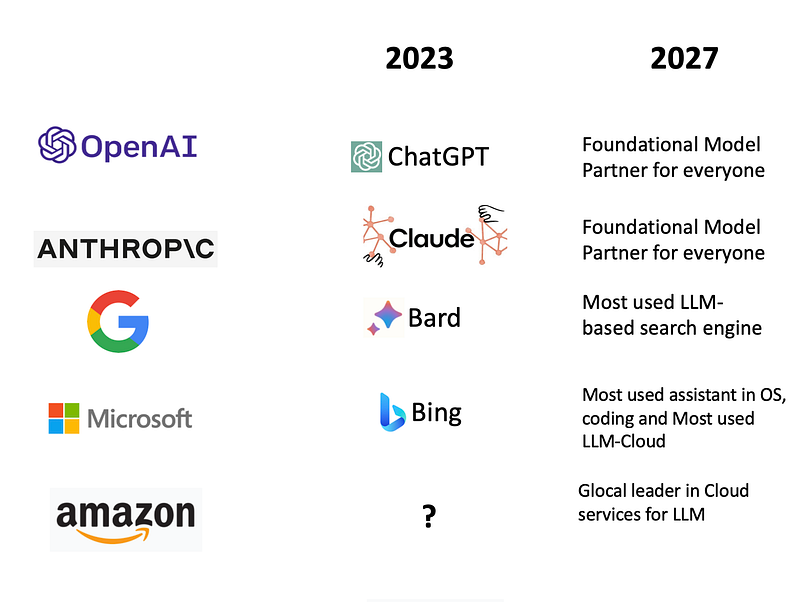
Enough chitchat. Let me just tell you who is going to compete with whom and what are the early signs of LARGE revenue models for each:
Now the next part is simple exptrapolation of everyone’s strategy based on where and how they are headed. People who are the most clear in strategy and branding in end-user (when I say end-user, I also mean Businesses), will win the AI-Arms race:
Conclusion: Pay Attention to the Wave
Despite many pauses, the development of GAI will proceed, and it will take its seat among the major technologies that have contributed to all things digital. So pay attention to LLaMa, ChatGPT, Bard, Co-Pilot, and all the others, and start identifying the processes that GAI can help. Chances are good that GAI can do much more than just assist.
References:
- “LLaMa, ChatGPT, Bard, Co-Pilot & All The Rest. How Large Language Models Will Become Huge Cloud Services With Massive Ecosystems.” — By Steve Andriole on Forbes
- Top Predictions and Trends for Generative AI in 2023
- Generative AI, OpenAI, and ChatGPT: What are they?
- The Future Is Here: How Generative AI Will Reshape Key Industries
- A Deep Dive into Generative AI: Building Blocks for Innovative Architectures
- The Future of Generative AI: Predictions and Possibilities