
Navigating the Abyss: When a Navy Helicopter Plunged into the Ocean
Struggling with powerlessness in the face of a maritime tragedy
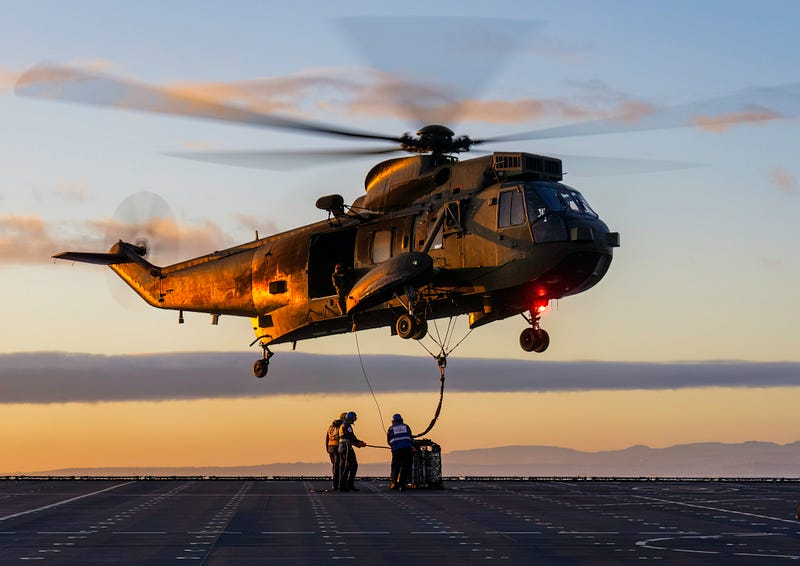
I was a year out of a psychiatry internship and working as a general doctor, the only physician on a Navy supply ship. January 2002, we were preparing to steam across the Atlantic and join the new War on Terror.
Off the coast of Norfolk, another supply ship was transferred to us via helicopter and connecting wires, all the munitions we would take to the fight. Considered too dangerous to do in port, the operation was done while the ships steamed less than one hundred meters apart and steel cables attached them.
If two ships tied to each other sounds dangerous, it is. But our Navy’s crews train hard to mitigate the risks of collision. They have as much control as you can in the ocean, which isn’t much.
The worst outcome is an explosion. The transfer is done at sea so such a catastrophe would destroy only us and not a city. We carried so many munitions that the blast radius from their mass detonation would have been four to five miles.
So, while that transfer of weapons was happening, I was having a normal day treating sailors in sick call. I knew the risks of collision and explosion were there, but they didn’t bother me much. I wasn’t expected to do anything about them, kind of like a passenger on a plane.
I had to focus on what I could do something about. At least as a doctor, others and I had the expectation I could do things about injuries and illnesses.
It was mid-morning, at the tail end of daily sick call. Four corpsmen and I were treating whoever showed up with the usual headaches, sore backs, and colds. A fifth corpsman was on the main deck with the sailors involved in the transfer process, a requirement because of the high risk of injuries from tight wires and large bombs.
On the ship, my psychiatry background helped with the more abstract complaints: “My recruiter lied to me. I’m not supposed to be on a ship.” Those happened more than you might expect in an all-volunteer Navy, a service that, by definition, goes to sea. But right after 9/11, most of the ship’s crew wanted to cross the ocean and join the fight.
I don’t remember which end of a sailor I was examining, either a foot or a scalp. Suddenly, “Emergency break away,” and a horn sounded over the ship’s 1MC (announcement system). I felt the ship turn sharply.
The remaining sailors on sick call left to return to their duty stations for the emergency. Unless they were dying, their problems would have to wait.
The walkie-talkie on my waist filled with questions. Then I heard our commanding officer: “One of our helos is in the water. Doc, get to the hangar.”
In the seconds it took a helicopter’s engine to fail mid-flight, my morning changed from routine problems I knew how to handle to something I had minimal training for and no experience with.
The corpsmen and I grabbed our equipment bags and ran aft toward the ship’s hangar and flight deck. The senior corpsman, an experienced senior chief whom the Navy had trained for independent duty and functioned like a physician’s assistant, organized the other corpsmen for a potential mass casualty.
The helo had three crew members: two pilots and one enlisted sailor in the back. The crash might have also injured sailors working on both ships. The other ship had no doctor.
In the hangar, a flight officer briefed me on what happened and what I could expect.
As the helo was lifting a bomb from the other ship’s flight deck, its engine lost power. The pilot had set the bomb back down, and the sailor in the back miraculously unhooked it before the engine shut down. The helo then clipped the back of the other ship and fell into the ocean. As expected, it immediately flipped upside down and sank. Our second helo hovered above the crash site while the ships broke away from each other and turned around.
If the helo’s crew members got out as it sank, they were at risk of hypothermia from the winter water. They could also be injured, unconscious, or drowned.
The worst part for me was the waiting.
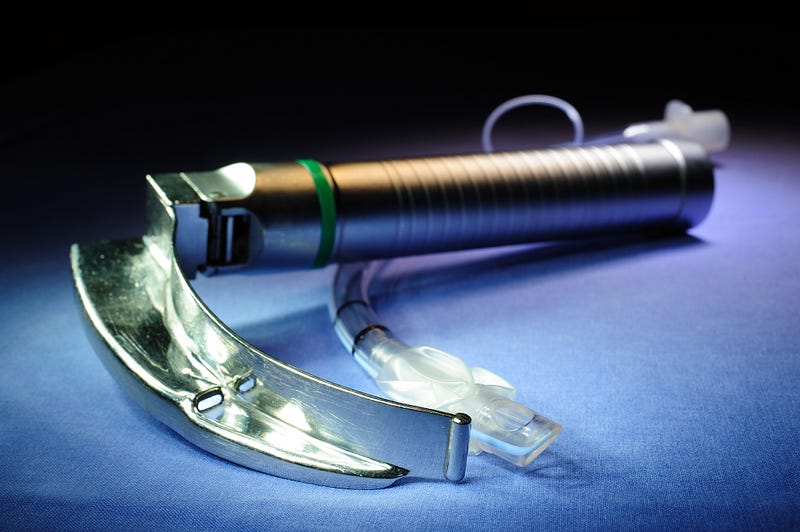
I stood near our stretchers with my equipment bag open and a laryngoscope in my hand. I’m not sure how many minutes passed, but I hadn’t held one that long before. Its strong metal reassured me. Its cold surface frightened me.
A laryngoscope is used to stick a tube down someone’s throat to help them breathe. If one of them wasn’t breathing, I would have to do that.
I imagined the bodies being brought to me with their lungs full of salt water. The ship’s crew would watch me, and my staff would fail to revive them.
My internship focused on psychiatry. I hadn’t intubated someone since medical school, under close supervision in a hospital. This was way outside of my area of meager expertise as a young physician.
For the first time as a doctor, a situation threatened to expose me to the world, including my lack of experience and my inability to stop death. Sure, I’d seen people die in hospitals and had my own patients die. But those happened in large treatment centers with all kinds of specialists and equipment available. The responsibility for saving them had never rested on me alone.
Now it was just me, five corpsmen, and what little equipment we had, too far from Virginia to get any help.
If people ever asked about that helo crash, I used to say the experience made me mature quickly and gave me more poise and self-confidence as a doctor. Perhaps it did. But to do that, it stripped away any lingering illusions I could look death in the face and beat it.
That’s what maturity really means, being forced to accept your limitations in an unpredictable world, including life’s indefinite nature and your limited ability to stop its end.
I didn’t have to face my death or anyone else’s that day. That would come later, during another deployment.
The second helo rescued the downed helo’s crew from the ocean. The Navy had trained them well for crashes. They’d been able to swim out of the sinking wreck. There were no severe injuries, although one had an injured shoulder that sent him back to Virginia before we crossed the Atlantic.
My psychiatry background proved useful in the coming weeks as I helped one pilot process his sense of guilt for not setting the helo safely down on the deck before its engine quit.
I’m glad I helped him with that, but my skills, along with the lack of life-threatening injuries from the accident, allowed me to relax and lie to myself again. Something terrible had happened, but it wasn’t so bad after all. I had handled it. I still had control.
When I tried to remember the first time I had a sense that death could come at any moment and there was little I could do, I remember waiting in that hangar. That changed me, but I didn’t have to confront and bear my powerlessness or experience it overwhelming me.
That would come later, when I was in Iraq on another deployment, when insurgents targeted doctors on Christmas morning, killing one and wounding others less than fifty meters from me.
I helplessly faced my mortality as mortars exploded on what is normally a day of peace and celebration, finishing what had begun six years earlier in that hangar. Those two days joined a string of others that contributed to my PTSD.
In the face of life’s unpredictability, my story reminds me that our journey is often beyond our control. Embracing vulnerability and acknowledging the limits of our influence can be a source of great strength.
We can reflect on our perceptions of power and the inevitability of the unexpected. Life’s uncertainties, though daunting, provide us with opportunities to grow and develop resilience.
We might find solace in accepting the transient nature of existence, cherishing each moment, and recognizing that true strength lies in our ability to navigate the unknown with grace and courage.
Thanks for reading my story. I’d love to hear your thoughts.