
Navigating Model Weight File Formats: .safetensors, .bin, .pt, HDF5, and Beyond

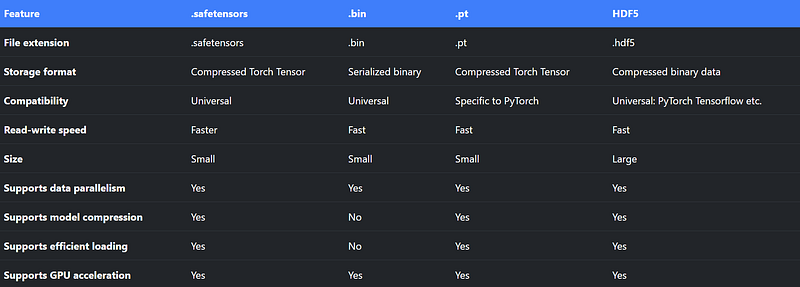
In the ever-evolving domain of deep learning, model weights play a crucial role in enabling trained models to perform their intended tasks. These weights, representing the network’s internal parameters, are typically stored in file formats that facilitate their efficient storage, retrieval, and sharing. While the traditional .pt format has long been the standard for storing PyTorch model weights, recent advancements have introduced alternative formats like .safetensors, bin, and HDF5, offering a range of options to suit diverse use cases.
.safetensors: Security and Efficiency in Harmony
Emerging to address the security concerns surrounding traditional formats like .pt and bin, .safetensors stands out for its robust type system, effectively safeguarding against malicious code injection into model weights. This protection shields against potential attacks that could compromise the model’s integrity or functionality. Additionally, .safetensors excels in loading efficiency, significantly reducing the time required to load model weights from storage.
import safetensors as st

# Create a tensor
tensor = st.Tensor(dtype=st.float32, shape=(10,))

# Save the tensor to a file
filename = "medium.safetensors"
st.save_file(tensor, filename)

# Load the tensor from the file
loaded_tensor = st.load_file(filename)

# Print the tensor
print(loaded_tensor)
.bin: Quantization for Compact Storage
Frequently employed for storing large language models (LLMs), .bin utilizes a 4-bit quantization approach, compressing model weights into a remarkably compact form. This quantization methodology can dramatically reduce the storage footprint of model weights, making .bin files more efficient to store and transmit. However, this efficiency comes at a slight cost in security, as .bin files are more susceptible to manipulation.
# Writing binary data to a .bin file
data_to_write = b"Hello, Medium World!"
with open("example.bin", "wb") as bin_file:
    bin_file.write(data_to_write)

# Reading binary data from a .bin file
with open("example.bin", "rb") as bin_file:
    read_data = bin_file.read()
    print(read_data.decode())
.pt: The Legacy Format with Familiarity
.pt, the original PyTorch model weight format, remains widely used due to its compatibility across PyTorch libraries and frameworks. Its binary nature enables efficient storage and retrieval of model weights. However, .pt’s security posture falls short compared to .safetensors, making it more vulnerable to potential attacks.
import torch

# Example PyTorch tensor
tensor_to_save = torch.tensor([1, 2, 3, 4, 5])

# Save PyTorch tensor to .pt file
torch.save(tensor_to_save, "medium.pt")

# Load PyTorch tensor from .pt file
loaded_tensor = torch.load("medium.pt")
print(loaded_tensor)
HDF5: A Versatile Data Structure for Deep Learning
Hierarchical Data Format 5 (HDF5), initially designed for scientific data storage, has gained popularity in deep learning due to its versatility. It can store multiple datasets of various data types, enabling efficient storage and retrieval of heterogeneous data structures. H5 also supports compression and indexing, further enhancing its efficiency and usability.
import h5py

# Writing data to an HDF5 file
data_to_write = [1, 2, 3, 4, 5]
with h5py.File("medium.h5", "w") as h5_file:
    h5_file.create_dataset("dataset_name", data=data_to_write)

# Reading data from an HDF5 file
with h5py.File("medium.h5", "r") as h5_file:
    read_data = h5_file["dataset_name"][:]
    print(read_data)
Choosing the Right Format: A Delicate Balance
The decision between .safetensors, .bin, .pt, and HDF5 is not a one-size-fits-all approach. The choice hinges on the specific requirements and priorities of the project. If security is paramount, .safetensors stands out as the clear choice. For efficiency and compatibility with existing libraries, .pt remains a viable option. However, for models that demand compact storage and are less sensitive to security concerns, .bin can be a suitable choice. When dealing with heterogeneous data structures, HDF5 offers a versatile and efficient solution.
Conclusion: A Diverse Landscape of Options
The evolving landscape of model weight file formats presents a diverse array of options, each with its unique strengths and limitations. .safetensors prioritizes security, .bin optimizes efficiency for compact storage, .pt offers convenience and compatibility, and HDF5 caters to heterogeneous data structures. The decision ultimately depends on the specific needs and priorities of the project. As the deep learning landscape continues to evolve, further innovations in file formats can be expected, further shaping the way we store, share, and utilize trained models.


