
Navigating Grief
When a spouse loses a parent

I originally started this post with the sentence: Navigating grief is new to me.
But then I thought, well, not really… I lost all of my grandparents as an adult, including my maternal grandmother to whom I was very close. As an only child, I was by my parents’ sides while they grieved the loss of their own mothers and fathers.
This grief is different. It is a generation closer — my husband’s father died yesterday.
I suppose all griefs are unique, and that most of us feel ‘new’ to navigating them. I have friends who seem to endure grief more frequently than most; perhaps grief has a familiarity to them I am lucky not to know yet in my life. Either way, I don’t mean to imply that this grief is any more special than any others; or it is because all grief is like that — always new, always exceptional.
But none of us get to dodge it forever.
I am learning today.
Yesterday I watched my husband tend to his dying father. I watched as he leaned in close to his softened face, slumping with age and shaggy with wild, white hair. Their eyes met — both red, one from insulin-deficiency and one from tears.
My husband kneeled down and took his father’s outstretched hand. “You wanna wrestle?” he joked, and the old man, ever a comedian, curled his dry lips into a wry smile and straightened up just a little to give it his best shot.
There’s a point on the journey of life when fathers trade places with sons. Perhaps it’s a tipping of the scales so subtle that neither one realizes they are on the other side until the shift becomes so obvious they take by surprise.
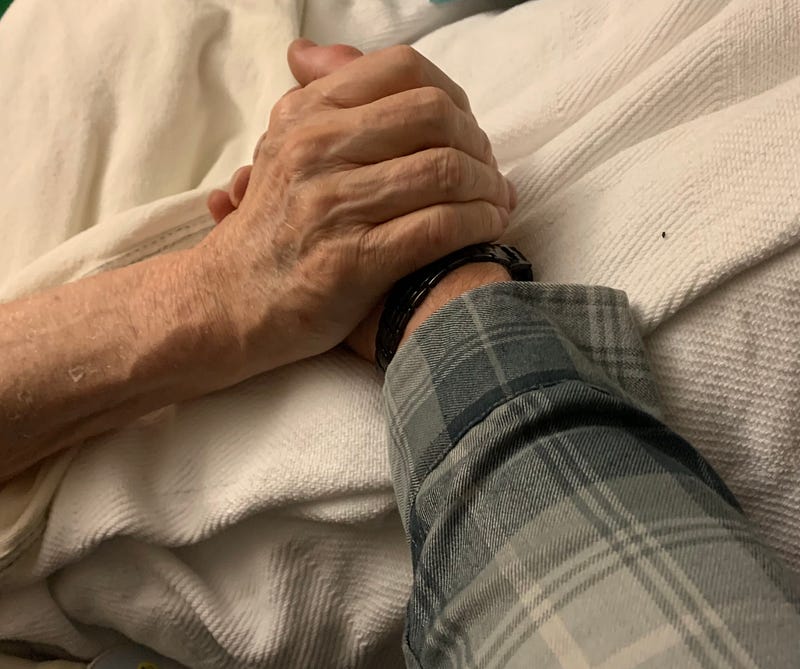
My husband is a man whose empathy and love run so deep they have almost destroyed him. He grew up feeling broken; there was a gaping hole where the unconditional love of his parents should have been. He was always searching for something to fill that hole or numb the pain of its existence.
There was so much love inside of him with nowhere to go; it was swelling to the point of bursting him apart, full annihilation. And pain, buried, condensed into a solid iron core at the center of him. When I met him, his emotions were tender to the touch. We bonded over our numbing strategies and he drenched me in his love.
So much has changed in the ten years we have known each other. Two kids, new jobs, a couple of moves, but a shift in consciousness and healing of his wounded inner child.
I was struck by the depth of his compassion and his presence with this man with who he has had a close but complicated relationship for his entire life.
Yesterday I held him as he stood, a bit shaky, and said goodbye to a father who did the best he could with what he knew. Today I watched him feel his grief and not turn it into self-loathing or anger. Today I watched them both find peace.
My husband’s strength comes from a light within him that had lain dark and dormant for so long, but now glows out of soul-charged eyes. Eyes that mirror those of his father’s youth, dark and sparkling. Eyes that mirror those of our young son, warm and loved.
Author’s Note: I dedicate this post to my father-in-law. I feel comfortable sharing this personal post about him because I think he would be pleased as punch to know he is the lead character in one of my essays.
As the family gathered a few days before his death, making corny and morbid jokes and swapping old stories, he looked over to me and said with a grin, “I bet this is giving you a lot of good material to write about.” He asked me if I was working on a poem in my head. Yes, Bill, I was. I wrote a special poem for you and your son, and it will be live on Sunday in P.S. I Love You.
My father-in-law was a huge supporter of my writing. He read a lot of my blog posts and much of the poetry I share here on Medium. He was very proud of my husband and I for the life-shift we made when we quit drinking and became more present for our kids. This one’s for you, Bill.