
Nature & Not Nature:
Reflections on Religious Meanings
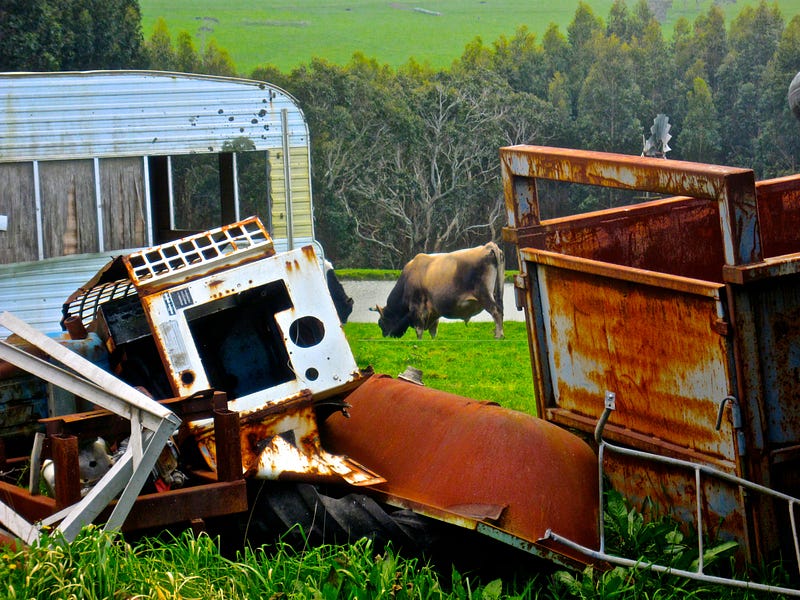
A few years ago when I took this photograph, my aim was to contrast the beauty of unspoiled nature with the mess of the junkyard. The photo certainly does project the vivid contrast between a ‘purely natural’ landscape in the background (cow, grass, trees, pond) and a foreground that has been littered with the waste products of the human experience (the brutal honesty of technologies left to decay and rust).
In the earliest periods of mankind’s history, we tend to think of humans as part and parcel of the natural world, and indeed most indigenous theologies still do so think. But with the arrival of Christianity and the Abrahamic religions four thousand years ago, the book of Genesis settled on another view of the matter in a short text which is perhaps the best-known passage of the entire Bible:
“Be fruitful, and multiply, and replenish the earth, and subdue it: and have dominion over the fish of the sea, and over the fowl of the air, and over every living thing that moveth upon the earth. … Behold, I have given you every seed-bearing plant on the face of all the earth, and every tree whose fruit contains seed.” (Genesis 1:28/29)
This telling of the Biblical creation story set up a world-view in the West that spread widely and to this day remains the dominant way in which most people see and understand how the world works: a power hierarchy that extends from God and the angels down through man, the animals and plants, but which is based upon a fundamental, hard and fast, division between mankind and the rest of nature, a division which, always and everywhere, prioritizes humans over nature.
A little over 50 years ago, an Historian of Science, Lynn White, Jr. published a very readable, if somewhat simplistic, essay entitled the Historical Roots of Our Ecologic Crisis. In this highly influential story, he recounts the history and impact of such beliefs about the human/nature interface. He further argues that our seeming unwillingness to rethink that relationship has resulted in an inability to address the roots of our environmental problems.
In White’s words, “What people do about their ecology depends on what they think about themselves in relation to things around them,” in relation to the world of nature. Furthermore, “we shall continue to have a worsening ecological crisis until we reject the axiom that nature has no reason for existence save to serve mankind.” White’s article is still a damn good read, and I highly recommend it.
Lynn White Jr., The historical roots of our ecologic crisis. Science. 155, 1203–1207 (1967).
We moderns seem to believe that nowadays the race of man has indeed proven himself distinctly above and beyond the animals and the rest of nature. And in a sense that’s true. Our science and technology have seemingly worked miracles. We often contrast the god-given with the man-made (or perhaps better said, the intrinsically natural with the socially mediated). But is such a distinction even possible to make?
Let’s go back to the photograph! What elements of the photo are purely or intrinsically natural without any human mediation? Before reading on, may I ask you to inspect the photo once again?
To start with, the cow has been genetically manipulated through hundreds of generations. The grass, upon which the cow munches, grows in a meadow or paddock that has been regularly mown and highly fertilized over long periods of time. Fertilization advice is calculated using soil analysis. Certainly, pesticides and weed killers are likely to have been applied. Indeed, the so-called ‘weeds’ to be eradicated are often simply the original native, or ‘natural’ grasses that previously grew there.
Furthermore, the little lake in the picture is almost certainly a farm pond formed by damming the natural drainage. And the trees are nothing more than an entirely artificial windbreak, often populated by exotics rather than the native species that ‘nature’ had placed there.
In other words, when we think hard about it, the only things truly ‘natural’ in this photograph are perhaps the rust and decay processes underway in the foreground, and perhaps a few of the weeds in the immediate foreground some of which may be native ground-cover species. My original perception which said that nature equals the beautiful bits was nearly 100% wrong.
On the other hand, there is a sense in which we might propose that some elements of the above photo are more ‘natural’ than others. For instance, it does seem to me that a living animal (however genetically engineered it may be) is more intrinsically natural than say a junk yard of old vehicles.
Another way of thinking about ‘nature’ is to consider it as a wonderfully complex array of systems and processes, that include the cycles of life and death and evolution. In the photo above, the trees and grasses grow, the collected water instantly becomes an abode for life, the rust is an assurance that the forces of regeneration are at play, or perhaps we should say at work.
Peter Wohlleben opens his book, The Weather Detective, with the following words: “The moment we step out the door and stroll through the garden or a nearby park, we are surrounded by nature. Thousands of processes, from the minute to the gargantuan, are unfolding all around us, and they are fascinating and beautiful to behold — if only we open up our senses and take notice of them.”
In other words, looking at this photo, one might suggest that nothing in it is natural or alternatively that everything in it is natural.
Does any of this matter? Yes, indeed it does. Perhaps mainly because we are facing the urgent man-made crisis of Climate Change. Many who deny the existence of a Climate Crisis point out that major changes of climate and sea level over millions of years have always been a part of nature.
Well, yes and no. Those people to whom the world has delegated the job of studying these matters, i.e. the scientific community in its many disciplines, these professionals are in full agreement, and have been in agreement for decades, that the current developments are far, far more rapid than the planet has previously experienced, and that these changes are caused by humankind.
It is also clear to most people who have studied the problem that it can only be ameliorated by learning 1) to restrict our industrial and agricultural emissions into the air, sea and soil, 2) to limit the size of our human populations and 3) to rethink the human relationship with nature. In this essay, I am concerned mainly about the third of these issues.
To take one example, windbreaks, such as depicted in the photograph above, might be considered no more than a pathetic remnant of a natural forest or woodland, not really worth preserving except for agricultural, or perhaps aesthetic, purposes. On the other hand, especially if increased in size, windbreaks can indeed provide ‘natural’ corridors of movement for endangered species whose place in nature has been largely destroyed. But this strategy will only work if we also provide larger islands of old growth forests, where that is possible. We must preserve and nurture native floral and faunal habitats, if we want to help more species to survive the current threat of habitat destruction brought on by centuries of thoughtless human waste control and pollution.
Climate Change is not a threat to nature as such; rather, it is a threat to the many natural processes that make possible human life.
Of course, the advent of Climate Crisis is the greatest danger of all to human life and to the life of many other species. And if we don’t develop a very clear idea of what we actually mean by “nature” and how we can live within it rather than without it, then we are in deep and dark trouble, as most people are beginning to realize. At present, we live in our pathetic little shells, crying in the adolescent spirit of St. Augustine: “Please God, give us clean energy, but not just yet”