
Nature™ Inc.: Conservation in an age of privatization
A new environmental film from Patagonia shines a light on the fight for America’s public lands.
When I was 14, back in the 1990s, I went on a guided, two-week rafting trip down the Grand Canyon with my dad. Our trip began at Phantom Ranch, and snaked 192 miles down to Lake Mead. At the 93.9 mile marker, our group of about 10 people reached Granite Rapid. Our group was led by an experienced guide and family friend.
A good distance before Granite Rapid, our guide tied our groups’ rafts on shore and hiked downriver to scout the rapid. I remember him looking a bit uneasy. He said he could take each of the rafts through the rapid, giving us the option to hike down and meet him at the other end.
I’m not sure how that discussion went. Some in our group took that option. But my next memory is my dad and I holding tight onto ropes along the side of our raft as we quickly approached Granite rapid. We were in the front, our guide steering in the back.
My memory from there is a pinball machine: a mess of images, noises, light, water, and somehow, the dark and cold from the river now rising two-stories above me.
At one point through all this, I remember looking back. Our guide wasn’t there. Nowhere. We lost him. I looked ahead. More walls of water, and a force I knew well from surfing and wanted to avoid: being pulled under by water.
I looked back a few moments later. A hand was gripped around a rope, pulling a drenched and disheveled body in, like a wet cat that fell into a pool.
After making it through the rapid, we learned that we miraculously navigated most of the Granite Rapid, one of the more intense rapids of the Colorado River, with our guide hanging off the side of the raft.
‘The Fight for America’s Public Lands’
I’ve had many memorable experiences in U.S. National Parks, like Yellowstone, Yosemite, Volcano National Park, and the Grand Canyon, but I realize I’ve taken for granted how tenuous the laws are protecting these places from the steady wear and tear of profit-driven desire gnawing at their edges.
You’re probably aware that the Trump administration is hell-bent on dismantling U.S. environmental regulations established over the decades.
See here for running tally of all the 100 environmental rules the administration has already rolled back or is in the process of rolling back.
But unless you’re an environmental policy analyst, or an activist engaged in protecting public lands, you may not know about current efforts underway to privatize public national parks, monuments, and forest reserves.
Public Trust: The Fight for America’s Public Lands is a new environmental documentary produced by Robert Redford and Patagonia founder Yvon Chouinard. It’s directed by David Garrett Byars and examines the Trump administration’s relentless assault on environmental regulations. In particular, it delves into the selling off of public lands to oil, gas, and coal companies.
The film argues that the vast majority of Americans approve of protecting the environmental health of our public lands, rather than selling them off to the oil, gas, and logging companies. Yet despite this overwhelming public support for maintaining public lands, a number of legislative initiatives, greenwashed and being crafted discretely behind the closed doors of corporate think tanks, are now behind much new public land policy.
In the film, we learn about Washington D.C.'s efforts to dismantle environmental protections for Utah’s Bears Ears National Monument, Alaska’s Arctic National Wildlife Refuge, and Minnesota’s Boundary Waters Canoe Area Wilderness. Throughout, the film tells the story of the Indigenous people, scientists, and community activists fighting against this slow but steady selling off of our public lands for the short-term, profit-driven gain of a few corporations.
As Patagonia’s founder, Yvon Chouinard says:
“Imagine our country without our public lands — without protected parks and streams, wilderness and other wild places. If the oil companies and this administration continue to choose rigs over your kids’ future, we will lose what’s left of our shared 640 million acres. Public Trust is a much-needed wake-up call that everyone should go see.”
The American Antiquities Act of 1906
“On June 8, 1906, President Theodore Roosevelt signed into law what would later become known as the Antiquities Act of 1906. With one swift swoop of his pen, President Roosevelt bestowed upon generations of Presidents the broad discretionary authority to designate any parcel of land, within the borders of the United States, as a “national monument.” Such a designation sets aside the parcel of land for conservation purposes and protects it from development. Since its enactment, sixteen Presidents have used the Antiquities Act to designate 157 different parcels of land as national monuments.”
– Maureen A. McCotter (2019): A Presidential Power of Monumental Proportions: Does the Antiquities Act Permit the Review and Revision of National Monuments or Can the President Steal Your Land?
Fast forward 111 years.
Executive Order 13792
On April 26, 2017, Trump issued Executive Order 13792 to the Department of the Interior. The order called on the Department of the Interior to conduct a review of the 27 national monuments created since 1996. The review would determine whether the size and scope of the monuments had any merit.
The secretary of the Interior, the walking-talking conflict of interest Mr. Ryan K. Zinke, undertook this review. His aim was to determine whether the size of any of the 27 national monuments should be ‘revised.’
When the Executive Order came out, many policy analysts, conservationists and, environmental activists believed that the review would target two of the biggest national monuments, both in Utah: Grand Staircase-Escalante and Bears Ears National Monuments. Even though order 13792 didn’t say so explicitly, those familiar with these two monuments knew that Grand Staircase-Escalante and Bears Ears National Monuments were the monuments being put on the chopping block (read: auctioning block).
This is because both are home to–you guessed it–large deposits of oil, coal, and gas.
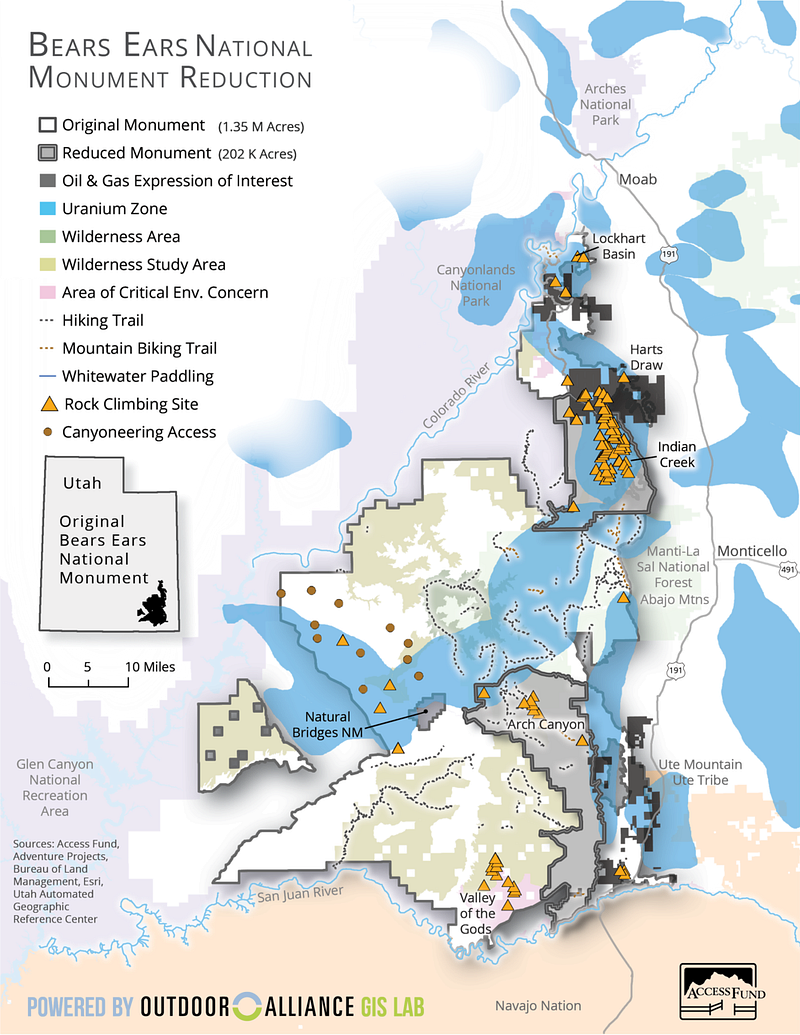
And so, while depressing but not surprising, on December 4, 2017, President Trump announced what many predicted: he would scale back Bears Ears and the Grand Staircase-Escalante National Monuments: nearly two million acres of combined loss:
Research reveals just how extensive the dismantling of environmental regulations by the Trump Administration has been, and how these efforts have been so successful:
“The Trump Administration’s efforts to comprehensively dismantle Obama-era policies had special force in federal public land management. The disassembling included a substantial reduction in the size of national monuments, a jettisoning of protections for sage grouse habitat, and a widespread fostering of fossil fuel-friendly policies, such as ending leasing moratoria, attempting to revoke methane emission controls, and a scuttling hydraulic fracturing regulation. Congress was a willing partner in this deregulatory campaign, eliminating revised land-planning regulations, authorizing oil leasing in the Arctic National Wildlife Refuge, and threatening to codify in statutes the Administration’s regulatory rollbacks in order to make them more permanent. Collectively, these initiatives amounted to the most substantial rollback in public lands protections in American history.”
– Michael C. Blumm and Olivier Jamin, Environmental Law, Vol. 48, №2 (Spring 2018), pp. 311–375
A key point I learned from the film is this:
Calls to return federal lands to the states are really just a sly tactic to expedite the selling off of public lands to private companies.
The secretive think tank behind this rhetoric, and the crafting of legislation aimed at dismantling the Antiquities Act is ALEC: The American Legislative Exchange Council.
On their website they make this argument:
Another example of unity can be found among hunters, who pride themselves on being conservationists who want to preserve public lands, including national monuments, while simultaneously advocating for their right to hunt. Hunters agree on the need to restrict the broad executive discretion that the Antiquities Act affords and believe that the best way to preserve the land is to leave it to locals in the state who have first-hand experience and knowledge of how to best maintain it.
Hal Herring is an outdoor journalist, an activist for public lands, and a life-long outdoors enthusiast. In the documentary Public Trust, Hal’s research reveals the real motive behind the ‘return control to the locals/to the states’ rhetoric. The Trump administration talks about the ‘review of monuments’ as an effort to wrest control of public lands from Washington D.C., and give it back to the people. But, as Herring’s research shows, states have historically opted to put monuments on the auction block as soon as they have control of public lands.
Idaho, for example, has sold at least 41% of public lands to private development since statehood. Utah 54%.
The public-to-private-land three-step
I call it the public-to-private land three-step:
- First, pitch the ‘return-public-land-control-to-the-states’ narrative to the public.
- Second: meanwhile, craft legislation that enables the federal government to do this. Like S.335, The Federal Land Freedom Act, which aims “To achieve domestic energy independence by empowering States to control the exploration, development, and production of oil and gas on all available Federal land, and for other purposes.” Or HR 861, which aims to “terminate the Environmental Protection Agency.”
- Third, once legislation is passed, open up the land to mining and drilling.
Over the course of the Trump presidency, the company Patagonia has increasingly mobilized its voice against the Trump administration’s dismantling of environmental regulations and policies. I’m not making any money from saying this, and Patagonia isn’t perfect, but if more companies stepped up the way Patagonia has over the past 3 years, we’d be in a much better place.
The journalist Naomi Klein is not known for endorsing multinational corporations. She made a name for herself skewering the greed, inhumanity, and ecological destructiveness of unfettered, free-market business. Yet she wrote the forward to Patagonia founder Yvon Chouinard’s autobiography, Let My People Go Surfing. She writes,
“As a journalist, I don’t endorse multinational corporations, even “green” ones like Patagonia. I have spent enough time digging into global supply chains to know that even the most socially conscious corporations have their dirty secrets, some of them secret even to the head office. Such is the nature of rampant outsourcing….And yet I have no qualms about endorsing this remarkable book. Because this is the story of an attempt to do more than change a single corporation––it is an attempt to challenge the culture of consumption that is at the heart of the global ecological crisis. And as someone who has spent two decades investigating corporate greenwashing-ever since my first book, No Logo–I can tell you that this attempt is rare.”
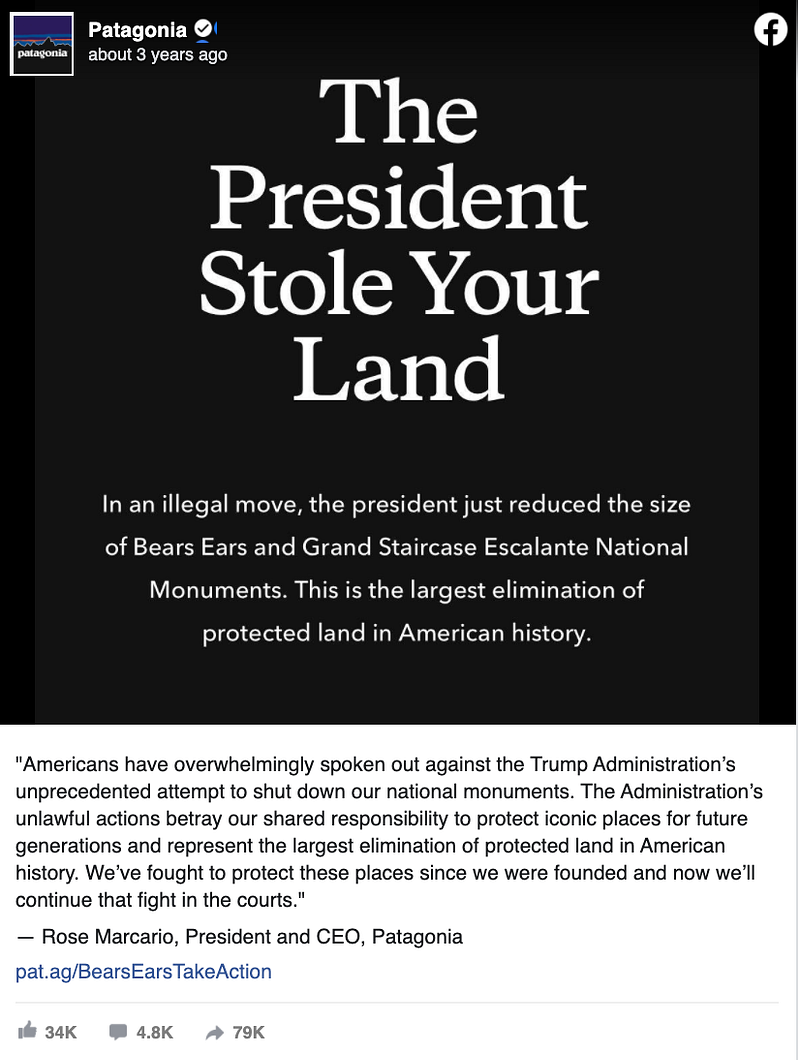
After the documentary, I tuned into a fantastic live discussion and Q&A with several key people involved in the fight for protecting public lands. Learning more about the work they’re up to is a good place to start:
- Bernadette Demientieff, is Executive Director of Gwich’in Steering Committee: “The Gwich’in Steering Committee was formed in 1988 in response to proposals to drill for oil in the Sacred Place Where Life Begins, the coastal plain of the Arctic National Wildlife Refuge.”
- Leah Stokes is Assistant Professor in Political Science at the University of California, Santa Barbara. Follow her on Twitter to stay up to speed on latest developments (and setbacks) in energy and climate policy and politics.
- Bryan Sybert is Executive Director of the Conservation Lands Foundation, a lesser-known but important conservation organization aimed at building grassroots, community-based support for a newly designated (since 2009) network of conservation lands in the United States.
- Joel Clement was Director of the Office of Policy Analysis at the US Department of the Interior before resigning in 2017 as the first public whistleblower of the Trump Administration. He accused Interior Secretary Ryan Zinke of silencing climate science. Today, he is a Senior Fellow with The Union of Concerned Scientists, working to expose political interference in science.
- Finally, Jeremy Rubingh is the film producer behind Public Trust. Follow his projects on environmental storytelling on Instagram.
Much of the Trump administration’s ability to gut environmental protections rests on our lack of knowledge of what they’re doing behind closed doors. So for me, becoming an advocate for public lands means learning more about the issues impacting my own well-being, and the well-being of the places I care about and the people who live there. What public lands are near you? And how can you protect them?
- To receive updates from Patagonia on action steps related to protecting public lands in the United States, you can text DEFEND to 71333. They will ask you where you are, what environmental issues concern you, and connect you with resources to take action protecting public lands near you.
- Learn about the Indigenous land you are living on and connect with Indigenous people in your area. Indigenous groups are often on the front lines of environmental and climate crises, due to a long history of systemic racism and marginalization.
- Read Bernadette Demientieff’s article about why “Protecting the Arctic Refuge is Non-Negotiable” here.
- If you happen to be someone from a non-marginalized group who loves the outdoors and cares for our public lands, learn about outdoor allyship. The Mellanin Base Campe Guide to Outdoor Allyship is an excellent place to start.
- Vote!


