
MINDFULNESS
Nature Awakens Us: Rediscovering Bottom-Up Attention in a Top-Down World
Each moment presents a choice — the path we choose makes all the difference
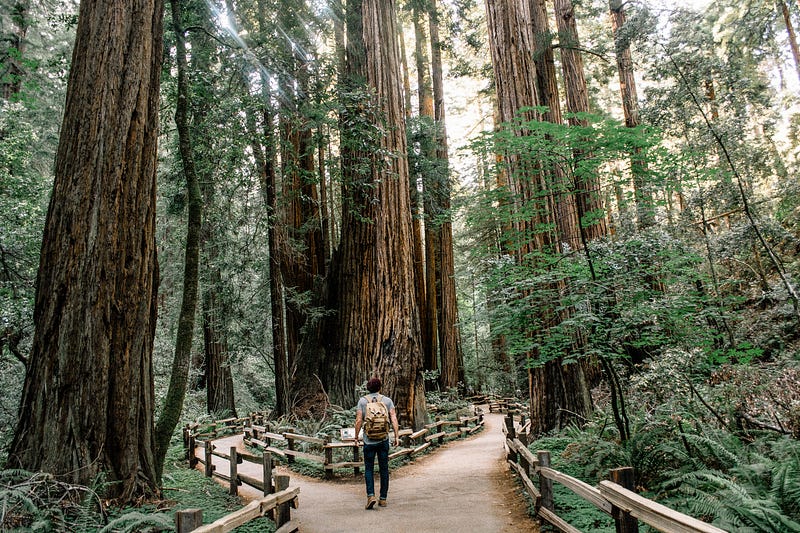
Robert Frost wasn’t directly commenting on the brain’s top-down and bottom-up attention networks when he wrote the poem, “The Road Not Taken.” He couldn’t have been, because — well — those terms hadn’t been invented yet. Even though he didn’t use those terms, maybe just maybe the tension between these two competing forms of attention is what he was talking about.
The well-known, well-loved opening lines of the poem place the narrator at a significant intersection:
Two roads diverged in a yellow wood, And sorry I could not travel both And be one traveler, long I stood And looked down one as far as I could To where it bent in the undergrowth*
Possibly it’s because I’ve been reading about the brain’s two primary attention networks, but when I read the poem now, I can’t help but think of the truths it offers about human consciousness. I can’t help but think it’s trying to teach me something about the moment-by-moment choices I make in terms of how I experience the world.
Top-down attention
One superpower we have as humans is to be nonpresent — to be mentally in a different time and place than we are physically. This ironic superpower allows us to think abstractly and analytically. Among other things, it has led to our ability to split the atom, fly to the moon, understand our evolutionary past, and predict our planetary future.
Those who study human attention use the term “top-down” to refer to this brain state, this ability to focus on abstractions — to analyze, plan, and reflect. Key features of this kind of thinking are its willfulness and exclusivity. In other words, we do it by choice and while we’re doing it, it fully occupies us. Any driver who has arrived at a destination without remembering having driven the trip understands how compelling top-down thinking can be. In this example, part of the brain is driving the car as if on auto-pilot, and the conscious part of the brain is occupied with other thoughts.
Top-down attention is a form of seeing, but it blinds us to everything else. Empowering, exhilarating, and world-changing as top-down thinking is, it represents only half of our potential ways to be in the world.
Bottom-up attention
Bottom-up attention, in contrast, is a form of attention that stems from our senses and the older (in an evolutionary sense) parts of the brain. It involves seeing, hearing, smelling, touching, and tasting — and the thoughts that directly arise from those sensations. It’s about being in the present. This type of attention is associated with intuition and openness to information from external sources.
To the poem’s narrator, the two paths are equally compelling. The narrator ends up choosing the slightly less traveled path while admitting the amount of use the two have received is not all that different:
Then took the other, as just as fair, And having perhaps the better claim, Because it was grassy and wanted wear; Though as for that the passing there Had worn them really about the same,
In modern times and for most of us, the more heavily trodden path is the path of top-down attention. It’s the path we were put on by our parents. It’s what we were taught in school. In modern culture, self-regulation and future orientation are more highly valued. From a young age, we are taught, “Do this now so you can have that reward later.” “Good things come to those who wait.” “Patience is a virtue.” “No pain, no gain.” “If you fail to plan, you are planning to fail.” Our society places high value on solving problems and making decisions. The fact that we increasingly spend our lives in indoor environments with comparatively little sensory stimulation contributes to our deficit in bottom-up experience.
The choice is in each moment
Importantly, the poem’s narrator is attracted to both roads and regretful that choosing one will exclude the experience of the other. The narrator regrets having to choose and understands the gravity of that choice:
Oh, I kept the first for another day! Yet knowing how way leads on to way, I doubted if I should ever come back.
Recent research on attention tells us we are capable of focusing on only one thing at a time. I like to think I can double or triple-task. I pretend that while on a walk I can think about an important decision, carry on a text conversation, and soak in the sights and sounds of the forest — all at the same time. The truth is, I can truly do only one of these if I am to do any of them well. Like the narrator in Frost’s poem, I must choose. Also like the narrator, I know that in gaining one thing I am giving up the other.
Each moment of my life is a choice between the two paths. Top-down or bottom-up? I can live in a world of internal thought — in some past or future moment. Or I can live in the present one.
In reality, I will sometimes choose one and sometimes the other. But, as the poem reminds me, it’s not that simple. For the choice I make in this moment influences the choices available to me in future moments. Each path I choose leads to a different place. Each place I go makes me a different person. There’s no going back:
I shall be telling this with a sigh Somewhere ages and ages hence: Two roads diverged in a wood, and I — I took the one less traveled by, And that has made all the difference.
Earlier versions of us — hunter-gatherers — likely felt the tension of this duality less acutely. Paying attention to the details of the natural world provided their sustenance. Opening their senses and noticing the minute characteristics of plants and animals was the work they did to survive. Being aware of the sights, sounds, and smells of the forest, the taste of edible wild plants, and the texture of the earth on their feet provided their livelihood. They focused more on the present — and less on the future.
Overcoming a deficit in bottom-up experience
The takeaway for us is that, yes, this duality is a tension in our lives. And because our culture and the modern world emphasize and reward top-down thinking, we are likely deficient in bottom-up experience, in being physically present in the physical world — unless we go out of our way to seek it. Recent research tells us that spending time in nature is one of the best ways to quiet our anxious, ruminative (top-down) minds. It’s one of the best ways to reawaken ourselves to this more sensory, richly rewarding form of experience.
Experiencing the world via bottom-up attention has additional benefits. It makes us more aware of the synchronicities, the meaningful coincidences, in our lives. It opens us up to a more intuitive way of being in the world. It also opens us up to the experience of awe.
So next time we are making entries in our calendars, we can remind ourselves to ask these questions, “When am I going to set aside an hour to be present and dwell more deeply in the world? When will I set aside time to walk that greener, less traveled path, the one with the birdsongs and the rays of sunlight filtering down through?”
Outdoors enthusiast and non-conformist that he was, Robert Frost would approve.
*“The Road Not Taken” by Robert Frost was written in 1916 and is in the public domain.
Read more on Medium and support emergent writers! Become a member with the link below:


