avatarJames Marinero, MSc, MBA

Free AI web copilot to create summaries, insights and extended knowledge, download it at here

5186

Abstract

tion to a market economy was often rocky; during the early 1990s the country had to deal with high inflation and food shortages, a situation typical across several ex-USSR countries.</p><blockquote id="9522"><p><i>Over the past 30 years, Mongolia has transformed into a vibrant democracy, tripling its GDP per capita since 1991. The country has made important progress in reducing poverty over the past decade, but growth has been volatile and slowed down in recent years. Job creation remains a critical challenge for the country, especially among the younger population. These challenges were amplified by the COVID-19 pandemic, which took a heavy toll on people and the economy despite substantial government support. With vast agricultural, livestock and mineral resources, and an educated population, Mongolia’s development prospects look promising in the medium- to long-term counting on the implementation of structural reforms.</i></p></blockquote><blockquote id="7518"><p><i>Mongolia’s economic growth is expected to accelerate to 5.2 percent in 2023 driven by a rapid recovery in mining production resulting from the removal of border restrictions, and the commencement of the Oyu Tolgoi underground mining stage. — <a href="https://www.worldbank.org/en/country/mongolia/overview">World Bank</a></i></p></blockquote><p id="4ca8">Its top 5 exports are (2022):</p><ul><li>Mineral fuels including oil: US6.8 billion (53.9% of total exports)</li><li>Ores, slag, ash: 3.7 billion (29.3%)</li><li>Gems, precious metals: 1.1 billion (8.9%)</li><li>Wool: 455.3 million (3.6%)</li><li>Salt, sulphur, stone, cement: $110.4 million (0.9%)</li></ul><p id="d192">Source: <a href="https://www.worldstopexports.com/mongolias-top-10-exports/">https://www.worldstopexports.com/mongolias-top-10-exports/</a></p><p id="648d">The climate of Mongolia is not good for widespread agriculture, with country’s high altitude, extremes of temperature, long winters and low precipitation being challenging for farmers. Mongolians are traditionally a nomadic horse-loving people and the growing of crops was disdained with animal herding being much more important.</p><p id="82a9">Nowadays, agriculture accounts for about 10% of the country’s GDP.</p><h1 id="25f7">Geopolitics</h1><h2 id="5801">Relations with China</h2><p id="ee8b">Relations with China have become significant. Since the 1990s, China has become Mongolia’s biggest trading partner, and a number of Chinese businesses operate in Mongolia.</p><p id="e6cc">China’s rapid economic growth and its ambitious Belt and Road Initiative have presented opportunities for Mongolia to strengthen its trade ties and benefit from infrastructure projects. Lying on ‘The Belt Road’, the country serves as a key transit corridor for China, enabling the transportation of goods to and from Europe. This has led to increased investment and economic cooperation between the two nations.</p><figure id="6c2f"><img src="https://cdn-images-1.readmedium.com/v2/resize:fit:800/1*dfjeJ9UMe3vEiuZUnOBleQ.png"><figcaption>China in Red, the members of the Asian Infrastructure Investment Bank in orange.. Credit: By Lommes — Own work, CC BY-SA 4.0, <a href="https://commons.wikimedia.org/w/index.php?curid=58884083">https://commons.wikimedia.org/w/index.php?curid=58884083</a></figcaption></figure><blockquote id="8efa"><p><i>Mongolia’s relationship with China is complicated by the fact that a significant part of what was traditionally Mongolia is now an “autonomous region” of China (Inner Mongolia), with a population of ethnic Mongolians larger than that of Mongolia itself. This, and the activities of secessionist groups in the province, is a persistent point of conflict between China and Mongolia. —<a href="https://theconversation.com/mongolia-squeezed-between-china-and-russia-fears-new-cold-war-202086"> TheConversation.com</a></i></p></blockquote><h2 id="e495">Relations with Russia</h2><p id="8b0d">Mongolia’s border with Russia is 3,500 km long, and the long and strong relationship with Moscow continues — with some caveats.</p><p id="5351"><b>Ukraine invasion</b></p><p id="c6a2">The Russian invasion of Ukraine has caused a few ripples in Ulaanbaatar.</p><blockquote id="7d92"><p><b><i>Mongolia is the only functioning democracy in the entire continental Eurasian expanse</i></b><i>, stretching from South Korea to Ukraine. Mongolia has maintained close diplomatic and military ties with the West.</i></p></blockquote><p id="25ff"></p><blockquote id="5bf2"><p><i>Mongolia’s abstentions on the U.N. votes on Ukraine were the best Ulaanbaatar could do given the circumstances. Mongolia also did not impose any sanctions on Russia.</i></p></blockquote><blockquote id="e81f"><p><i>Mongolia has also hosted <a href="https://thediplomat.com/2022/10/russian-citizens-flooding-into-mongolia-to-evade-conscription/">thousands of Russians</a> since the war started. Every Russian who is in Mongolia is a Russian who is not fighting in Ukraine. This is Mongolia’s quiet contribution to ending the war</i></p></blockquote><p id="7d6c"></p><blockquote id="fd0a"><p><b><i>There are also close personal ties among Mongolia’s political elites to both Russia and

Options

Ukraine.</i></b><i> Among the four Mongolian presidents who studied abroad, two were trained in today’s Russia and the other two were educated in western Ukraine. <b>Ukrainian President Volodymyr Zelenskyy himself spent three years of his childhood in Mongolia. </b>His father was an important figure in developing Mongolia’s major Erdenet copper mine. Ukrainian culture and people have a significant place in Mongolia.</i></p></blockquote><blockquote id="dc56"><p><i><a href="https://thediplomat.com/2023/03/the-war-in-ukraine-could-formally-end-in-mongolia/">TheDiplomat.com</a></i></p></blockquote><h1 id="f285">Relations with the West</h1><p id="4b66">In terms of relations with the West, Mongolia has been cautious in its approach. The government has sought to maintain its sovereignty and independence while engaging in limited economic cooperation with Western nations. It has attracted foreign investment in sectors such as telecommunications, banking, and mining.</p><h2 id="dd5a">NATO</h2><p id="9c38">This is what really surprised me.</p><p id="41ec">From the <a href="https://www.nato.int/cps/en/natohq/topics_85297.htm">NATO website</a>:</p><ul><li>NATO and Mongolia have been engaged in dialogue and cooperation since 2005. It is one of a number of countries beyond the Euro-Atlantic area — often referred to as “partners across the globe” — with which NATO is strengthening relations.</li><li>Since March 2012, work has been taken forward through an Individual Partnership and Cooperation Programme. This was renewed most recently in April 2020.</li><li>Mongolia provided support for NATO-led defence capacity building efforts in Afghanistan.</li><li>Political dialogue and practical cooperation are being developed across priority areas, including improving interoperability, addressing emerging security challenges such as terrorism, non-proliferation and cyber threats, developing mechanisms for crisis prevention and management, and building capacity.</li></ul><h1 id="f3e7">Conclusion</h1><p id="d715">It seems to me that the government of Mongolia is in a powerful — some would say dangerous — position, a democracy landlocked between Russia and China and astride one lane of the Belt Road. It is therefore able exert considerable leverage in the international ring and is of major interest to the West and NATO.</p><p id="42d6">Wrestling is an important national sport in Mongolia and according to TheDiplomat, Mongolia could well be the location of Russia-Ukraine peace talks, should they ever occur.</p><p id="f696">More context:</p><div id="9ccf" class="link-block"> <a href="https://www.nato.int/cps/en/natohq/topics_85297.htm"> <div> <div> <h2>Relations with Mongolia</h2> <div><h3>NATO and Mongolia are committed to strengthening relations to address shared security challenges. This includes…</h3></div> <div><p>www.nato.int</p></div> </div> <div> <div style="background-image: url(https://miro.readmedium.com/v2/resize:fit:320/0*GDbkKIdM1e2o2B27)"></div> </div> </div> </a> </div><div id="609d" class="link-block"> <a href="https://www.scmp.com/economy/china-economy/article/3226527/chinas-land-links-mongolia-will-run-24/7-opening-greater-access-critical-coal"> <div> <div> <h2>Exclusive: China’s land links with Mongolia will be open 24/7</h2> <div><h3>Land-locked Mongolia is bolstering ties with major trade and economic partner China, with enhanced border…</h3></div> <div><p>www.scmp.com</p></div> </div> <div> <div style="background-image: url(https://miro.readmedium.com/v2/resize:fit:320/0*0XOr7tSVo1MRuEU2)"></div> </div> </div> </a> </div><p id="2729"><i>If you follow me I guarantee variety in your inbox with some unusual perspectives! I write on a wide range of topics that interest me including humour, tech, space, geopolitics and travel. I also write about…</i></p><p id="61ac"><b>…far away places</b></p><p id="abae"><i>If you appreciate stories like these and want to support me and other writers, please consider signing up to become a Medium member. It’s only $5 a month, giving you unlimited access to incredible stories on Medium. If you sign up using <a href="https://james-marinero.medium.com/membership">my link</a>, I’ll earn a small commission at no extra cost to you.</i></p><p id="24a3"><i>Or maybe just <a href="https://ko-fi.com/jamesmarinero">buy me a coffee?</a> and tell me what you liked reading (or not)…</i></p><figure id="6e02"><img src="https://cdn-images-1.readmedium.com/v2/resize:fit:800/1*QeQr0J6dshTDJHUZ_MtLdw.png"><figcaption></figcaption></figure><p id="2cf2"><i>My novels are available at my <a href="https://jamesmarinero.gumroad.com/">Gumroad</a> bookstore. Also at <a href="https://www.amazon.com/stores/James-Marinero/author/B0055RWF6U">Amazon</a> and <a href="https://books.apple.com/us/author/james-marinero/id490200686">Apple</a></i></p></article></body>

Geopolitics

NATO, Mongolia and Ukraine

A surprising NATO ally, stuck between China and Russia in more ways than one, Mongolia has close links with Ukraine
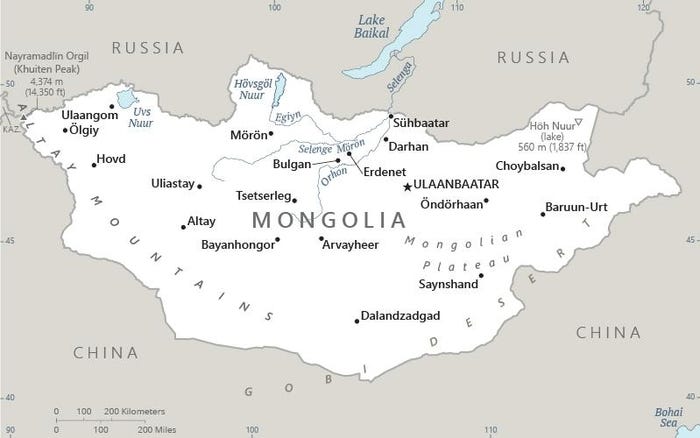
Mongolia map. Image: Public Domain via CIA.org

This story came about as a result of developments in China-Russia politics which I try to keep up to speed with. My interest was piqued recently by their links with Mongolia and I started to explore.

Mongolia is a fascinating country in so many ways. I’ve not visited yet — the nearest I’ve been is Almaty in Kazakhstan and and the polluted aluminium refining city of Novokuznetsk in southwestern Siberia, both about (600 km — 400 miles) from the Mongolian border. So near yet so far, and I certainly will not be sailing there.

The country has played a significant role in Russian and Chinese politics, but I was surprised to learn that in the 21st century it is aligned with NATO.

Travel with me to Mongolia, and find out about Ukraine’s close links with this often forgotten country. As a “democratic oasis” in between two of the most autocratic countries on earth, Mongolians empathise strongly with the plight and aspiration of Ukrainians.

The facts on the ground

Mongolia is a landlocked country in East Asia, bordered by Russia to the north and China to the south. It covers an area of 1.5 million square kilometres (580 thousand square miles), with a population of just over 3 million, making it the world’s most sparsely populated sovereign nation.

It is also the world’s largest landlocked country that does not border a closed sea, and much of its area is covered by grassy steppe, with mountains to the north and west and the Gobi Desert to the south. Ulaanbaatar, the capital and largest city, is home to roughly half of the country’s population.

Geographically, Mongolia occupies a strategic position between Europe and Asia.

The country is bordered by several nations, including Russia to the north, China to the east, and other Central Asian countries such as Kazakhstan, Turkmenistan, and Uzbekistan. Mongolia’s geographical location has played a crucial role in shaping its politics, trade, and relationships with neighbouring powers.

Some history

Mediaeval

Most of us have heard of the ‘Mongol hordes’ sweeping down from the steppes. Led by Genghis Khan and his successors, they were a feared and highly mobile force of skilled horsemen and archers that swept across Asia and Europe during the 13th and 14th centuries.

The extent of the Mongol Empire was vast, stretching from the Pacific Ocean in the east as far as modern-day Finland, Poland and Hungary, and from Siberia in the north to the Indian subcontinent in the south. They even controlled what is nowadays Afghanistan — and that was no mean feat. It was a ruthless and brutal invasion, with atrocities an order of magnitude worse than those of the Soviet Union.
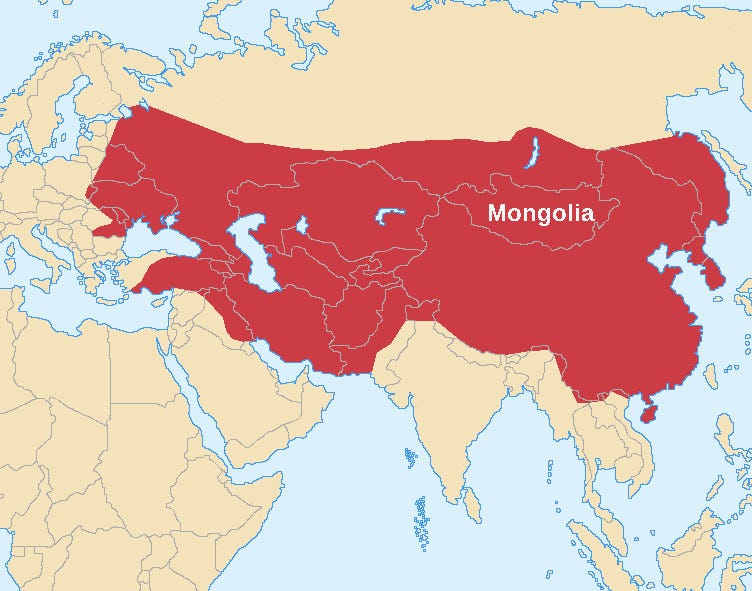
The Mongol Empire 1294 superimposed on a modern political map of Eurasia. Author overlay of ‘Mongolia’ name. One frame from the gif, credit: CC BY-SA 2.5, https://commons.wikimedia.org/w/index.php?curid=23348014

20th Century on

As a result of the Russian Civil War, the White Russian Lieutenant General Baron Ungern-Sternberg arrived in Mongolia in October 1919, and helped Mongolian force defeat the Chinese forces in Niislel Khüree (the modern-day capital, Ulaanbaatar).

Then White Russia was defeated in the Russian civil war and Bolshevik Russia became involved, supporting the establishment of a communist Mongolian government and army. This Mongolian army took the Mongolian part of Kyakhta from Chinese forces in March 1921, and in July, Soviet and Mongolian troops arrived in Khüree. Mongolia declared its independence on 11 July 1921.

In consequence, Mongolia was closely aligned with the Soviet Union over the next seven decades but was never a constituent republic of the USSR — it remained a separate country with its own political and economic system during the Soviet era.

The fall of the Soviet Union strongly influenced Mongolian politics and youth. It underwent a peaceful Democratic Revolution in January 1990 and a multi-party system and a market economy was created. The term “People’s Republic” was dropped from the country’s name.

In 2023 Mongolia is a semi-presidential representative democratic republic with a directly elected President (Wikipedia).

Economy

The transition to a market economy was often rocky; during the early 1990s the country had to deal with high inflation and food shortages, a situation typical across several ex-USSR countries.

Over the past 30 years, Mongolia has transformed into a vibrant democracy, tripling its GDP per capita since 1991. The country has made important progress in reducing poverty over the past decade, but growth has been volatile and slowed down in recent years. Job creation remains a critical challenge for the country, especially among the younger population. These challenges were amplified by the COVID-19 pandemic, which took a heavy toll on people and the economy despite substantial government support. With vast agricultural, livestock and mineral resources, and an educated population, Mongolia’s development prospects look promising in the medium- to long-term counting on the implementation of structural reforms.

Mongolia’s economic growth is expected to accelerate to 5.2 percent in 2023 driven by a rapid recovery in mining production resulting from the removal of border restrictions, and the commencement of the Oyu Tolgoi underground mining stage. — World Bank

Its top 5 exports are (2022):

  • Mineral fuels including oil: US$6.8 billion (53.9% of total exports)
  • Ores, slag, ash: $3.7 billion (29.3%)
  • Gems, precious metals: $1.1 billion (8.9%)
  • Wool: $455.3 million (3.6%)
  • Salt, sulphur, stone, cement: $110.4 million (0.9%)

Source: https://www.worldstopexports.com/mongolias-top-10-exports/

The climate of Mongolia is not good for widespread agriculture, with country’s high altitude, extremes of temperature, long winters and low precipitation being challenging for farmers. Mongolians are traditionally a nomadic horse-loving people and the growing of crops was disdained with animal herding being much more important.

Nowadays, agriculture accounts for about 10% of the country’s GDP.

Geopolitics

Relations with China

Relations with China have become significant. Since the 1990s, China has become Mongolia’s biggest trading partner, and a number of Chinese businesses operate in Mongolia.

China’s rapid economic growth and its ambitious Belt and Road Initiative have presented opportunities for Mongolia to strengthen its trade ties and benefit from infrastructure projects. Lying on ‘The Belt Road’, the country serves as a key transit corridor for China, enabling the transportation of goods to and from Europe. This has led to increased investment and economic cooperation between the two nations.
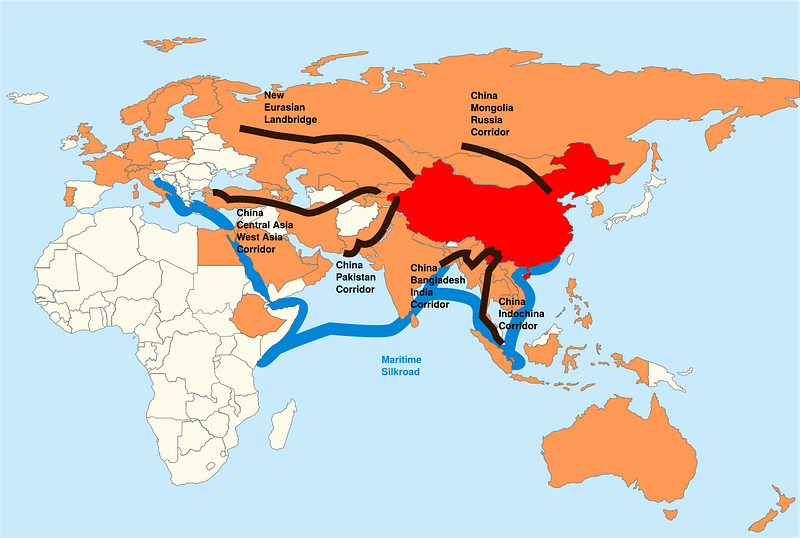
China in Red, the members of the Asian Infrastructure Investment Bank in orange.. Credit: By Lommes — Own work, CC BY-SA 4.0, https://commons.wikimedia.org/w/index.php?curid=58884083

Mongolia’s relationship with China is complicated by the fact that a significant part of what was traditionally Mongolia is now an “autonomous region” of China (Inner Mongolia), with a population of ethnic Mongolians larger than that of Mongolia itself. This, and the activities of secessionist groups in the province, is a persistent point of conflict between China and Mongolia. — TheConversation.com

Relations with Russia

Mongolia’s border with Russia is 3,500 km long, and the long and strong relationship with Moscow continues — with some caveats.

Ukraine invasion

The Russian invasion of Ukraine has caused a few ripples in Ulaanbaatar.

Mongolia is the only functioning democracy in the entire continental Eurasian expanse, stretching from South Korea to Ukraine. Mongolia has maintained close diplomatic and military ties with the West.

Mongolia’s abstentions on the U.N. votes on Ukraine were the best Ulaanbaatar could do given the circumstances. Mongolia also did not impose any sanctions on Russia.

Mongolia has also hosted thousands of Russians since the war started. Every Russian who is in Mongolia is a Russian who is not fighting in Ukraine. This is Mongolia’s quiet contribution to ending the war

There are also close personal ties among Mongolia’s political elites to both Russia and Ukraine. Among the four Mongolian presidents who studied abroad, two were trained in today’s Russia and the other two were educated in western Ukraine. Ukrainian President Volodymyr Zelenskyy himself spent three years of his childhood in Mongolia. His father was an important figure in developing Mongolia’s major Erdenet copper mine. Ukrainian culture and people have a significant place in Mongolia.

TheDiplomat.com

Relations with the West

In terms of relations with the West, Mongolia has been cautious in its approach. The government has sought to maintain its sovereignty and independence while engaging in limited economic cooperation with Western nations. It has attracted foreign investment in sectors such as telecommunications, banking, and mining.

NATO

This is what really surprised me.

From the NATO website:

  • NATO and Mongolia have been engaged in dialogue and cooperation since 2005. It is one of a number of countries beyond the Euro-Atlantic area — often referred to as “partners across the globe” — with which NATO is strengthening relations.
  • Since March 2012, work has been taken forward through an Individual Partnership and Cooperation Programme. This was renewed most recently in April 2020.
  • Mongolia provided support for NATO-led defence capacity building efforts in Afghanistan.
  • Political dialogue and practical cooperation are being developed across priority areas, including improving interoperability, addressing emerging security challenges such as terrorism, non-proliferation and cyber threats, developing mechanisms for crisis prevention and management, and building capacity.

Conclusion

It seems to me that the government of Mongolia is in a powerful — some would say dangerous — position, a democracy landlocked between Russia and China and astride one lane of the Belt Road. It is therefore able exert considerable leverage in the international ring and is of major interest to the West and NATO.

Wrestling is an important national sport in Mongolia and according to TheDiplomat, Mongolia could well be the location of Russia-Ukraine peace talks, should they ever occur.

More context:

If you follow me I guarantee variety in your inbox with some unusual perspectives! I write on a wide range of topics that interest me including humour, tech, space, geopolitics and travel. I also write about…

…far away places

If you appreciate stories like these and want to support me and other writers, please consider signing up to become a Medium member. It’s only $5 a month, giving you unlimited access to incredible stories on Medium. If you sign up using my link, I’ll earn a small commission at no extra cost to you.

Or maybe just buy me a coffee? and tell me what you liked reading (or not)…

My novels are available at my Gumroad bookstore. Also at Amazon and Apple

Travel
Ukraine War
Mongolia
Belt And Road Initiative
Eurasia
Recommended from ReadMedium
avatarDylan Combellick
Artillery Advantage

Ukraine vs. Russia

10 min read
avatarBogdan Maftei 💎
Hope Lights the Streets of Kyiv!

12 min read