avatarJonny B

Free AI web copilot to create summaries, insights and extended knowledge, download it at here

2626

Abstract

ng and around giving birth compared to White women</a>. This concept comes from research that examines mortality rates by race which is a use of the science of public health: epidemiology. Epidemiology is the study of the distribution of diseases in populations. If you needed to reread that (as I did a few times while studying) here’s a simpler way to explain it: Epidemiology studies <i>who</i> gets diseases <i>when</i>, <i>where</i> they are, and <i>how</i>. The example of Black women above is only one example of the kind of answers you will find when you start asking these types of questions.</p><figure id="b9ee"><img src="https://cdn-images-1.readmedium.com/v2/resize:fit:800/1*eTt4AjMkfJhrcYjiTmHwwA.jpeg"><figcaption>Photo by <a href="https://unsplash.com/@goumbik?utm_source=unsplash&amp;utm_medium=referral&amp;utm_content=creditCopyText">Lukas Blazek</a> on <a href="https://unsplash.com/s/photos/charts?utm_source=unsplash&amp;utm_medium=referral&amp;utm_content=creditCopyText">Unsplash</a></figcaption></figure><h2 id="c1dd">National Public Health Week Themes</h2><p id="c123">During NPHW every day has its own theme and reading them shows you just how broad the impacts of public health are:</p><ul><li>Monday: <a href="https://www.nphw.org/Themes-and-Facts/2022-Racism"><i>Racism: A Public Health Crisis</i></a></li><li>Tuesday: <a href="https://www.nphw.org/Themes-and-Facts/2022-workforce"><i>Public Health Workforce: Essential to our Future</i></a></li><li>Wednesday: <a href="https://www.nphw.org/Themes-and-Facts/2022-community"><i>Community: Collaboration and Resilience</i></a></li><li>Thursday: <a href="https://www.nphw.org/Themes-and-Facts/2022-world-health"><i>World Health Day: Health is a Human Right</i></a></li><li>Friday: <a href="https://www.nphw.org/Themes-and-Facts/2022-accessibility"><i>Accessibility: Closing the Health Equity Gap</i></a></li><li>Saturday: <a href="https://www.nphw.org/Themes-and-Facts/2022-Climate-Change"><i>Climate Change: Taking Action for Equity</i></a></li><li>Sunday: <a href="https://www.nphw.org/Themes-and-Facts/2022-mental-health"><i>Mental Wellness: Redefining the Meaning of Health</i></a></li></ul><p id="569a">Click any of the links to explore a theme that might interest you.</p><h2 id="8ad8">What does accessibility mean in Public Health?</h2><figure id="005e"><img src="https://cdn-images-1.readmedium.com/v2/resize:fit:800/1*L1OH8b28vS0yRiquQnN7BQ.jpeg"><figcaption>Photo by <a href="https://unsplash.com/@sonance?utm_source=unsplash&amp;utm_medium=referral&amp;utm_content=creditCopyText">Viktor Forgacs</a> on <a href="https://unsplash.com/s/pho

Options

tos/access?utm_source=unsplash&utm_medium=referral&utm_content=creditCopyText">Unsplash</a></figcaption></figure><p id="cbb0" type="7">New mothers in the most powerful nation in the world are dying at higher rates compared to other less powerful countries.</p><p id="c045">On the day of publishing this article the theme of NPHW is <b>Accessibility</b>. One of the biggest issues we face with access in the US has to do with health insurance and the cost of care. Health insurance is the way that we access care and without it, if you find yourself needing it, the costs can be exorbitant. In 2020, <a href="https://www.census.gov/library/publications/2021/demo/p60-274.html">28 million people</a> in the US did not have health care. This means that whenever any of them did need to seek care they had two options: do not go to a doctor <i>or</i> go to a hospital and face the possibility of paying an absurd amount of money. This is not a decision anyone should have to face because neither option is a good option and I can assure you that many of those 28 million people did.</p><p id="fe71">For some perspective, the United States is the <b><i>only </i></b>industrialized nation that does not guarantee some form of health care to all of its citizens. This is a problem and we can see the effects of this in some realities such as the fact that the <a href="https://www.commonwealthfund.org/publications/issue-briefs/2020/nov/maternal-mortality-maternity-care-us-compared-10-countries">US has the highest rate of maternal mortality</a> in industrialized countries and it is not even close to other countries. You are reading that correctly. New mothers in the most powerful nation in the world are dying at higher rates compared to other less powerful countries.</p><p id="aea6">These facts about health care accessibility are alarming to put it mildly. They are also the tip of the iceberg. But, Public Health practitioners around the country and around the world are trying to do something about it. If you want more information on Public Health and NPHW you can visit <a href="https://www.nphw.org">www.nphw.org</a> where they have a wealth of information and resources for you.</p><p id="920b">If you enjoyed my article and want to read more as I write, please subscribe to email updates on my <a href="https://healthyb.medium.com/">profile page</a> by clicking the envelope under my photo. If you want to support my writing you can always buy me a coffee (for which I and my caffeine addiction would be grateful) ☕ by <a href="https://www.buymeacoffee.com/healthyb">clicking this link</a>.</p></article></body>

National Public Health Week

Public health is where you are

Photo by Jed Villejo on Unsplash

This week is National Public Health Week (NPHW) in the United States (Apr. 4–10). Public Health as a concept is something we probably all feel more familiar with since 2020. However, many people probably think about it as the government sector which designs rules that are meant to help us get through pandemics or the people who study infectious diseases. These ideas are true, but they aren’t all that public health is. Public health is an incredibly broad field with many sub-purposes which include addressing social determinants of health, working towards building health equity and creating policies that are designed to do all of these things and more. The theme of NPHW in 2022 reflects this: Public Health is Where You Are.
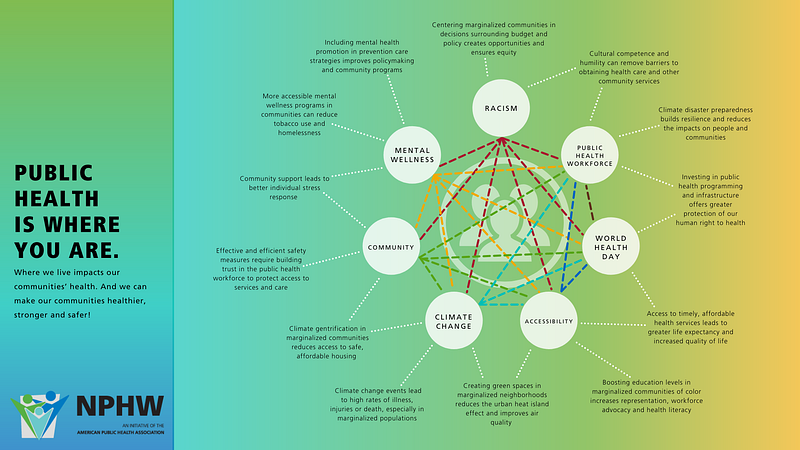
For NPHW by the American Public Health Association

The impacts of public health touch all of us, everywhere we are, at all times.

The theme of “Public Health is Where You Are” touches on the fact that the impacts of public health touch all of us, everywhere we are and at all times. It is literally, and figuratively, the air that we breathe. For example, one term that is important to practitioners is the “social determinants of health”. These are the factors that impact our health that we often don’t take into account such as where we live, the community we are a part of, our education level, and our income. All of these things have been shown to play a role in the health of communities and individuals.

One of these determinants of health include race. As an example, you may have seen headlines over the last few years about the fact that Black women are more likely to die during and around giving birth compared to White women. This concept comes from research that examines mortality rates by race which is a use of the science of public health: epidemiology. Epidemiology is the study of the distribution of diseases in populations. If you needed to reread that (as I did a few times while studying) here’s a simpler way to explain it: Epidemiology studies who gets diseases when, where they are, and how. The example of Black women above is only one example of the kind of answers you will find when you start asking these types of questions.

Photo by Lukas Blazek on Unsplash

National Public Health Week Themes

During NPHW every day has its own theme and reading them shows you just how broad the impacts of public health are:

Click any of the links to explore a theme that might interest you.

What does accessibility mean in Public Health?

Photo by Viktor Forgacs on Unsplash

New mothers in the most powerful nation in the world are dying at higher rates compared to other less powerful countries.

On the day of publishing this article the theme of NPHW is Accessibility. One of the biggest issues we face with access in the US has to do with health insurance and the cost of care. Health insurance is the way that we access care and without it, if you find yourself needing it, the costs can be exorbitant. In 2020, 28 million people in the US did not have health care. This means that whenever any of them did need to seek care they had two options: do not go to a doctor or go to a hospital and face the possibility of paying an absurd amount of money. This is not a decision anyone should have to face because neither option is a good option and I can assure you that many of those 28 million people did.

For some perspective, the United States is the only industrialized nation that does not guarantee some form of health care to all of its citizens. This is a problem and we can see the effects of this in some realities such as the fact that the US has the highest rate of maternal mortality in industrialized countries and it is not even close to other countries. You are reading that correctly. New mothers in the most powerful nation in the world are dying at higher rates compared to other less powerful countries.

These facts about health care accessibility are alarming to put it mildly. They are also the tip of the iceberg. But, Public Health practitioners around the country and around the world are trying to do something about it. If you want more information on Public Health and NPHW you can visit www.nphw.org where they have a wealth of information and resources for you.

If you enjoyed my article and want to read more as I write, please subscribe to email updates on my profile page by clicking the envelope under my photo. If you want to support my writing you can always buy me a coffee (for which I and my caffeine addiction would be grateful) ☕ by clicking this link.

Public Health
Motherhood
Race
Health
Social Determinants
Recommended from ReadMedium