
SCIENCE HUMOR
NASA Wants to Send Your Dopamine Receptors to Mars
Yes, the first Martian could be you
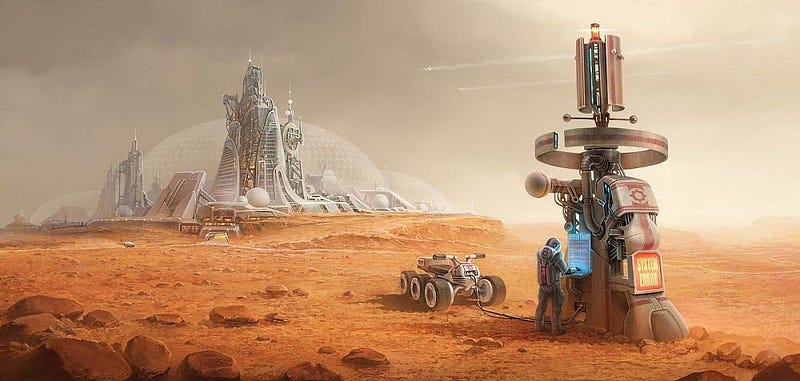
NASA engineers at mission control in California erupted in shouts of joy last month as the Perseverance Rover landed on Mars. It’s an exploration craft about the size of a family car. And a decade of work — not to mention billions of dollars — were invested to make sure the landing went smoothly. It’s not an easy thing to do.
“Confirmed, confirmed, that it is safely on the surface of Mars,” Mission Control announced as the Perseverance landed in a crater on a part of Mars that has never been explored before.
The Perseverance is now sending footage back to earth at “the speed of a teenager posting to Instagram” Lauren Worley told Times Radio immediately after the landing. Worley is a former NASA press secretary who is known as “Space Lauren” on Twitter.
Mike Watkins, director of Nasa’s Jet Propulsion Laboratory, added:
“There is something special about the first few days (of the mission) because we have just landed a representative of Planet Earth on a place on Mars that no-one has ever been to.”
The Perseverance will spend two earth years on Mars in an attempt to answer David Bowie’s question: “Is there life on Mars?”
It’s Only the First Step Towards NASA’s Ultimate Mission
Special as the moment is, it’s only one step towards NASA’s ultimate mission.
NASA wishes it could send a human just like you to Mars. And one day, they’re planning to make that happen.
You’ve got a special ability that would send the heart rates of NASA engineers shooting through the sky if they could send it to Mars. In fact, you’re reading this article because of that special ability.
When you saw the article, chemicals shot through your brain, and you clicked on the title to find out more. You saw this article as something shiny, like a kid seeing an interesting-looking rock. You wanted to flip it over to see what lurks beneath.
That’s a big reason we want to explore space, the instinct to find out “what’s underneath that rock?” We discover this instinct from the moment we start exploring as babies, and we never lose it.
NASA has found it impossible to replicate this “what’s under the rock?” curiosity in robots or Mars rovers.
Your Brain’s Ability Beats All NASA’s Hi-Tech Space Gadgets
The Perseverance is equipped with a small helicopter. This will mean the first powered flight on another planet. It will allow NASA to explore more hard-to-reach places and get a birds-eye view of the planet. It’s going to find out all kinds of interesting stuff.
But even with all that specialist tech, NASA wishes it could send a human just like you. Each new thing discovered on Mars is a pull on the one-armed bandit of changing how we understand the universe. Having a human there would drastically increase the odds of winning the jackpot.
“We want to send humans there because a human can go: ‘Wow, that rock looks interesting and shiny’,” Worley told Times Radio.
NASA wants to put humans on Mars because, from a neurological perspective, we’re driven by finding new information. Whenever we discover something new, we get the feel-good chemical dopamine shooting through our brains.
“A robot doesn’t have that natural instinct to discover,” Worley said in her Times Radio interview. “It doesn’t have any instinct beyond what’s programmed into it — and that means unless we’re walking on Mars ourselves and exploring the planet with our footsteps, there’s plenty we could miss.”
She added that a human is able to say:
“‘I’m going to go over there and pick [that rock] up,’ whereas a rover and a robot has to be programmed by humans on earth and is limited by what we see [through the images it transmits].”
The First Martian? It Could Be You
Now, it might not be you specifically that ends up on the nine-month journey through space to the red planet. And you might be relieved about that since the whole place has the stench of rotten eggs — not to mention the lack of oxygen.
But you’ve got the natural instinct NASA is looking for — and it’s one you can bring to your work, your creative pursuits, or your side hustle.
So the next time you find yourself in a slump of self-doubt, remember this — more than anything, NASA wishes it could put your brain on the next shuttle to Mars. Hopefully with your body attached too. Take that, slump!


