
Narrow-minded hypocrisy courtesy of Roy Clark’s ‘Do You Believe This Town’
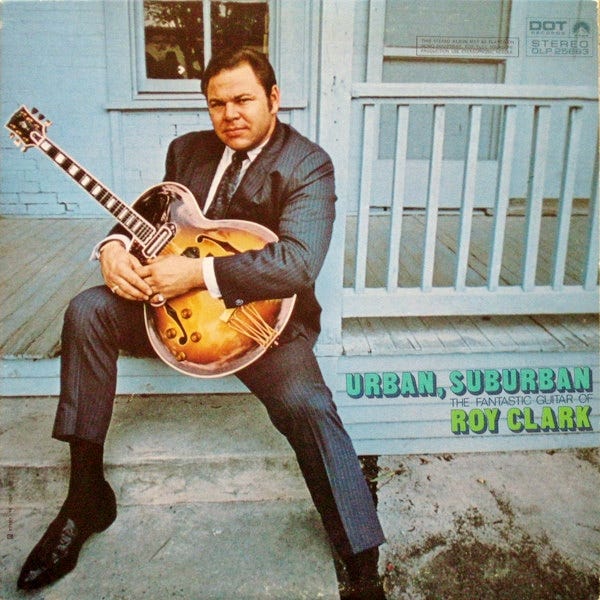
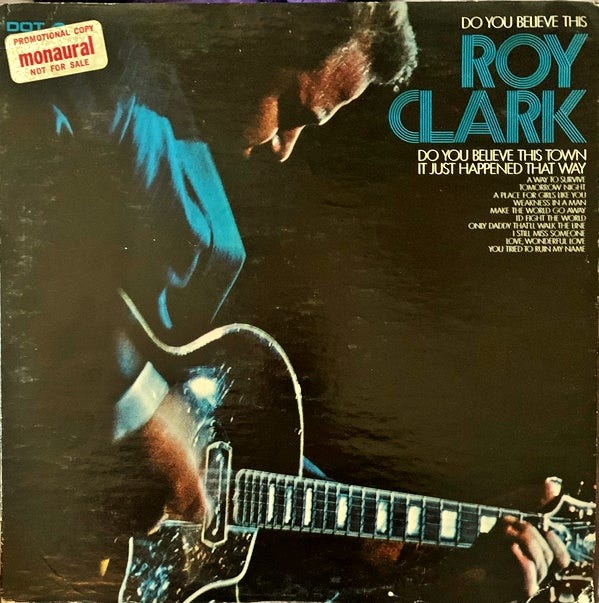
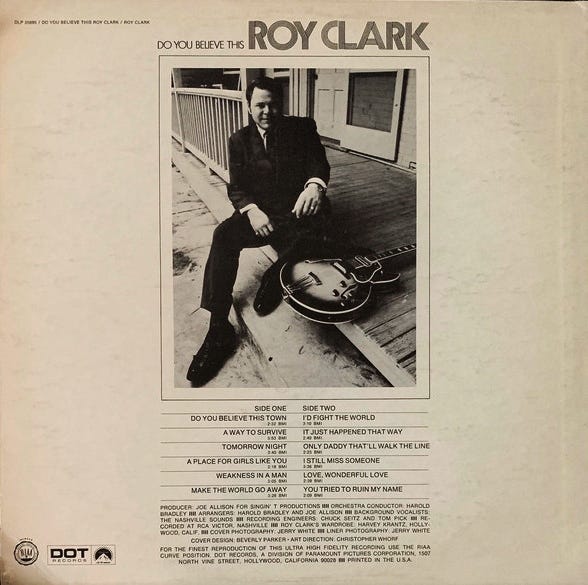
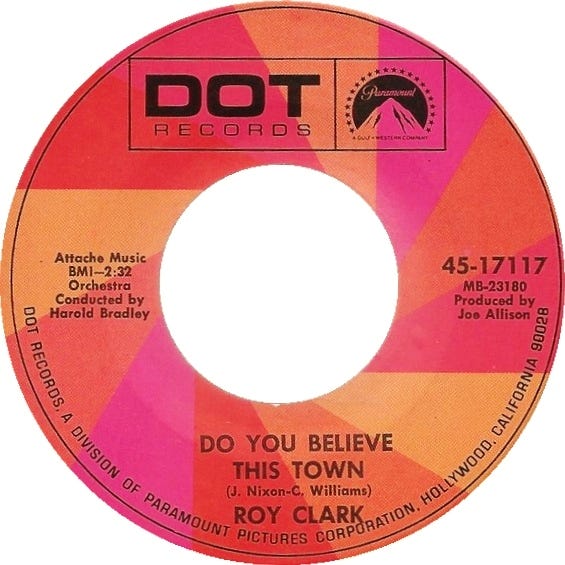
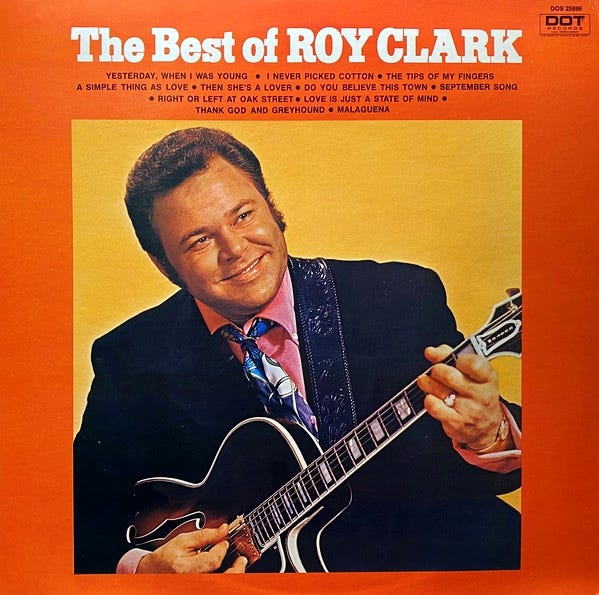
“Do You Believe This Town” was Roy Clark’s overlooked July 1968 social commentary on covert rural prejudice, recorded several months before Jeannie C. Riley’s much-ballyhooed “Harper Valley P.T.A.” A nameless pastoral community is not as it seems. Town pillars, from the mayor to the chief of police, are knee-deep in hypocrisy. The church deacon “preaches brotherly love every Sunday, and forecloses loans on widows’ homes every Monday.” The final verse is even more scathing — “Do you believe they burned a house down yesterday…if the folks who lived there had a-known their place, they could still be hangin’ around.” The summer of 1968 was rife with the assassinations of Martin Luther King and Robert F. Kennedy, racial unrest, and a draft that transformed optimistic high school graduates into damaged Vietnam vets. Authority was no longer unchallenged. Good guys wore black.
Joining Buck Owens as co-host of the long-running Nashville showcase Hee Haw the following year, who would have surmised that Clark embraced liberal hippie values? He actually sat in with First Lady of Southern Soul Candi Staton for a hair-raising Gibson Byrdland guitar attack on B.B. King’s “The Thrill Is Gone,” risky for a picker courting a conservative audience over 50 years ago.
Slamming into a brick wall at No. 53 C&W, the 2009 Country Music Hall of Famer’s plea for tolerance was not for naught. “Do You Believe This Town” launched the most commercially rewarding chapter of the lightning fast axeman’s career on Randy Wood’s Dot Records [third single “Yesterday When I Was Young,” a dramatic rendering of the French ballad, became Clark’s biggest pop crossover smash] as well as a five-year collaboration with producer Joe Allison. The many-sided Allison previously shepherded Willie Nelson’s first major label deal on Liberty Records and penned Jim Reeves’ country standard “He’ll Have to Go.”
And Dean Martin, whose eponymous, freewheeling variety series ranked among the Nielsen Top Ten on NBC, submitted a version that closed side one of his I Take a Lot of Pride in What I Am LP. Martin’s producer Jimmy Bowen literally went to town, commissioning an obtrusive orchestra and girl group oohing, aahing, and chanting “yeah, yeah, yeah!” A stripped down remix of the original multi-track masters would be revelatory. For that matter, Clark’s original country folk take, driven by acoustic guitars, a dobro, bass, and drums, is in dire need of a sonic upgrade. Only a needle drop source is available. The founding Rat Pack crooner paid an additional tip of the hat by singing Clark’s first hit — “The Tips of My Fingers” — on My Woman, My Woman, My Wife in 1970.
As far as video material, a clip of Clark lip-synching to the studio master in Hee Haw’s debut season is all that survives. The 60-minute cornpone variety series built a nearly 30-year legacy in spite of being cancelled by CBS after two seasons of compelling ratings [the network’s “rural purge” paved the way for syndication]. Clark also depicted “Cousin Roy” on The Beverly Hillbillies, gamely participated in sketches with Flip Wilson, and guest-hosted The Tonight Show Starring Johnny Carson. His reputation as a stocky, happy-go-lucky comic consequently overshadowed his stellar musical credentials as a vocalist, songwriter, and instrumentalist [see his acoustic run through of “Malagueña” as Odd Couple Tony Randall and Jack Klugman sit incredulously]. A similar pitfall happened to Jerry Reed. In The Encyclopedia of Country & Western Music, Rick Marschall likened Clark’s voice to a “permanently hoarse tenor, and the emotion he brings to heart-songs sounds like every drop of feeling has been wrung out for the task.”
Nashville songwriters Joe Nixon and Charlie Williams are guilty as charged for “Do You Believe This Town.” A subsequent A-side by the duo, “Right or Left at Oak Street,” garnered more encouraging chart placement for Clark, narrowly missing the Top 20 by one slot. “Oak Street” also refused to pursue an insipid ear candy route, chronicling a husband’s tortuous decision about whether to leave his family or remain stuck “in the same old routine…I don’t know which takes more courage, the staying or the running away.” Williams’ history with Clark stretched back to his formative years with Capitol. Written in tandem with outlaw country forerunner Bobby Bare, the scarce “Through the Eyes of a Fool” landed snugly in the Top 40 in 1963. Of all his Clark contributions, 1970’s Top Five “I Never Picked Cotton” prevails as the most fondly remembered and has turned up on innumerable greatest hits compilations. The dusk of the disco decade found Williams still capable of authoring gold records as evidenced by Gene Watson’s “Farewell Party.”
Do You Believe This Town [Lyrics]
Joe Nixon and Charlie Williams © Attache Music, BMI
The woman next door has gone to the P.T.A., And stopped to see her best friend’s husband on the way, The folks down the street have a different faith, So everybody’s puttin’ them down, Do you believe this town?
Deacon Jones preaches brotherly love every Sunday, And forecloses loans on widows’ homes every Monday, But the smart guys say it’s the only way, To keep the economy sound, Do you believe this town?
Do you believe they voted this town dry, Well, you won’t believe it when I tell you why, The mayor and his cousin and the chief of police, Have got the bootleggin’ all nailed down, Do you believe this town?
Do you believe they burned a house down yesterday, You won’t believe the reason that they gave, If the folks who lived there had a-known their place, They could still be hangin’ around, Do you believe this town?
© Jeremy Roberts, 2021. All rights reserved. To touch base, email [email protected] and mention which story led you my way. I appreciate it sincerely.


