
NaNoWriMO Virgin: Debriefing My Experience
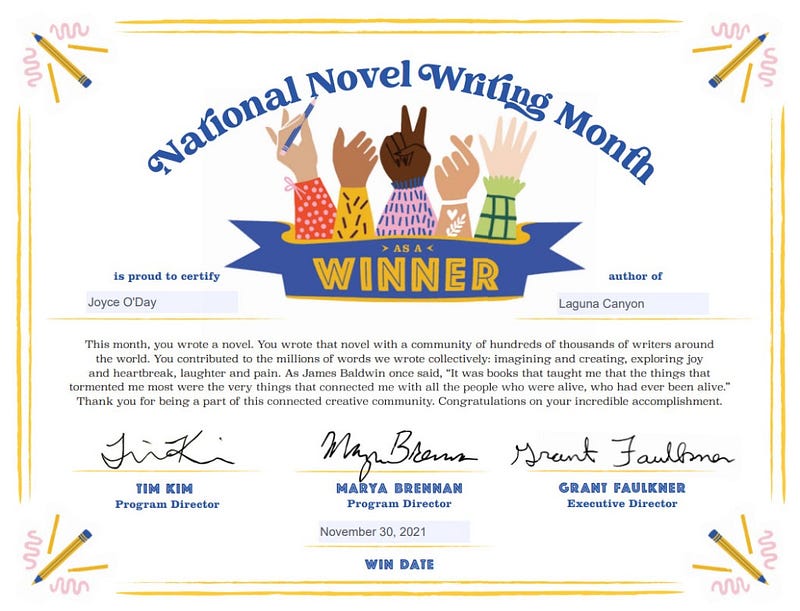
I not only “won” the competition by writing over 50,000 words, I advanced as a writer and creator.
Background
Over the years, I heard of NaNoWriMo (National Novel Writing Month), but never took the plunge. When I stumbled across an article promoting it last October, I signed up immediately and made a $30 donation to their 501(C)(3).
My goal was to write at least 2,000 words a day, rather than the prescribed 1,667, so I could buy myself some time if there were a day or two when my life interfered with my writing. I had a 12,187-word — largely autobiographical — manuscript I had begun in 2018, but abandoned. This time around, I was highly motivated.
Details of my Success
I can proudly say that I wrote at least 2,000 words every day; my lowest word-count day was 2,003 (November 3), which took 2 hours and 15 minutes, and my highest word-count day was 5,489 (November 30), when I wrote for 6 hours and 40 minutes. I “won” the competition on Day 21 when I achieved 50,051 words, and by Day 30 I had completed 79,629 words. Adding that to the 11,632 words that remained from my original manuscript after editing, I had written a total of 91,261 words.
In November, I dedicated over 121 hours to writing my first novel. My NaNoWriMo writing time exceeded 104 hours (6,245 minutes), averaging 3 hours and 45 minutes a day. I spent an additional 17.6 hours (1,060 minutes) planning, organizing, and editing, not counting the many hours my story bounced around inside my brain. Based on my NaNoWriMo writing time, I extrapolated that I probably spent 15 hours on the original 12,187 words, bringing my total work time to 136.5 hours for the first draft.
Insights
- My writing stamina increased weekly: Week 1 = 2083 word average; Week 2 = 2318; Week 3 = 2747; and Week 4 = 2836.
- Within the first week, I noticed that it took 10–15 minutes to get into a flow, wherein my characters took over dictating the events of the story.
- I am a planner, more than a pantser. I followed the “Save the Cat” format on the NaNoWriMo website. “Save the Cat” specifies a series of beats aka plot points which lead to a well-structured story. Hence, I had very specific designations that my characters had to arrive at, but I allowed my characters to find their own way along the journey to those resting points.
- I write scene by scene, not worrying about chapters or perfection, skipping over names or details I could create or embellish later and factual details that would need to be confirmed or researched.
- I made an effort to stay in chronological order, but allowed myself to move on to bigger scenes that inspired me, leaving notes in the draft concerning smaller scenes I would need to fill in later.
- I discovered how much I enjoyed the process of creative writing versus academic or Medium-style essay/article writing. I looked forward to going into my office to get started every night.
Side Work
I pulled a dozen fiction books from my shelves to study the first sentence, first paragraph, and first chapter of each novel.
I read countless articles about writing on Medium and other online sources.
I checked out four books about writing from the library and plan to read at least that many more over the next few months.
I read numerous articles criticizing NaNoWriMo, along with a few encouraging ones. Thank you, Justiss Goode, for being an inspiration and for your encouragement.
Two Things That Worked In My Favor:
- I am a retired teacher who lives with my retired husband and an adult daughter, so I did not have to compete with my job or a needy family to get my writing done. Most of my writing was completed in the evening after dinner, when I substituted TV time for writing. I look forward to going into my writing space for a few hours every evening, and so far, I have not missed a night!
- I broke my ankle on night #7, which prevented me from being distracted by housework and yard work and any other activity that involved standing. In general, I was a captive writer.
Where do I go from here?
I plan to spend December on my first revision. After that, I will allow some family members and selected friends to provide feedback.
I need to conduct assorted historical and factual research, which will require a visit to Southern California: locations, museums, and the National Archives in Riverside.
I need to consult with experts in the legal field to ensure my courtroom scenes ring true, and I plan to reach out to a couple of criminals to make sure all the details are realistic.
My Misstep
The last two days of writing, I went off on a tangent. I allowed one of my main characters to have an adventure that was intended to lead to the conclusion, but it led to an entirely new story that destroyed the final “Save the Cat” beats, thus weakening the ending — but I’m counting it as a win. The 5,450 misdirected words that I wrote on those last two days in November can be applied to a sequel of this story. Removing this section lowered my total word count to 85,811, and I still need to readjust the ending, so that it stays true to the “Save the Cat” format.
Future Plans
Like most fiction writers, I would love to see my novel traditionally published and sold at nation-wide chains like Barnes and Noble, before being turned into a mini-series on Netflix. However, if that does not come to pass, I will be satisfied releasing it as a serial novel. A shout-out to Rodney Goodall and his publication on Medium: World of Web Novels, which provides a wealth of information concerning all aspects of writing and publishing novels in an online serial format.
I have three more ideas for novels: the sequel to this novel, a near-future science fiction novel, and a suspense novel.
Final Takeaway
I can do this! I can write fiction and find personal fulfillment in the process. Getting into the flow of creative writing became a sort of creative meditation.
Watch for it!
Laguna Canyon: On the verge of getting busted for dealing drugs in their coastal Californian town during the psychedelic 1970s, two high school girls must confront the rifts in their dysfunctional families and forgive the sins of their parents before they can develop the self-esteem needed to successfully transition into adulthood.
Books I’ve read since beginning NaNoWriMo for structure and formatting advice and overall inspiration:
- Save the Cat! Writes a Novel: The Last Book on Novel Writing You’ll Ever Need by Jessica Brody (Based on the Books by Blake Snyder), 2018.
- Writing the Breakout Novel: Insider advice for taking your fiction to the next level by Donald Maass, 2001.
- The Emotional Craft of Fiction: How to Write the Story Beneath the Surface by Donald Maass, 2016.
- Writing Popular Fiction by Dean R. Koontz, 1974.
- Bird by Bird: Some Instructions on Writing and Life by Anne Lamont, 1994.
- The Art & Craft of Novel Writing: Timeless advice with examples from literary masters-Flaubert to Hemingway to Oates by Oakley Hall, 1989.
Originally published at http://joyceoday.com on December 15, 2021.


