
Naked women on the walls, Part Two.
How I got so interested in those women six years ago.
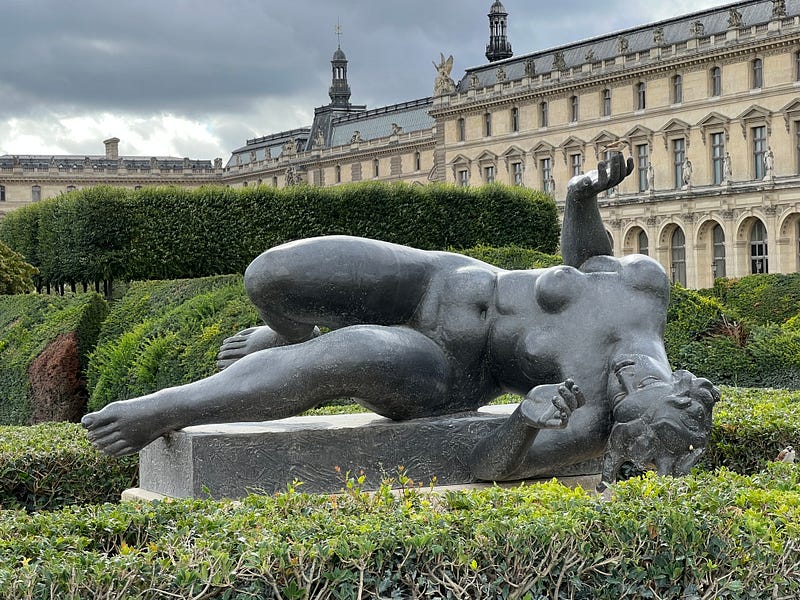
Well, it was Paris. Paris, six months of glorious solitude, and nobody looking over my shoulder or caring at all what I was writing about.
So I decided to write about sex.
I cannot tell you how unlikely that was.
It’s not just that I grew up in New England in the fifties and sixties, the daughter of politically liberal but sexually repressed parents. (More on that later, or never. I mean ewwww.)
It’s not just that I spent several decades NOT out as a lesbian.
It’s that, well, one just doesn’t write about sex. (Back to the point about New England.) Even fictional sex. And I have no idea how far I’m gonna get with this essay.
But I started by promising you an answer to why I was looking at the naked women on the walls, and it’s not just that I decided, randomly, to put explicit sex scenes in my fiction that year.
It’s that there are so many naked women on the walls, and in the parks, and in the advertisements, and in the magazines, and on television, and in the movies, and on the beaches, and so on.
How is one not going to look at the naked women?
In Part One I talked about the male gaze and feminist anger about the flaccid, placid naked women.
In this Part Two, I want to talk about shame and embarrassment. Well, I’m not sure “want to” quite covers the case. I think it is necessary to talk about shame and embarrassment.
They are not the same thing, of course. But let’s just put that aside. For me, it’s all wrapped up in one sloppy package.
When I was four or five, I remember, I would sit outside in the summer sun in Maine in long pants and a sweater. (Yeah, even for Maine that was extreme.) My mother tried to persuade me to change into lighter clothes. She was probably successful, but by then I was well into the shame thing.
I had a normal kid body. At that time, it was straight (so to speak) and lean enough, and just — normal. I mean, not exceptional. I was lucky — I could blend into my white community easily, being white and all.
But of course I never felt that I did blend in. I did want to be covered up all the time, and that was not odd for the era, of course, though I sometimes took it to an extreme. But I hated dresses and skirts. Hated them from the beginning of time and still do seven decades later. And growing up as a girl in the fifties, you didn’t get to act on your hatred of dresses and skirts.
So I was “normal,” but it was a forced presentation, a performance, and I usually got it wrong. I was covered up, yes, in so many ways. I hated it.
And of course that hatred of dresses was just the pale shadow of what one didn’t get to act on. Oh, it was important all right. I’m pretty sure my mom was sympathetic, but she also had a strong need, as a young mother, for her kids to blend in. And she struck out on that count until the third one — pretty and blonde and compliant and cute as hell. Love that girl (well, woman, now). More on the middle one later. Love her, too. I’m so lucky in my sibs.
Anyway, I had to wear dresses and skirts. We had to have Easter dresses, even though we were not particularly religious. As I got older (middle school-ish), Mom found a dressmaker who used patterns from the store to make me plain jumpers (the US kind, not the British kind) and kilts. Those were marginally comfortable. I wore turtlenecks and loose sweaters on top and tights underneath, but again, in those days you didn’t wear leggings without worrying about boys and other people seeing your — you know, your private places, if the wind came up or you wanted to play on the jungle gym.
In eighth grade I started gaining a bit of weight — no longer straight and lean, shall we say. Certainly no longer lean, and for the most part, no longer straight. But whoa, that’s where the shame kicks in.
I did genuinely fall in love that year with a boy named Robert. The next year I crushed out on a boy named Barry. I did date and partner up with several boys and men on my way to exclusive lesbianism, somewhere in my thirties.
But I really fell in love, over and over, with girls. It was still the era of butch and femme, but I wasn’t consistent. Far from it. There was the butch athlete, the femme-y singer, the hypercool pianist, and the artist with long black hair and a radiant smile.
Embarrassed and ashamed, I never told any of them about my passion. (Thank heaven.) Anyway, there were still those boys, so it all must have been OK.
I got crushed out on, too, and that was way more than uncomfortable. There was the burly camp counselor who copied out the entire Edna St. Vincent Millay poem Renascence — I mean, copied it, in her handwriting, and gave it to me. Talk about embarrassed — but I’m betting it’s tucked away in a footlocker somewhere.
And then, the dyke-iest girls in the school warned me about getting into a car with the woman math teacher who, well, you know, just don’t.
I can’t remember at what age I realized that liking boys did not erase the liking girls that I kept tumbling into, not at all — so I made a pledge to myself that as long as I never told anybody about my feelings for girls I could stay in this world.
When you make a pledge like that, you’re not likely to write about sex, even if writing is what you do.
And you’re not likely to look at the naked women on the walls with anything but passing interest — really passing. Like, keep on walking. Because it’s as if all those real-life women you adored found out that you loved them, that you were curious about them, that you did have the fantasies you disavowed for so many years. Shame. And embarrassment. All in one sloppy package.
(That middle sister. She came out before I did. I should’ve been ashamed and embarrassed, to have my younger sister be braver than I was. I kind of was embarrassed. And ashamed. Her gutsy decision was a big part of the courage I finally found to bloody well come out, already.)
So the naked women on the wall — they’re personal. They’re not just more art, and not just a target of my feminist wrath. But it’s complicated.
More later?


