
Naked Truths About Life Drawing Classes
Experiences of drawing the human form
.jpg)
Not long ago I started attending life drawing classes at a local college.
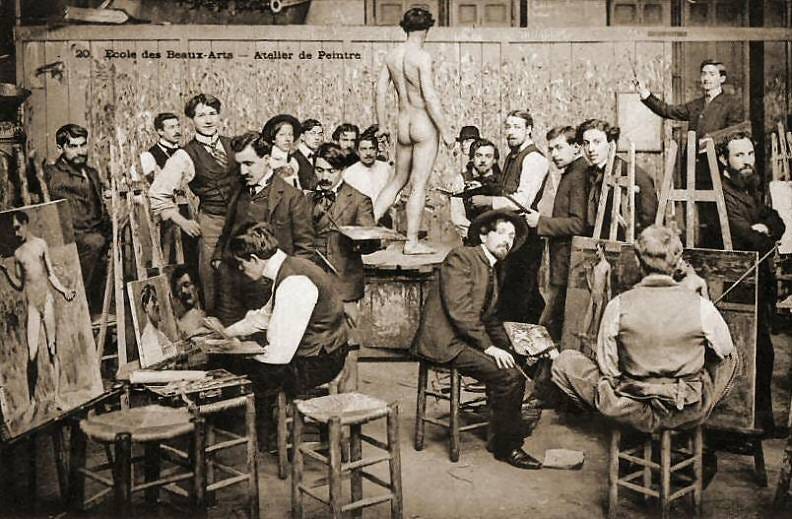
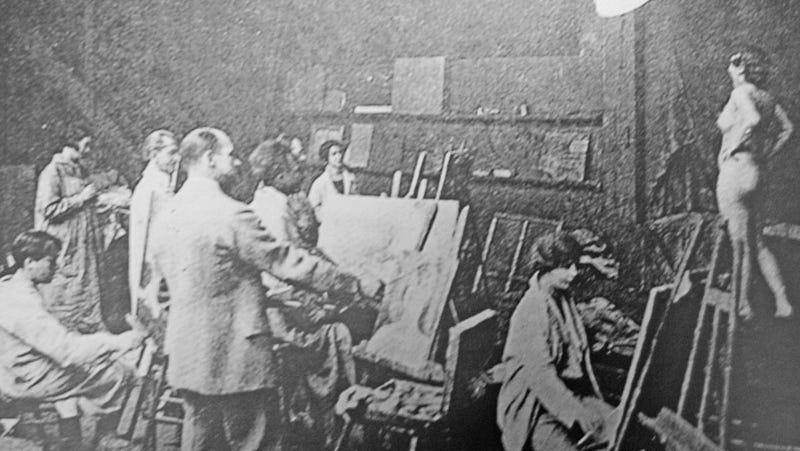
Just as you see in films or on TV, the disrobed figure sits in the centre of a room with a circle of easels surrounding them. Behind the easels, students drag charcoal blocks or dab Indian ink or smudge oil pastels across the paper, and do their best to render a decent likeness of the posed model in front of them.
People I tell are intrigued by this scene.
They wonder about the model, how young or old they are, if they’re male or female, about the nudity and the potential for allure or disgust.
The drawings I bring home are invariably endowed with some intimate swell of nakedness, and when I present them to my partner, I see her initial thoughts puzzled by the idea of my eye lingering over these confidential details…
Centuries of tradition
The practice of sketching from live models has long been seen as an essential component of artistic education, dating back to at least the Renaissance period.
One of the most intriguing, examples comes from 19th-century Paris.
The Académie Suisse was a notable life-drawing school in the heart of the city, attractive to many artists for its affordable fees and informal, somewhat bohemian atmosphere.
Virtually every great artist of the time passed through its doors, from Édouard Manet to Paul Cézanne. It was where Claude Monet met Camille Pissarro long before the term “Impressionism” was coined.
The drawing school enabled students to draw or paint directly from a nude model. For three weeks of the month, the artists were provided with a male model to work from, and for one week a female model.
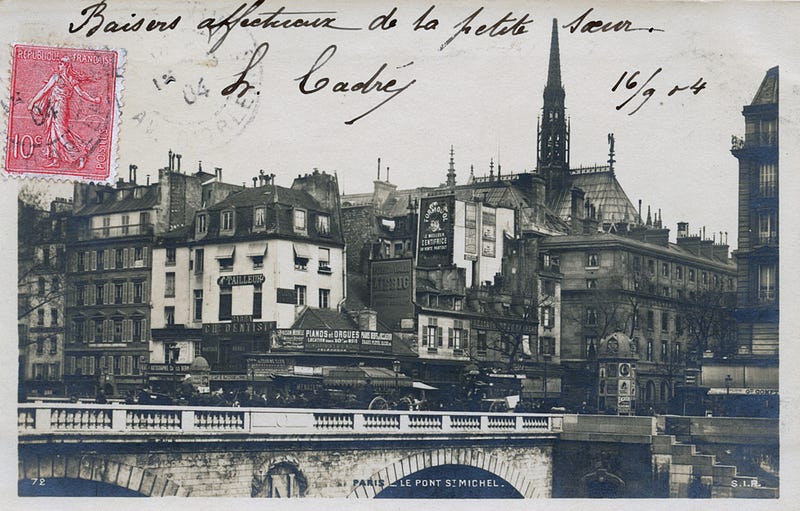

An evocative description of the Académie Suisse comes from the English artist Valentine C. Prinsep, who studied there during the 1850s. In his essay “A Student’s Life in Paris in 1859”, Prinsep recounts how on the evening of his first class he went with his paper and chalks to the door of the school, “knocked timidly,” and was admitted to a large room hung with studies. The model that night was a woman whom Prinsep recalls “had a very sweet voice, and while she was sitting would warble charmingly songs of what du Maurier called tout ce qu il y a de plus canaille [all that is most scoundrelous].”
Other accounts corroborate Prinsep’s vivid impressions, recollecting a dingy and decrepit set of stairs leading up to the second floor of the building on the corner of the Quai des Orfévres, where the shabby but lively studio was located. An amphitheatre of stalls and benches enough to seat 80 students was arranged around the room. Oil lamps lit the interior, whose walls were stained with cigarette smoke and covered with paintings that poverty-stricken artists had left in lieu of missed attendance fees.
Not that the fees were costly: students paid five francs per month to study there, which was one reason for its popularity. Another reason was its proximity to the local morgue which provided students was an endless supply of subjects to draw from. “The Morgue was a constant haunt,” recounted Prinsep. “When there was a new and what was considered an interesting subject to be seen there, word was brought to the atelier, and off we went to see the grizzly sight.”
The founder of the school was himself a retired model named Martin François Suisse, who had once posed for the venerated Jacques-Louis David. Suisse’s personal expertise undoubtedly lent the school part of its appeal, since whilst he provided little artistic tuition he did his best to ensure an interesting variety of models. He would even dress up as the painter David, much to the amusement of his students.
According the Prinsep, Suisse died on the night of his first class in 1859. “We went into the adjoining room and there was the poor old man, but he was lying dead in his bed. [..] I venture to think that in no place but Paris could such a thing happen.”
The academy passed into new ownership and sadly this fascinating chapter of Parisian art history ended.

First Week Nerves
My experiences at life drawing classes were not quite as ribald as Prinsep’s, but even so, the events of the very first session were enough to make me think twice.
I arrived a few minutes late, into an art studio with white-washed walls and stark electric lighting. Feeling a little tickled by first-week nerves, I came rushing into the art room to find the model — a male with a fair-sized belly and good, jowly face — already undressed and reclined in a state of confident ruin on a mattress in the middle of the floor.
I looked around and took my lead from the other students, who had already chosen their easels and had taken up their places behind them. Quietly, I picked up an easel — a large, cumbersome thing — and edged my way into the circle, where the only spot left was at the delta of the man’s open legs.
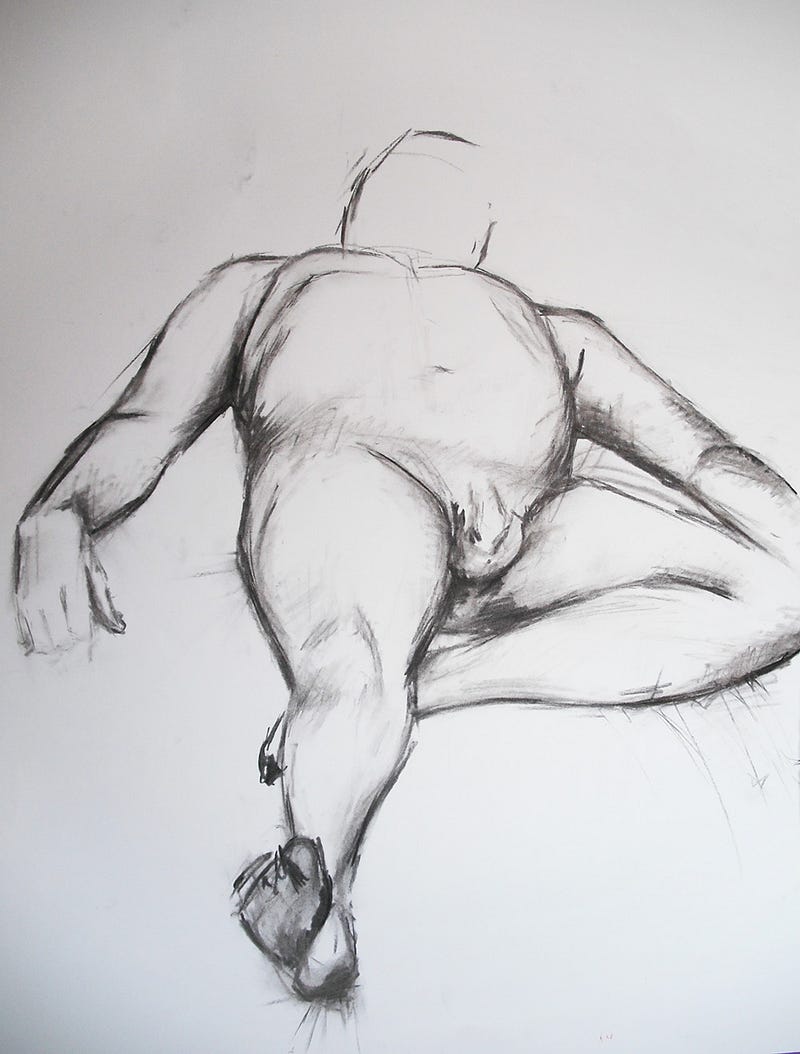
A requirement for all life models, I suppose, is a sure-footed immodesty, but even so, this level of boldness — legs splayed as wide as a pair of scissors — took me by surprise.
I composed myself with the thought that I was taking part in a tradition that has a venerable history in art, and took my charcoal stick in hand and began to draw.
Meanwhile, the model remained happily spread out on the floor. What started as a strange experience soon turned comical. Unlike Prinsep’s tuneful sitter, our model went the other way: midway through the evening he fell asleep and started snoring — which at least meant that he stayed perfectly still for the next hour.
Embarrassing?
The question I get asked repeatedly about these drawing classes is: aren’t you embarrassed? Apparently, the thought of staring at another person’s naked body — and having unqualified permission to do so — is fraught with all sorts of lurking concerns.
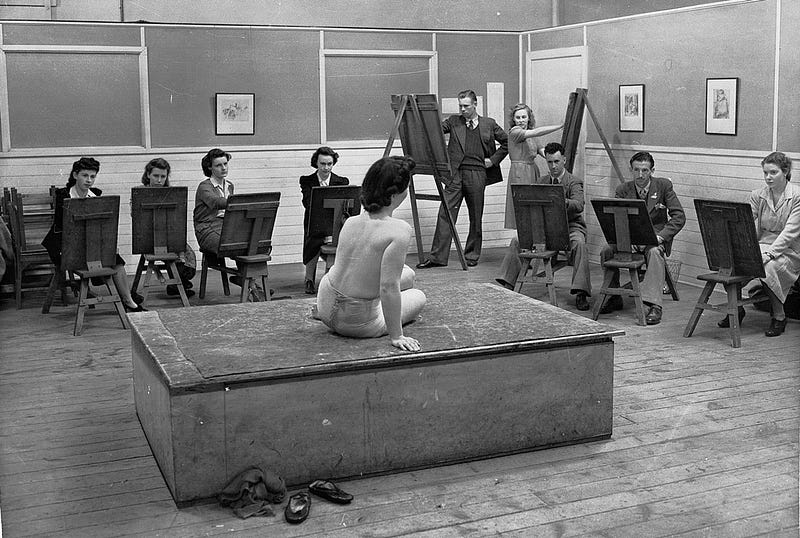

The funny thing is that, sooner or later, you forget you’re looking at a nude person — and gradually the connotations of nakedness that our modern world is so obsessed with slip away.
As the weeks have progressed, we’ve drawn male and female models in equal number. The noteworthy part is this: how quickly the nakedness became the norm. There’s no tittering, not even a hint of a repressed awkwardness. The students may be fretful about the quality of their artwork, but they are never concerned with the curious situation of fifteen pairs of eyes avidly scrutinising an unclothed human.
Attending life drawing classes liberates you from the sober guardedness of everyday life. Normal rules of social interaction are suspended. In this brief dissolution, a new form of freedom occurs: of being able to prioritise the act of drawing, and in the service of this, the effort of looking.
What takes precedence are the principles of drawing, of getting a line right, picking out a shadow, capturing a contour, or understanding the interplay between elements. In this shift, the actual thing you’re drawing becomes a collection of shapes to be translated onto paper.
At the end of each session, as the model gets dressed and the artists roll up their drawings to take home, the overwhelming sense is of having discovered something important. We came to learn to draw, only to realise it is also a matter of learning to see.

Christopher P Jones is the author of What Great Artworks Say, an examination of some of art’s most enthralling images.
Would you like to get…
A free guide to the Essential Styles in Western Art History? Download for free here.
Join me…
On Instagram for more great paintings on the go!