
Nahua Duality and “Ometeotl”
It’s become popular to deny that the Dual God Ometeotl was ever a thing. Many folks argue that scholar Miguel León-Portilla invented the deity to support what he wanted to believe about Aztec religion.
And I agree that Dr. León-Portilla was absolutely wrong to affirm that there was a seldom-mentioned, secretly worshipped supreme Aztec creator deity. The evidence is overwhelming that in the Triple Alliance, three gods led the pantheon: Huitzilopochtli, Tezcatlipoca, and Tlaloc. And creation had been carried out under the supervision of Quetzalcoatl and Tezcatlipoca. The other divine forces revered in Tenochtitlan did not include Ometeotl, as far as we can tell from the evidence that survived the Spanish Invasion.
However, I think I can show that the name Ometeotl—as a label for one of many divine dualities—did actually exist.
So you can grasp my argument, I need to teach you a BUNCH of stuff, so strap in. This will be a doozy.
As a preamble, you should know that duality plays a huge role in many indigenous Mesoamerican religions. Both K’iche’ Maya and Nahua texts feature creator dyads, for example.
The Maya dyads often share one basic name, prefixed with hun (“one”) and wukub (“seven”) as individuals to signal that they are two-in-one. For example, Hun Kame and Wukub Kame (death gods) or Hun Hunahpu and Wukub Hunahpu (corn gods … with Hun being generative and Wukub being a sort of sterile helper).
From the Codex Chimalpopoca, we know that Toltec King Ce Acatl (considered the incarnation of Quetzalcoatl) along with his sister Quetzalpetlatl worshipped a series of divine dyads, including the following:
- Citlalinicue (Star Skirt) and Citlallatonac (Star Place Abundance)
- Tecollaquenqui (Covered in Charcoal) and Eztlaquenqui (Covered in Blood)
- Tlalichcatl (Earth Cotton) and Tlallamanac (Earth Foundation)
Plus another pair that we’ll come to later.
Elsewhere, I’ve written of other male/female aspect pairs, like Xochiquetzal—Xochipilli or Mictecacihuatl—Mictlanteuctli.
But individual gods THEMSELVES were often seen as dual (male/female). Here are some quotes:
“in tonān, in totah, in tōnatiuh” — Our mother, our father, the Sun.
“in tonān, in totah in Mictlāntēuctli” — Our mother, our father, the Sovereign of the Dead Land.
“in tonān in totah in Tlāltēuctli” — Our mother, our father, the Sovereign of Earth.
“in tonān in totah in yohualtēuctli” — Our mother, our father, the Sovereign of Night.
This dual parental role extends to the being that gave rise to the gods themselves:
“tēteoh īnnān tēteoh īntah huēhuehteōtl” — The mother of the gods, the father of the gods, the Old God.
When Christians came along, they appropriated the parental dyad for their upstart deity, as well:
“Yehhuātl Dios huel monāntzin motahtzin”—That one, God, our true mother and father.
There were many other dualities beyond just male and female. Nearly every deity in the pantheon is part of a complementary pair with another.
- Chaos and Order
- Youth/Beauty and Age/Ugliness
- Sun and Moon
- Southern Stars and Northern Stars
Even places come in dyads:
Tonatiuh ichan, the Eastern Paradise of Male Warriors (who died on the battlefield), and Cihuatlampa, the Western Paradise of Female Warriors (who died in childbirth) And so on.
Another thread in the pervasive sense of duality underlying Mesoamerican religion is the notion of the nahual, the shadow or animal self, the double. In addition to human mages (nahualtin or wayo’ob … the latter the Maya equivalent), the gods themselves had shadow selves.
- Xolotl — double of Quetzalcōātl, god of order
- Tepeyollohtli — double of Tezcatlipoca, god of chaos
- Xiuhcoatl — double of Xiuhteuctli, god of fire
- Cuauhnochtli (an eagle perched on a cactus) — double of Huitzilopochtli, god of war and the sun
One way of knowing whether a group of people thought about or discussed a concept is whether there exists a term for that concept. In Classical Nahuatl, the word for “duality” was “ometiliztli.” It comes from “ome” (two) and the nominalizing suffix -tiliztli. Two-ness.
Another way of constructing the word “duality” would be with the suffix for abstract nouns, -yōtl. That would give us “omeyotl,” duality. Now, that particular word isn’t recorded, but a derivative of it is: “Omeyocan.” That “-can” is a locative. “Place of Duality.”
What is this oddly named region? The Codex Chimalpopoca (4:46–48) describes Ce Acatl (Quetzalcoatl’s incarnation, remember?) crying out to Omeyocan, where the dyads mentioned above (and the last one, to be discussed below) heard his prayers and kept him humble:
The Nahuatl original reads:
“Ōmpa ontzahtziya, iuh quimatiyah, Ōmeyōcān Chiucnāuhnepaniuhcān inic mani in ilhuicatl. Auh in iuh quimatiyah yehhuāntin ōmpa chanehqueh in quinnōtzaya, in quintlahtlauhtiaya huel mocnōmattinenca, tlaōcoxtinenca.”
English translation:
“As they knew, he cried out to the Place of Duality, in the Nine Folds, which is how heaven is arranged. And those who dwelled there, they knew that he called out to them, that he prayed to them, behaving with great humility and mourning.”
What else do sources tell us about the Place of Duality? In a discussion of the soul of a newborn infant, Book 6 of the Florentine Codex says that “ca ōyōcōlōc in topan in ōmeyōcān in chiucnāuhnepaniuhcān” — “it is created above us, in the Place of Duality, in the Nine Folds.”
So Omeyocan is above us. It’s where souls come from, somewhere in the folds or weavings-together of heaven (rather than the tiers of other religious traditions, Nahua heaven is conceived of as a single piece, fold upon fold).
Therefore, Omeyocan is a synonym for “Tonacacuauhtitlan,” Place of the Tonacacuahuitl (Tree of Abundance). As concerns the souls of children who die young, we learn:
“Quichichīnah in tōnacāxōchitl ītech nemih in tōnacācuahuitl ītech tlachichīnah.”—They suckle on the Flowers of Abundance– they live beside the Tree of Abundance, where they nurse.
That celestial bower is also known as Chichihualcuahuitl, the Nursing Tree (as babies’ souls are nourished from its flowers). The Place of Duality has another epithet: “in Tonacateuctli ichan” or “the Home of Tonacateuctli.”
That epithet brings me to the fourth dyad that Ce Acatl Quetzalcoatl and his sister were said to worship, inhabitants of the Omeyocan that the king cried out to: Tonacateuctli and Tonacacihuatl. Their names bear some close scrutiny.
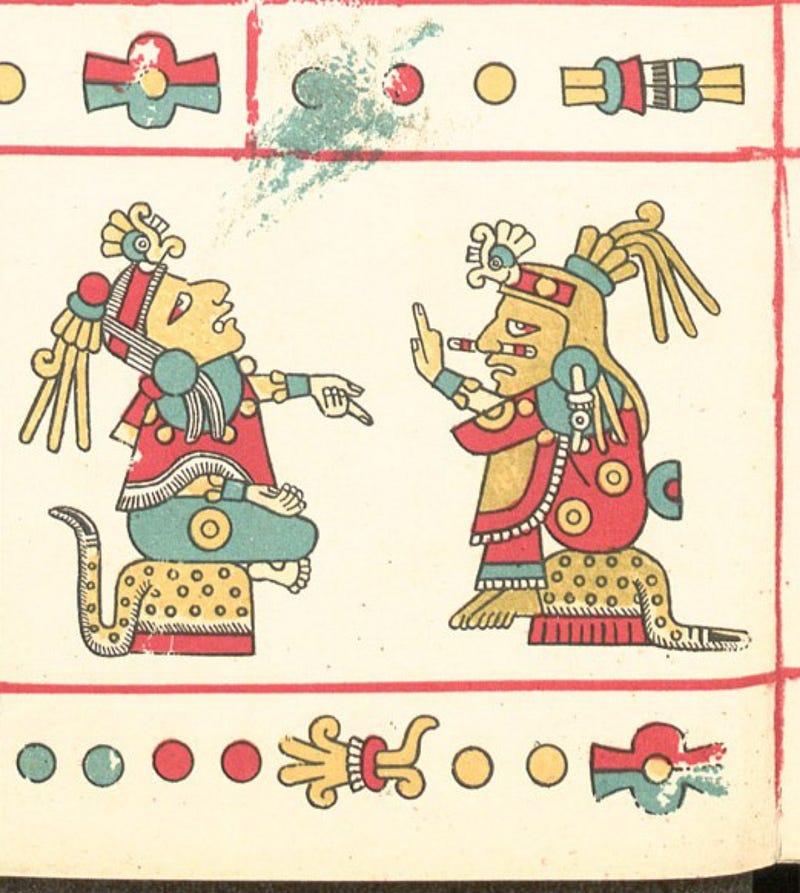
Tona is an impersonal verb meaning “to be warm/sunny.” Without the sun, there is no food, no earthly bounty. So “tonac” means “abundance” (with the implication that this is bountiful sustenance). Tona also gives rise to the noun “tonalli,” which can mean “warmth,” but also “day” or “day sign” (from the sacred calendar), and by extension “destiny” (as determined by the sign of one’s day of birth). Tonalli can also mean “soul.”
As a result, while this dyad’s names are “Abundance Lord and Abundance Lady,” there’s greater nuance.
In pre-Invasion Nahua thought, they rule over the place where human souls emerge and await birth. They are the source of our destiny. The codex Historia de los Mexicanos por sus pinturas (History of the Mexica through their Paintings) names this couple as the sole inhabitants of the uppermost fold of heaven.
NOW — the real argument begins.
Book Six of the Florentine Codex affirms that Tonacateuctli and Tonacacihuatl are epithets of gods more properly named “in ōmetēuctli in ōmecihuātl.” Literally “Two Lady” and “Two Lord.” Ruling in the Place of Duality.
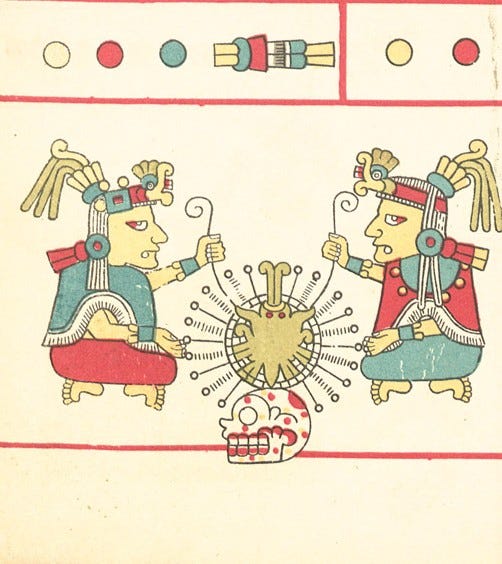
The Florentine Codex says of this dyad:
“In tonān in totah in ōme tēuctli in ōme cihuātl.” — Our mother, our father, Ometeuctli, Omecihuatl.
And at one point, the dyad is addressed. IN THE SINGULAR. To wit:
“In titlācatl in tōmetēuctli in tōmecihuātl.” — You are the Lord, you are Omecihuatl, you are Ometeuctli.
One being. Singular second person constructions. Two names, connected with duality. We can see that this is a two-in-one deity.
“Okay, David, I follow you up to this point,” my opponents will surely say. “But there’s no evidence people referred to this dyad with a single name. No one called it ‘Ometeotl,’ sorry.”
Let’s take a look. Admittedly, we have a fragmented set of sources. Much was lost. It may indeed be that no one used the name “Ometeotl” to name the duality, though they clearly believed it was a duality. But I think the possibility is worth considering.
One source of evidence is Cantares Mexicanos, the larger of the two surviving collections of Aztec cuicatl (songs). It consists of eighty-five folios on which ninety-one cuicatl were compiled in Nahuatl using Roman script somewhere around 1585. Transcribers and copyists edited these songs, of course.
One thing they did (it appears) was delete the names of indigenous deities, replacing them with “yehhuā” or “yehhuān” (s/he or they). Sometimes the word “Dios” [God] would be inserted as a gloss, retroactively making sacred songs center on the Christian deity.
In one of the songs, the narrator asks where he can go, since “ōme ihcac yehhuān.” “Ihcac” is “to stand” in the 3rd-person singular. “Yehhuān” is glossed “Dios,” so a literal translation would be “Two stands, them, God.” More idiomatic: “They, God, stand double.”
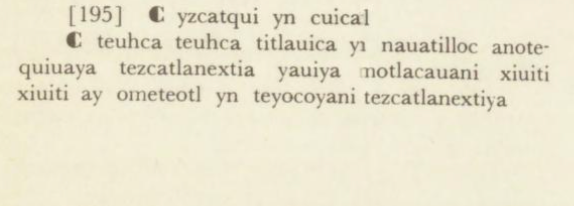
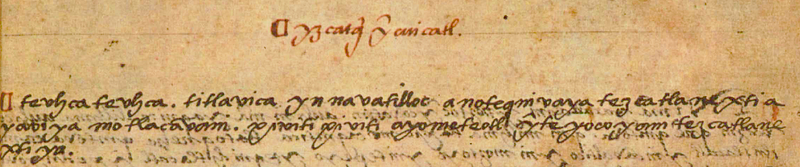
And in a hymn transcribed in the Historia Tolteca-Chichimeca, we get this double-standing god’s name. The sacred song contains the following line:
“Ōmeteōtl in tēyōcoyani”—Two-god, the people-creator.
That … seems pretty clear to me.
The second (and final) appearance of this name comes in the Codex Ríos: above an image of a god, a colonial hand has affixed the label “hometeule.” A close comparison shows that this icon of “Hometeule” is nearly identical to Tonacateuctli (as one would expect).
The “teule” part is immediately recognizable: it’s how the Spaniards heard and wrote down the Nahuatl word “teotl,” meaning divinity, deity, god. And, of course, the “h” is silent in Spanish. So “hometeule” seems to be a Spanish-speaker’s phonetic transcription of “Ometeotl.”
And that’s all we have, folks. Thin, I know. But seen within broad, pervasive pattern of duality, it’s credible that the dyad in Omeyocan, in addition to their individual identities as Omecihuatl and Ometeuctli, would be known as Ometeotl.
Before I wrap up, however, I should address an alternate theory first proposed by Richard Haly in 1992. Haly believes that in all the above mentioned cases, “ome” (two) is a misreading or scribal error for “omi” (bone), essentially looking to equate or associate an *Omiteotl or *Omiteuctli with Mictlanteuctli, who oversees the bones discarded by human beings in Mictlan, the Land of the Dead.
Aside from Occam’s Razor (this theory is not the simplest or most elegant of explanations and requires multiple identical scribal errors), Haly’s reading of ome as omi creates a major complication in that Omeyocan is described as being above us, in the folds of heaven (whereas Mictlan is viewed as an Underworld accessed in the north of our world). And re-tooling “Omeyocan” into *Omiyocan doesn’t quite work. I’m not sure what “omiyotl” would mean … boniness, I guess? Place of Boniness instead of Duality? Hrm. I just don’t find this line of speculation compelling.
None of the evidence is conclusive, however. And my argument isn’t meant to suggest that the Nahua peoples of the Triple Alliance worshipped Ometeotl as a sort of “true god” above other deities, like, I dunno, a dual prefiguration of the Christian Trinity. No, that sort of thing is complete colonial distortion, and anyone reading this article who is attempting to shoehorn Christianity into pre-Invasion Indigenous philosophy needs to stop that destructive shit immediately.
But, within the actual framework of Nahua sacred stories, it is feasible that Ometeotl was a label for this duality, the “Two God” in the “Place of Duality” within the nine folds of heaven.