
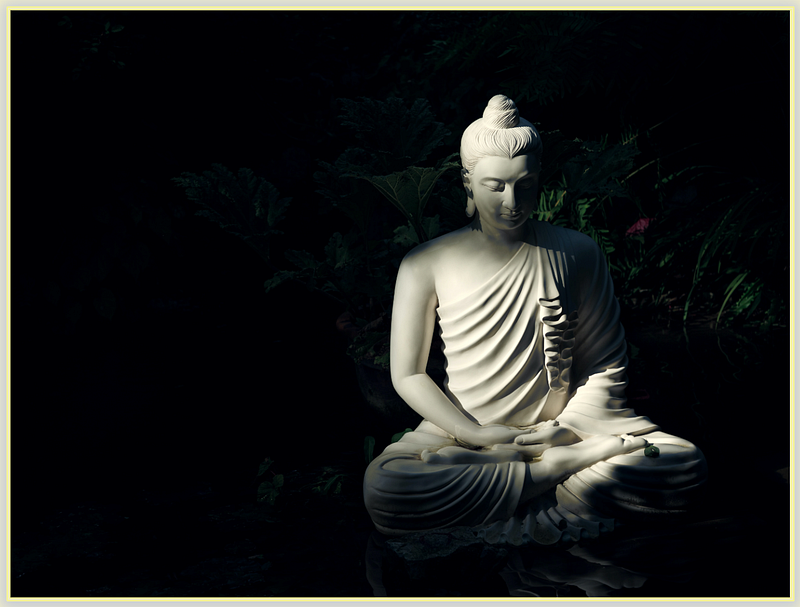
Tales of Nagarjuna
Come on a journey with me. Suspend your traditional notions of cause and effect. I will reveal the one cause of a billion negative effects. The idea is not my own. Its truth is not new. In fact, it is very old — to be found under stones left unturned, in quiet places, away from the hustle and bustle, in niches and nooks where truth can hide.
The Premise
Most of the suffering of mankind stems from the delusion that we are separate, independent beings, alienated from each other. Believing this is so makes us fearful, contentious animals, summons the worst of our base instincts, and imperils our species’ remarkable advancements over eons of evolution. We have made astounding technological achievements. But our internal wisdom has not advanced in proportion to counterbalance external technology.
“A human being is a part of the whole called by us universe, a part limited in time and space. He experiences himself, his thoughts and feeling as something separated from the rest, a kind of optical delusion of his consciousness.”
“If we examine the various ideologies that tend to divide humanity, such as racism, extreme nationalism, and the Marxist class struggle, one of the key factors of their origin is the tendency to perceive things as inherently divided and disconnected. From this misconception springs the belief that each of these divisions is essentially independent and self-existent.’’
A Look Back
Long ago, before Ptolemy, before Averroës, and Newton, there were people who sat around all day just thinking about things. Existential things. Cosmic things. Like, is what we see really what is, what are ethics, what is consciousness, is there any meaning to life?…
They could spend a lot of time just thinking because it was their job. The rulers of the day often thought it necessary to have a good philosopher by their side, whom they paid handsomely. One of these thinkers who pondered the great questions is the subject of this piece.
Nāgārjuna lived in India around the year 200. His ideas have resonated through the centuries. But you don’t have to be a Buddhist to appreciate their significance. As a metaphysical exercise, let’s see what he proposed, so long ago.
Along with the Buddha, who preceded him by five hundred years, Nāgārjuna argued that everything before us is an illusion. And that we are deluded by these illusions, the illusion of separateness being the most toxic. This was more than mere philosophical rhetoric to shock and amaze out on the speaking circuit.
1900 years later, quantum physicist Niels Bohr asserted, “Everything we call real is made of things that cannot be regarded as real.” — to which Einstein objected, “No reasonable definition of reality could be expected to permit quantum mechanics.” Since then, quantum mechanics has proven to be a very accurate and reliable theory, rendering Einstein’s definition of reality unreasonable.
Philosophers may be given to flights of fancy from time to time — conjuring up airy notions that have no relation to the real world, or the practical mechanics of things — but this is an unusual case when viewed in the light of recent developments in the world of physics.
And, like the great physicists, these ancient philosophers arrived at their conclusions only after years of careful and rigorous thought experiments.
If Nāgārjuna and the Buddha were right, everything we’ve been doing so carefully, all the planning and plotting to get ahead — is all for naught. An illusion of success. And an illusion of failure. Like a real-life Monopoly game. Only, the victors in real life get real money — which turns out to be an illusion.
This counterintuitive angle suggests that the game of Monopoly is an illusion within an illusion, that there are many layers of delusion. The best we can do is peel off some of the layers, one by one, like an onion to get to the truth. “To undo what hath been done.”
Jesus of Nazareth spoke of denying one’s self, along with the machinations of “selfhood”.
Even more astounding is the ancient assertion that you and I are not autonomous individuals and that we have no inherent existence — a theory supported by the latest findings in quantum physics. In fact, nothing has a claim to being independent or autonomous.
Buddhists have long held this to be true, along with the concept of dependent arising — the newest science seems to be catching up to the oldest truth.
“The general or universal definition of ‘dependent origination’ or ‘dependent arising’ is that everything arises in dependence upon multiple causes and conditions; nothing exists as a singular, independent entity.”
From The Universe In A Single Atom:
“One may ask, apart from misrepresenting reality, what is wrong with believing in the independent, intrinsic existence of things?
“Nāgārjuna:
“‘This belief [in the separateness of people and things] has serious negative consequences. It is the belief in intrinsic existence that sustains the basis for a self-perpetuating dysfunction in our engagement with the world and with our fellow sentient beings. By according intrinsic properties of attractiveness, we react to certain objects and events with deluded attachment, while toward others, to which we accord intrinsic properties of unattractiveness, we react with deluded aversion.’
“In other words, Nāgārjuna argues that grasping at the independent existence of things leads to affliction, which in turn gives rise to a chain of destructive actions, reactions, and suffering. In the final analysis, the theory of emptiness is not a question of the mere conceptual understanding of reality. It has profound psychological and ethical implications.”
A Look Forward
Is the human race suffering under some kind of “affliction”? Do we not know who we are? — A radical notion.
We keep repeating the same things, century after century, the only difference being our technological capacity to engage fear, hate, greed, war …. are our political efforts merely deluded attempts to maintain a delusion — contentious desires beneath a thin veneer of civilization?
This delusion [of separateness] is a kind of prison for us, restricting us to our personal desires and to affection for a few persons nearest to us. Our task must be to free ourselves from this prison by widening our circle of compassion to embrace all living creatures and the whole of nature in its beauty.
— Albert Einstein
