
Spiritual Quest
Myths about Spirituality
Shrimad Bhagavad Geeta Chapter 3
“When one can achieve an elevated state of being through spirituality, why should one perform any (other) Karma? And drawing a parallel, why should I indulge in the cruelty of war, for even winning this war won’t fulfil my purpose of attaining the universal consciousness.” Bewildered with these thoughts, Arjun plead for a definite direction.
In response, Shri Krishna talks about the following to further declutter Arjun’s judgement.
- Ways to perform Karma
- Karma for material success
- Conduct of an accomplished seeker
- The bonded state of soul
Ways to perform Karma
Verse 3.3 to 3.8
There are two ways to perform Karma, one leads to sufferings and the other leads to bliss.
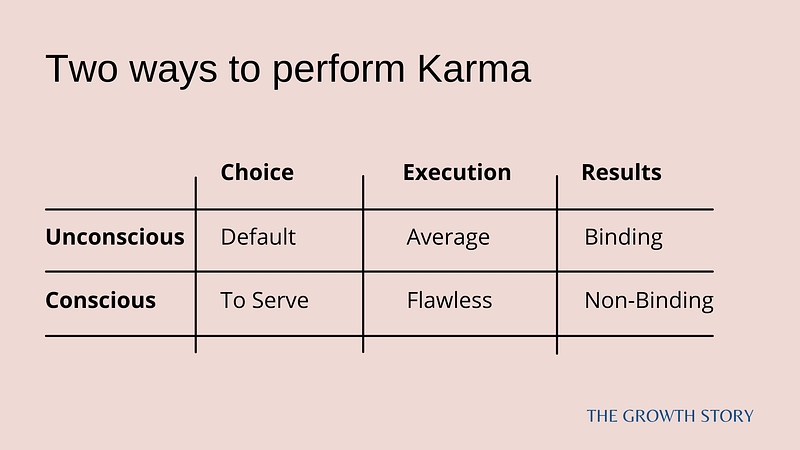
We live unconsciously under the dominance of our mind. The wavering mind aspires for myriads of worldly experiences. Should we run behind our every desire? Certainly not, unless we want chaos in our lives.
Then, how do we pick on our desires and decide what to do and what not?
There is another feeble element, the intellect, which acts a gate keeper and restricts the ill-fated desires. However, it wields limited influence over mind. It just warns us against the fancies of our mind.
Unfortunately, in our default (unconscious) state, mind over-rules our intellect and picks on any Karma. Often we doubt if our efforts would bear the desired fruits, for we have limited abilities to execute (bring desires to fruition). We wield no control over how and when these results would manifest to us. Sometimes the results manifest to us immediately or with slight delay, but some Karma may not manifest results at all in our present lifetime. And we (the soul) remain bounded into an infinite loop of birth and death, waiting for these results to manifest.
Shri Krishna introduces a conscious way to perform Karma, in which the doer has total control over the choice (or purpose), execution and the results of his actions. An accomplished seeker wields the powers to perform Karma in this way. Such a state of consciousness is Sahaj Samadhi. In this state, the elevated soul can perform any Karma (to attain a righteous purpose) without getting bound to bear its fruits.
Such a person lives a normal life but has command over the elements of nature. In such a state, she performs only the essential Karma and lives a purposeful life. Her lifestyle is indistinguishable from those of an average person.
Myth#1 Spirituality is for the seers who live a secluded life.
Myth Buster#1 Spirituality is for those who want to live a purposeful life.
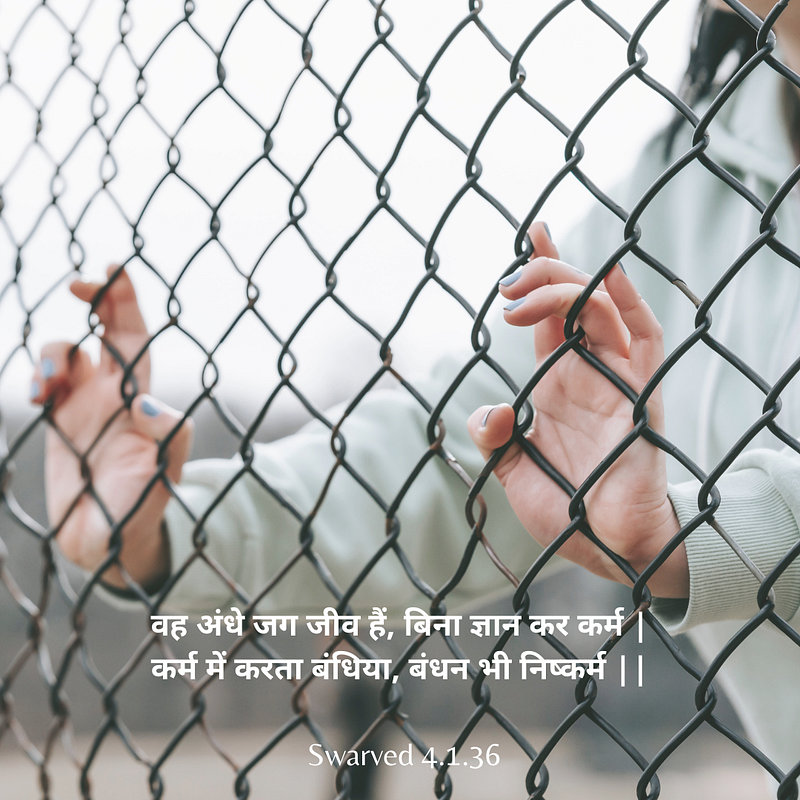
In the next chapter, Shri Krishna digs deeper and talks about default Karma (good and bad), vi~Karma (the special actions, those which lead to spiritual ascend), and a~Karma (those that are not binding) to provide instructional guidance to the seekers. I will talk about these in coming essays.
कर्म अकर्म विकर्म है, तीन भेद हैं कर्म |
फिर सकाम निष्काम हैं, कठिन ज्ञान सत कर्म ||
Swarved 5.2.56
Karma for material success
Verse 3.9 to 3.17
Live a symbiotic life to attain material success.
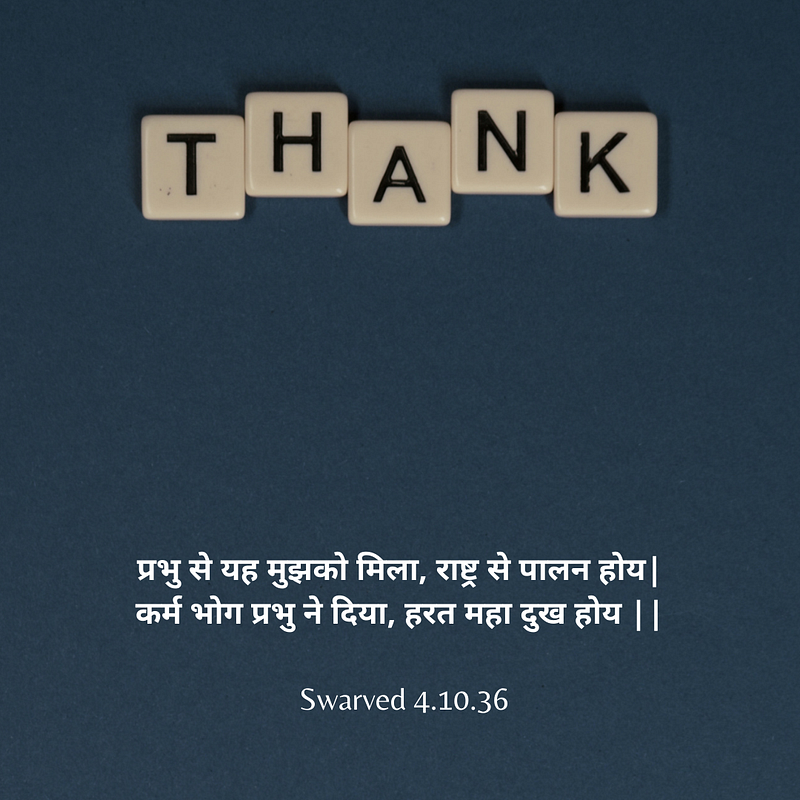
While there is a higher purpose of life, we live in a materialistic world which serves as a platform for all our spiritual explorations. Shri Krishna exemplifies the symbiotic relationship between the human being (the seeker) and the universe.
There is a give and take relationship between us and the universe. Our interactions are symbiotic. When we serve the universe, we get back the materialistic possessions (health, wealth and happiness). When we are grateful and obliged to our ecosystem, we get back ample life energies.
Yagna is one way to serve the universe. It’s a Vedic ritual through which we offer gracious objects (herbs, cereals, fruits, milk, yogurt etc.) to the holy fire while reciting the Vedic hymns. The fire (of Yagna) transforms these objects into micro-elements which disperse into the biosphere to benefit all. Shri Krishna prescribes Yagna as a medium to seek material possessions. Yagna serves as a bridge between us and the gods (powers of the universe).
We also serve through our actions. When we offer our time and energies to serve the nature and propel its cause, we get back the desired reward. This is a lesson on sustainable living and care for all — biotic and abiotic.
Notably, this care begins at our home. When we own our part of the responsibility in the family, we care for our family members. As our consciousness grows, we expand scope of our care; we empathize with fellow human being. What drives such an inner perception? What makes us proud of weighing our responsibilities over our rights? It is the spiritual realizations, an appreciation of the higher purpose in life.
When we create something, we owe a part of it to the powers that sustain the ecosystem in which we thrive. We ought to be grateful and obliged to the nature and its components — both living and nonliving, both plants and animals and to our fellow humanity.
Conduct of an accomplished seeker
Verse 3.18 to 3.35
Accomplished seekers lead by example.
Shri Krishna gave two examples to put across his idea of an accomplished seeker. First, he took the example of King Janaka — who fought several wars and ruled his kingdom for many years and yet; he attained the universal consciousness.
Second, he exemplifies himself and said, “I do not need to perform any Karma, yet I live a life of a normal person, for I am the torchbearer of spirituality”.
Accomplished seekers have a profound responsibility to lead others by example. They are the torchbearer of spirituality, living legends for others to follow. If they refrain from routine Karma, others would copy their act in ignorance. Such mindless following would lead to widespread confusion and inactivity, which would threaten the progress of the humanity.
Shrimad Bhagavad Geeta stresses on importance of leading by example. In politics, we regard hands-on leaders such as Mahatma Gandhi. Most successful business leaders don’t rely on their positional powers to achieve long-term vision of their firm. Similarly, parents don’t preach civilization to a child, rather, they show superior conduct and let their child observe and learn. For ongoing sustainable development, it is essential for the leaders to lead by doing.
Spirituality teaches us to consider our life as a service to humanity. At lower levels of consciousness, we toil to raise our abilities and awareness of the world. At a higher level, we ought to do the same to lead others from darkness to light.
So, even when Arjun attains the universal consciousness, the right thing is to take part in war in his full might.
Myth#2 When one attains the universal consciousness, one denounces one’s worldly duties.
Myth Buster#2 With great powers comes great responsibilities. Such accomplished seekers become the torchbearer for others. They perform all the routine activities (like a normal person) and live a life of purpose. Their purpose is to serve the humanity. Last thing they do is to take recluse.
Bonded state of Soul
Verse 3.36 to 3.42
Under the influence of nature, the soul remains bonded.
Arjun further enquires about the Soul. He asks, “When the Soul is so powerful, why does it succumb to perform the evil?”
The soul is like a pristine mirror. It takes light (energy) from the universal consciousness and reflects it upon the elements of nature to execute the life functions and desires.
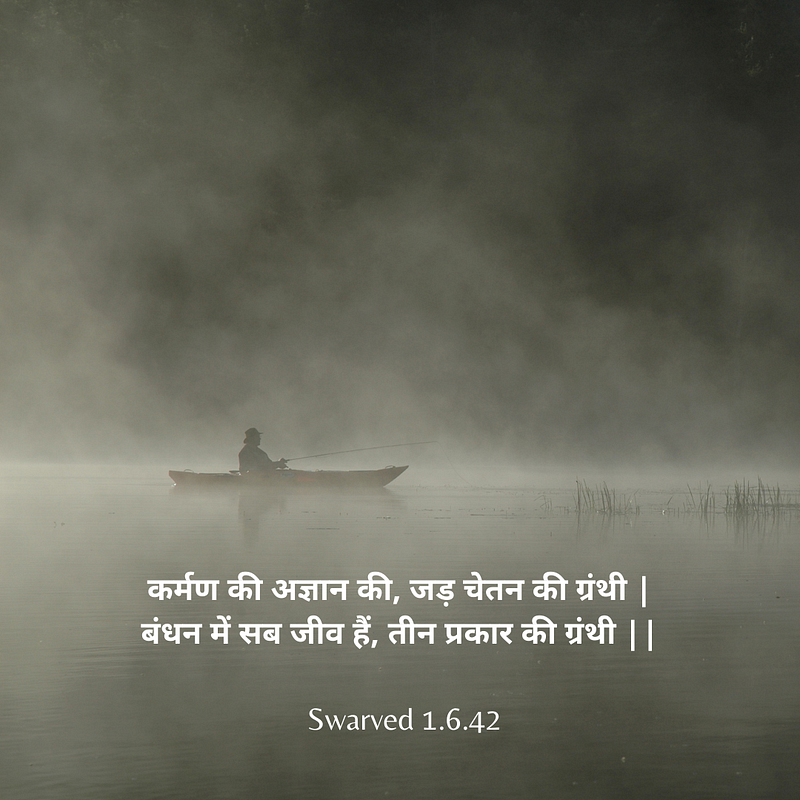
When the soul amalgamates with the nature, it loses its vitality. Nature is akin to dust in the mirror. It affects the mirror in two ways. First, a dusty mirror cannot receive sufficient light (energy) and second, it cannot properly reflect what it receives.
As the dust thickens in the mirror, the soul falls into a state where it sheepishly accepts the dominance of nature. It lacks sufficient conscious energy, resulting in poor selection and execution of our actions. Ultimately, we succumb to many Karma that we would refrain from in our conscious state.
When we practice spirituality, we gradually wipe out these layers of dust from our soul. There are three layers that need to be cleared:
a. Layer of Karma: Our actions results in good or bad experiences for us. Either way, we constantly build up this layer of dust onto our soul.
b. Layer of darkness: Our ignorance of the wider schema of creation builds up another layer of dust. Not knowing the elements of this creation and their impact on us keeps us rooted in our sufferings.
c. Layer of a mixed state of soul: Our current state itself causes our sufferings. In our body form, we (soul) are under the influence of nature, which adds another layer of dust to our soul and keeps it bonded.
Spirituality serves as an instrument to clear these layers of dust. In coming chapters, Shri Krishna talks about the ways to empower ourselves (soul) and ascend into a higher level of consciousness.
Related Post: My realization on other chapters of Shrimad Bhagavad Geeta: Chapter-1; Chapter 2a; Chapter 2b
Where can I get the access to the original text?
Beginners may find this useful.
For deeper insights, get a copy of the book from Vihangam Yoga. If you are in the US, contact North America Institute of Vihangam Yoga.
These revelations are based on my over twenty years of immersion in Swarved, The Encyclopedia of Spirituality. Swarved is available on Amazon and on Google Play store in multiple languages.