
MYSTERIOUS PHYSICS
Mysterious Flash In The Sky: The Tunguska Event
How mysterious events have led to astonishing developments in modern physics.
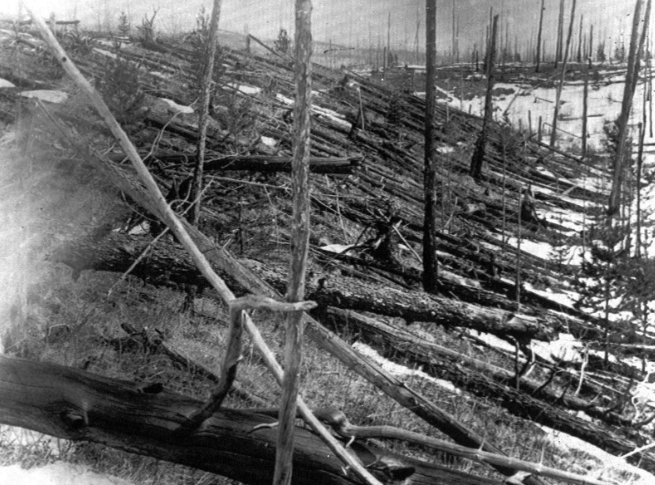
A mysterious flash over Kyiv has recently been reported and people are wild with anticipation over the explanation. NASA has confirmed it was not one of their satellites and people speculate a meteor re-entering the atmosphere. Of course, this is a war zone so there will be speculation the flash could be related to those operations. Reports of potential Russian “super weapons” (no matter how hard to believe) being in development don’t help with speculations. But one good thing that comes of mysterious events like this is that the speculation eventually can give rise to good science and it can even lead to pushing science forward as we attempt to explain the event. Case in point is the Tunguska event.
Tunguska Event
Tunguska was a remote area located within what is modern day Russia and on June 30th, 1908 a 12 megaton explosion occurred that flattened 80 million trees over 830 square miles. An estimated 1,000 scholarly papers have been published about the event. The first scientific expedition didn’t take place until 1927 because of the remoteness of the area and political upheaval within Russia. There is an entire wikipedia entry devoted to this event, but it’s very limited in doing it justice. The explosion was a mystery for a long time and the explanation is still not entirely in consensus. The leading explanation has and still is a meteor however, there are many details about the event that are hard to explain and the first expeditions did not turn up the expected evidence of a meteor impact. In fact, there have been reported numerous isotopic anomalies at the site. This is only partially covered in the wiki entry. NASA investigated this at least as far back as 1988. In that paper they compare the event to a thermonuclear explosion. Of course, this is odd considering it happened in 1908.
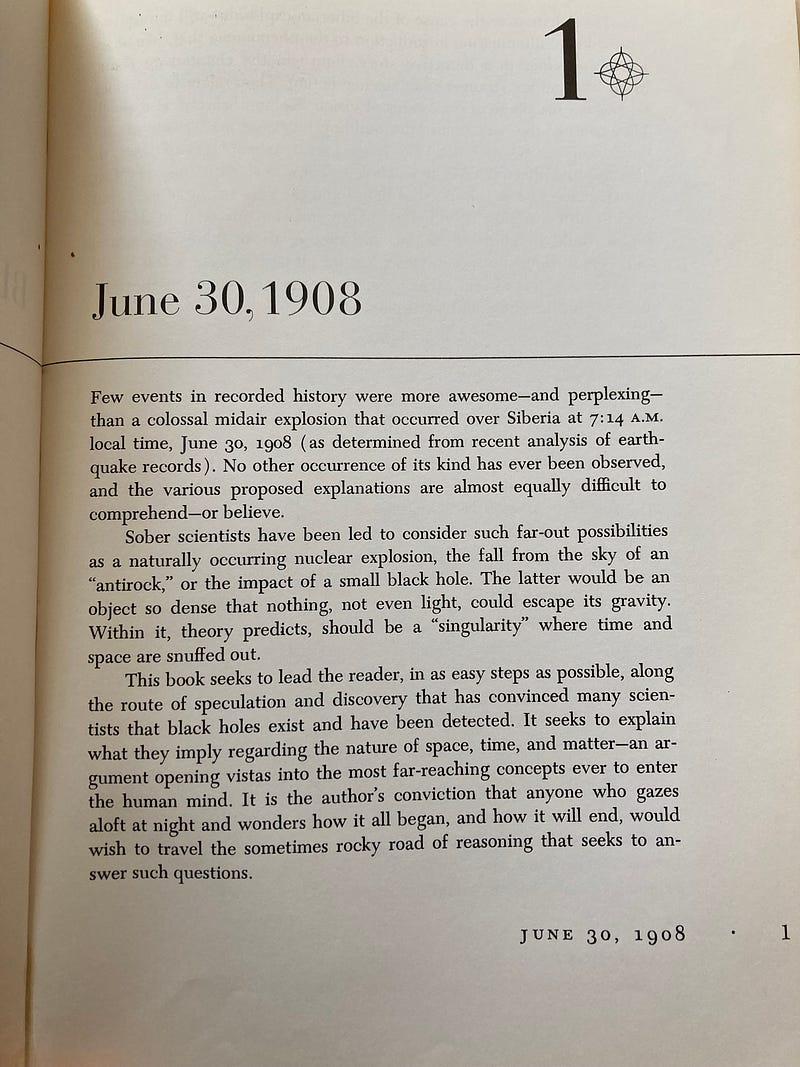
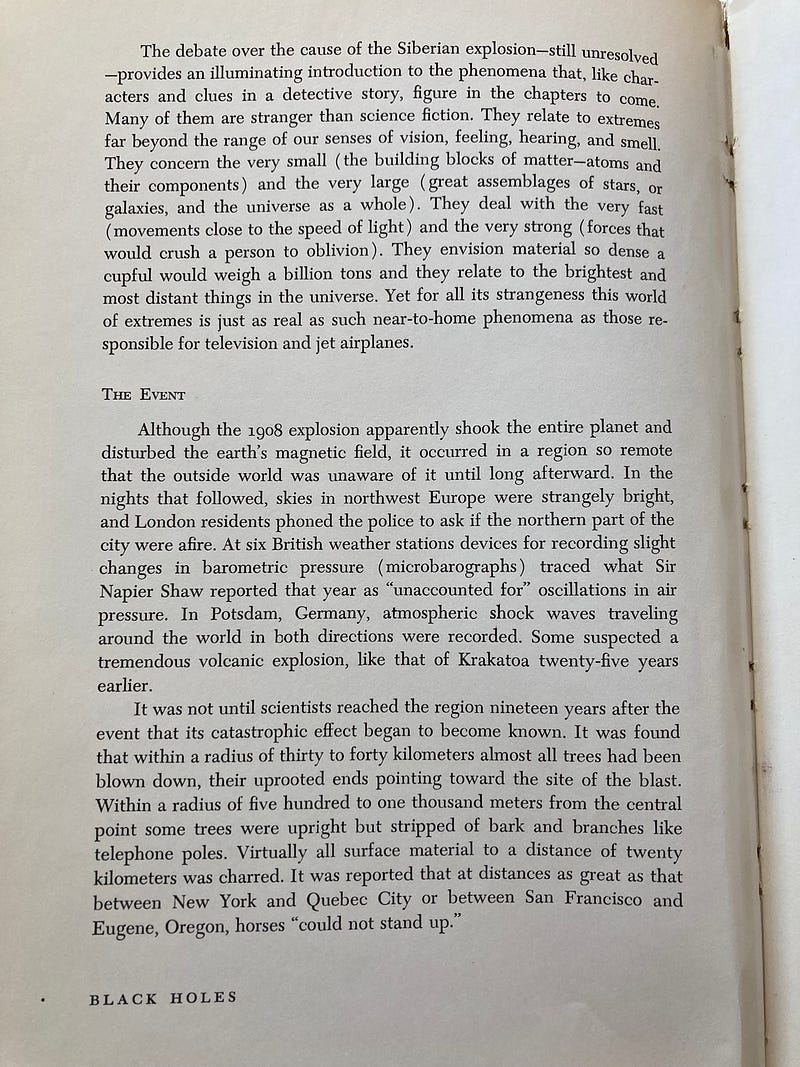
However, that isn’t the strangest hypothesis that has been put forward over the 100 year investigation. Walter Sullivan, a journalist of numerous awards and science editor of the New York Times, was a very popular writer in his era with many books published. Sullivan, opens up his 1979 book Black Holes: The Edge of Space The End of Time with a fascinating dive into the Tunguska incident. He uses it as an anecdote to how science not only still has mysteries it can’t fully explain (proving we have more to learn) but that it according to him played a part in the formation and popularization of theories on black holes! He jumps into the many different explanations put forward over the years and the scientific communities search to solve the puzzle. And yes, some scientists proposed miniature black holes as an explanation. It’s likely not what happened and isn’t at all a popular explanation for the event, however, it helped prompt some of the first serious explorations of the advanced physics behind black holes according to the esteemed science journalist.
Mysterious Events
Diana Pasulka in her book American Cosmic details how the monolith symbolism in Arthur C. Clarke’s 2001: A Space Oddity represents something deeper about humans relationship with technology where it becomes almost religious. Stanley Kubrick explains his vision of it for the film adaptation as representing imagination including that which is still unimaginable.
Pasulka of course dives into the topic of UAP’s or UFO’s and how it represents the same thing. She came into the topic by studying old church reports of spiritual experiences involving floating orbs only to realize they seemed to resemble modern day ufo reports. Now seems to be the time to be looking at such a subject considering the recent legislation and congressional hearings on UAP that have taken place. Mysterious lights in the sky appear to not only be going mainstream, but are getting serious scientific attention.
We Are Not Alone
Where does the popular phrase, “We are not alone” come from? The answer is a very interesting dive into the history of science and public perception.
In 1964 Walter Sullivan, science editor of The New York Times, published a book titled “We Are Not Alone: Is there life on other planets?” in which he very thoroughly dives into the apparently recent shifted perception within a small group of the scientific community at that time on the subject of life on other planets.
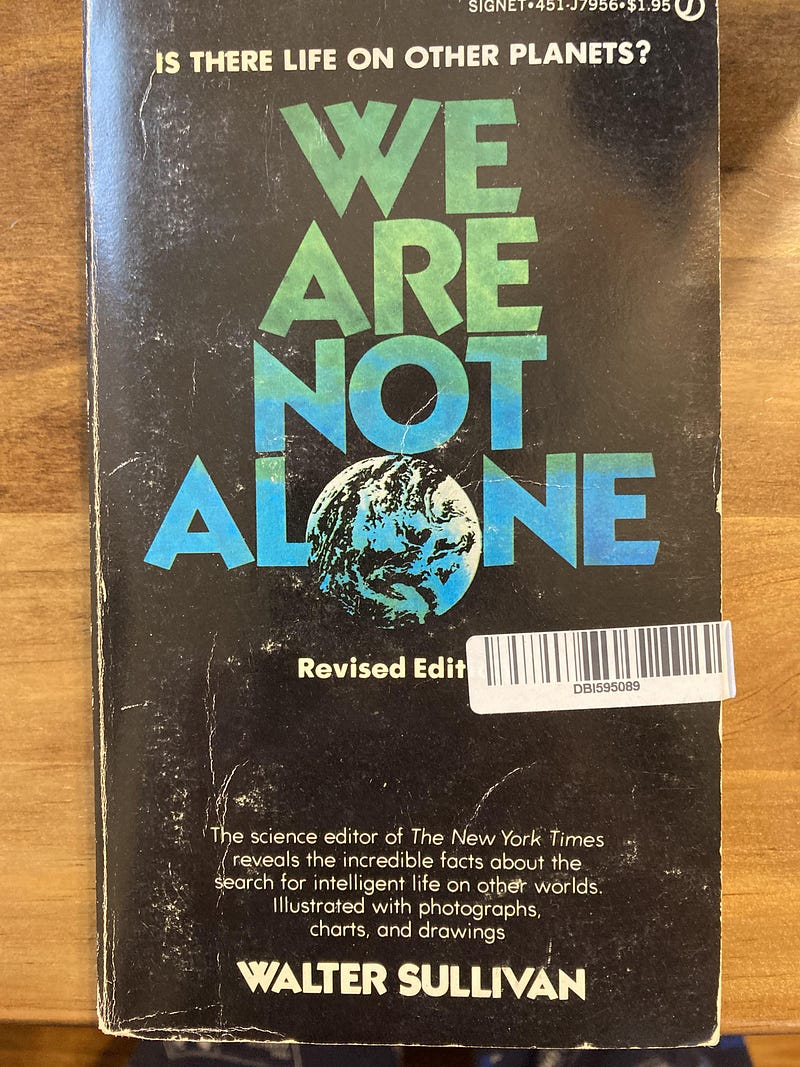
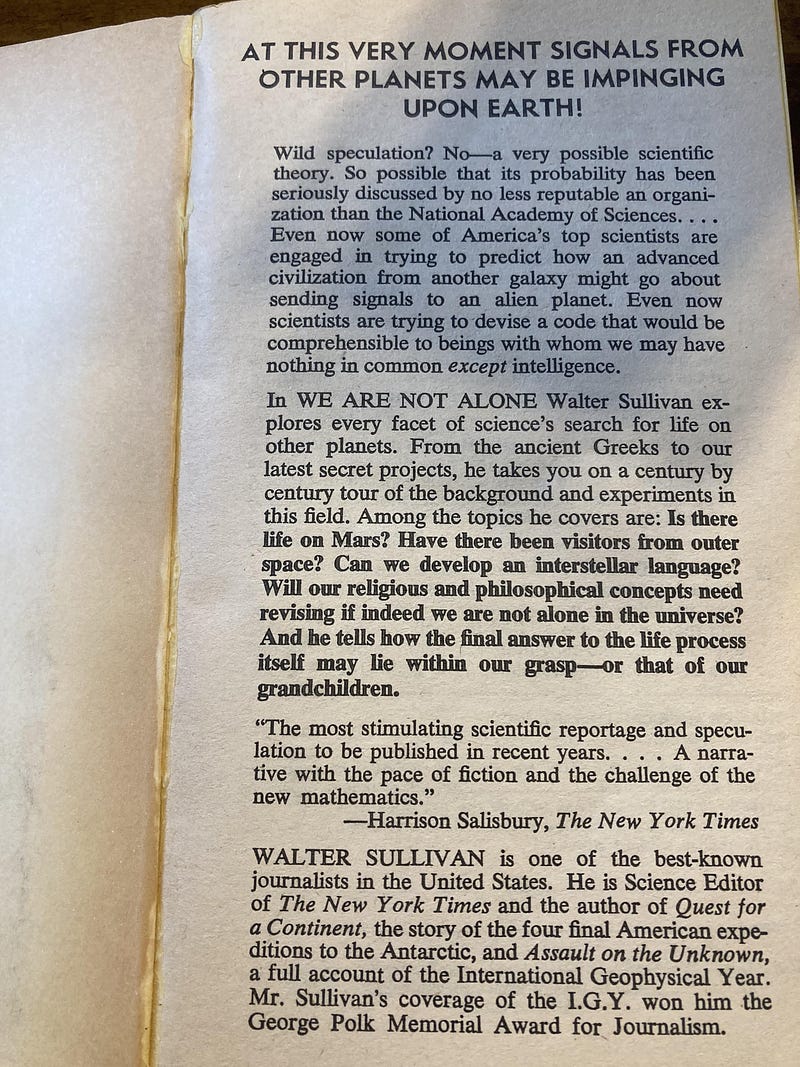
The first page is transcribed below with bolding added by me for emphasis:
AT THIS VERY MOMENT SIGNALS FROM OTHER PLANETS MAY BE IMPINGING UPON EARTH!
Wild speculation? No — a very possible scientific theory. So possible that it’s probability has been seriously discussed by no less reputable an organization as the National Academy of Sciences…Even now some of America’s top scientists are engaged in trying to predict how an advanced civilization from another galaxy might go about sending signals to an alien planet. Even now scientists are trying to devise a code that would be comprehensible to beings with whom we may have nothing in common except intelligence.
In WE ARE NOT ALONE Walter Sullivan explores every facet of science’s search for life on other planets. From the ancient Greeks to our latest secret projects, he takes you on a century by century tour of the background ad experiments in this field. Among the topics he covers are: Is there life on Mars? Have there been visitors from outer space? Can we develop an interstellar language? Will our religious and philosophical concepts need revising if indeed we are not alone in the universe? And he tells how the final answer to the life process itself may lie within our grasp — -or that of our grandchildren.
“The most stimulating scientific reportage and speculation to be published in recent years…A narrative with the pace of fiction and the challenge of the new mathematics.” — -Harrison Salisbury, The New York Times
WALTER SULLIVAN is one of the best known journalists in the United States. He is Science Editor of The New York Times and the author of Quest for a Continent, the story of the four final American expeditions to the Antarctic, and Assault on the Unknown, a full account of the International Geophysical Year. Mr. Sullivan’s coverage of the I.G.Y. won him the George Polk Memorial Award for Journalism.
A few things stand out to me. One is the attitude that speculation is acceptable in scientific reporting. The author is one of the best known journalist in the US at the time. I find the fact that he is an editor at The New York Times very interesting. I also find it interesting that he authored two books on Antarctica. In fact, he was one of the only journalists to actually go to Antarctica during Admiral Byrd’s Operation High Jump! Very interesting…
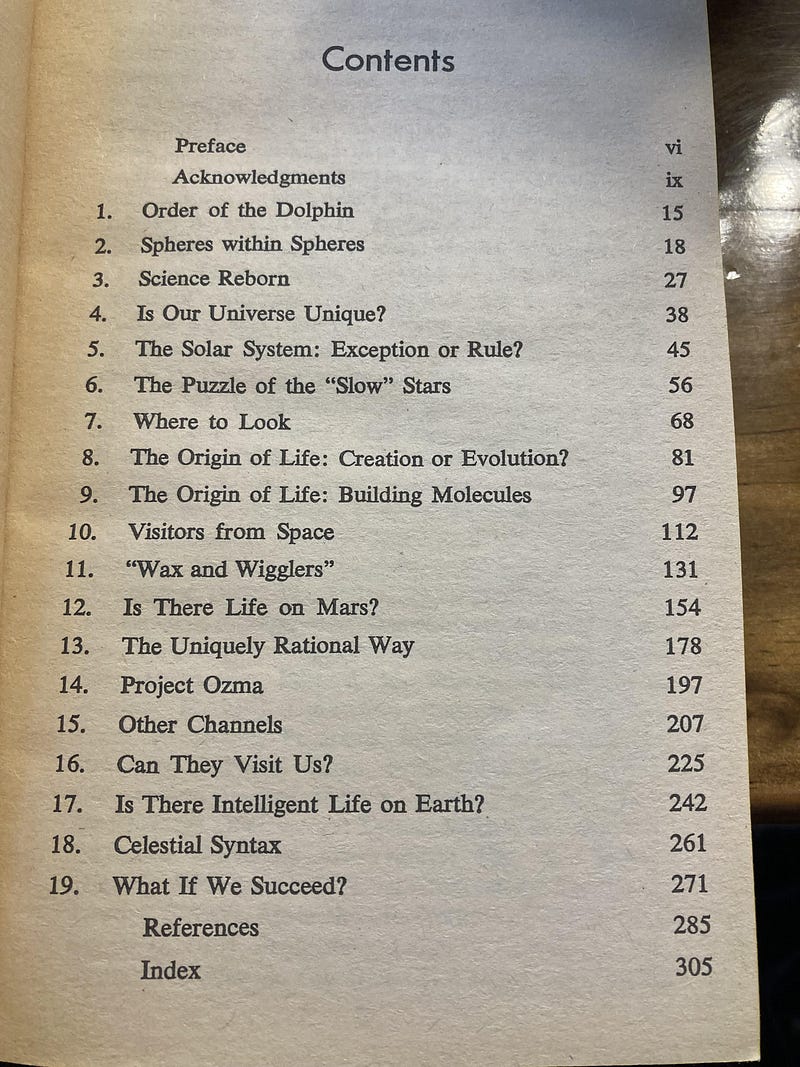
Below is a link to the entire book in electronic format for free. https://archive.org/stream/in.ernet.dli.2015.133944/2015.133944.We-Are-Not-Alone_djvu.txt
So why is this relevant? Well many people in “ufology” are surely familiar with some of the theories involving Antarctica and of course the most popular hypothesis for ufo’s is in fact the ET hypothesis. So, it is a bit interesting that the most popular science journalist of his time and New York Times editor published books on both subjects. Perhaps this very clear node in the network of memes is relevant to where some of the mythology within ufology has come from. Followers of Sullivan’s work (of which he had many) would’ve been fascinated by both subjects.
I haven’t had a chance to dig into this book yet, but I do find it interesting that it states “And he tells how the final answer to the life process itself may lie within our grasp — -or that of our grandchildren.” It’s been 60 years since the book was written so it would be interesting to dissect that statement.
Back to mysterious lights in the sky
Mystery lights, explosions, and isotopic ratios are the kind of thing that get me excited in the morning. That’s why I conducted and published my primary research into experimental physicist Ken Shoulders’ work which has bizarre connections to ufo’s via direct involvement of Hal Puthoff and claims of isotopic wizardry.
The Tunguska event is also mentioned in Oke Shannon’s notes from the Advanced Theoretical Physics group. That is a whole other rabbit hole if you have the time that leads to extra dimensional physics as well as more claims of isotopic wizardry.
Then you have the relatively recent announcement that the Department of Energy (DOE) is funding “cold fusion” research. Yes, that’s real.
Then of course we have the Allen Dulles rabbit hole.
IF YOU ENJOY MY WORK PLEASE FOLLOW ME ON MEDIUM
You don’t have to join Medium to read my work, but if you do use the link below.