
Mysteries of Magenta
A colour twittle explained
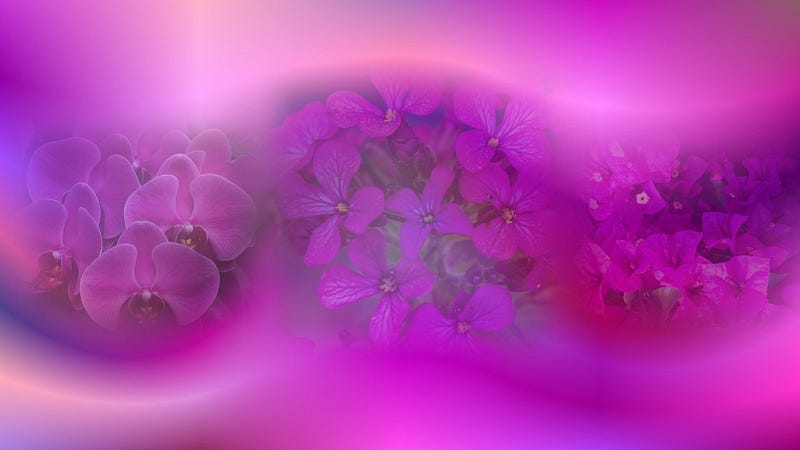
The mysteries of magenta an aberration of the human mind red and violet spectral ends embrace universal love of mankind
© Carolyn Hastings 2021
I love colours. My favourite is blue but that doesn’t mean I don’t like other colours. I do. I love them all. It’s just that I love blue the most.
So why didn’t I write a twittle about blue? That’s because I’ve already written one!
Kisses of Blue
A forget-me-not twittle — as in, please don’t forget #twittle
carolynhaasp.medium.com
Sure, I could’ve written another one — and I probably will one day — but I wanted to write a twittle about magenta. To my knowledge, we don’t have a magenta twittle — now we do!
I discovered the mysteries of magenta when I was researching a poem I wrote earlier in the year, The Colour of Eudaimonia.
The line I wrote for magenta went like this -
Magenta convergent opposites triumphant cerebral epiphany a symphony of universal love CH 2021
I went on to explain that magenta is the only colour that doesn’t have a wavelength.
It’s literally an aberration of the mind whereby the brain overrides the colour spectrum so that the average of long wavelength red and short wavelength violet is perceived as magenta and not green. The brain, in effect, recasts the light spectrum as a wheel bringing together the violet and red spectral ends to complete the loop. Is it any wonder that magenta should symbolise universal love? CH 2021
✥ Magenta ✥ Universal love ✥ Harmony and balance ✥ Transformation ✥ and everything else you’d expect when polar opposites blend together in happy co-existence. 😊
Except magenta doesn’t exist. Not in the real world anyway.
So, where does that leave universal love? 💞
In the same place as magenta? An aberration of the mind? A perception of something we can never have? 😯 Oh, dear. Sorry if that thought bursts your feel-good, love bubble. 😬
Since magenta isn’t a pigment that can be extracted from anything in the natural world, the dye that produces the magenta colour is a man-made synthetic. And an important one at that. It’s the ‘M’ in the CMYK colour model (cyan-magenta-yellow-black) that is used in printing presses and computer printers.
If you’re looking for the scientific theory behind magenta, Amelia Settembre has written a fascinating article on the subject -
Thank you to Lee Ameka and for tagging me into her Red Bulb — Red-ok-write-about-any-colour prompt. 🙏
Thank you also to William J Spirdione for tagging me into the prompt via his twittle of green —
How could I refuse a twittle opportunity?!
As Lee explains, a twittle is ‘exactly one hundred (alphabetical) characters in a four-line micro poem.’
I’ve been choofing the twittle train around Medium since October last year. We now have quite a collection of happy twittlers on board but there’s always room for more. Join us. 😄 🚂
Extra thanks to Lee for welcoming me into her wonderful publication, Self-Crafted, and to all of you for reading. 🙏 💕
Image credits
Background image — Image by David Zydd from Pixabay Flower images (left to right) — - Image by Anne & Saturnino Miranda from Pixabay - Image by Martin Hetto from Pixabay - Image by mhoward9 from Pixabay